Over the past year, real-world asset tokenization has moved from proof-of-concept to broader institutional adoption, and the role of on-chain financial infrastructure continues to draw attention. In a recent discussion, Liam Caruana, Head of RWA at Chainlink Labs, shared specific views on the definition of asset tokenization, its current state, institutional demand, and how infrastructure can support future growth.
Tokenization: Digitalization Makes Financial Markets More Efficient
Liam defines tokenization as 'digitalization.' Its essence is to make financial markets better, improve the infrastructure on which capital markets operate, and bring efficiency, liquidity, and utility. Tokenization is a broad term that means putting assets on the blockchain, including securities, commodities, and various financial assets. This definition emphasizes not the technology itself, but the upgrade of the existing financial system.
Past 12 Months: Accelerating Adoption and Tokenized Equities Driving Retail Participation
The past 12 months have seen dramatic changes, and the industry is now in a very favorable position. Adoption has increased significantly, not only in terms of financial infrastructure and the entities putting real assets on-chain, but also in terms of technological maturity and user adoption. Tokenized equities have become an important force driving retail investor adoption, and the industry as a whole is growing rapidly.
Infrastructure Layer: The Critical Link Connecting All Participants
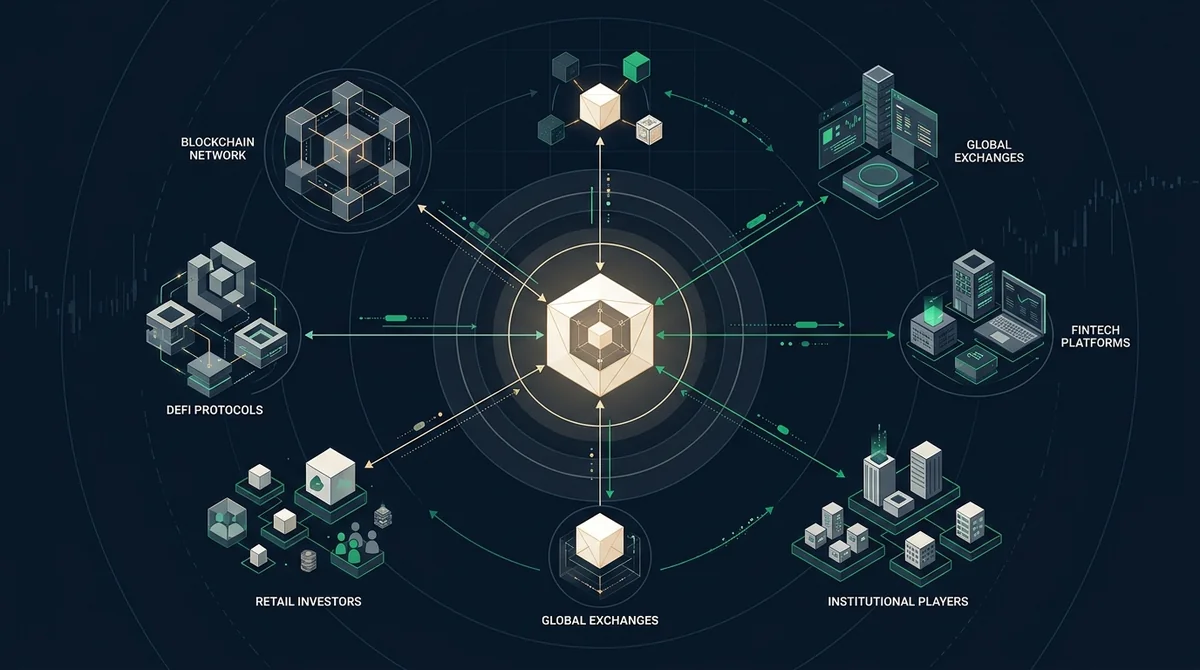
In the current ecosystem, participants include blockchains, DeFi protocols, exchanges, fintechs, distribution channels, retail investors, and institutions. Infrastructure providers are playing a critical layer connecting all participants, and they are deeply involved at the blockchain layer, the DeFi protocol layer, and the asset issuer layer. Taking tokenized equities as an example, Chainlink is collaborating with Coinbase, Robinhood, Ondo, Xstock, and others, playing a role in liquidity, distribution, and efficiency. This connecting-layer role enables different participants to work together rather than forming isolated silos.
Institutional Conversations: From 'Not Knowing What to Do' to 'How to Successfully Implement'
Compared with previous years, the conversation between traditional institutions and infrastructure providers has clearly shifted. A few years ago, asset managers, banks, hedge funds, and other institutions may not have been sure how to participate in RWA, but now they know what to do and how to do it, and they proactively seek ways to implement successfully. Infrastructure providers engage from several different angles: first, as technology providers, they provide the critical infrastructure institutions need, including data sources, cross-chain interoperability standards (CCIP), and orchestration capabilities for more complex use cases, such as orchestration of complex transactions like corporate real estate; second, as ecosystem partners, institutions understand that every layer of the value chain is related to infrastructure technology, so they work together to think about how to use these technologies to make digital asset projects successful.
Successes and Challenges: Some Institutions Have Made Progress
Not all institutions have succeeded. Some have achieved results, but there is still room for improvement. For asset managers, effective distribution remains difficult, while leaner or more crypto-native teams tend to achieve results more easily. Overall, however, the industry has made great progress. Simple and complex use cases are currently roughly split in half, but once banks and large asset managers go on-chain, the scale they bring will be far larger than the current market. Working with fintechs and new brokerages is generally easier than working with banks, but both types of institutions are essential for liquidity and real adoption. Complex use cases require more time because they must consider regulation, infrastructure requirements, and risk appetite; when these scenarios go on-chain, the scale of success will be on a completely different level.
From Technology Demonstrations to Business Cases
Currently, the biggest bottleneck many teams face is not the technology itself. The technology already exists and has been proven; almost all large asset managers have already launched at least one product or are about to. Banks are progressing more slowly, but they also know that technology is not the bottleneck. Institutions come with questions, and the solution focus is on efficiency—how to build a business case internally and convince internal teams and leadership that blockchain technology can reduce costs, improve distribution, or increase revenue. The industry has shifted from purely innovation-showcasing conversations to real business conversations, meaning P&L-level conversations focused on how to generate revenue and how to derive value from projects. This is a positive signal.
Future Scale: Preparing for a $100 Trillion Market
Over the next 6 to 12 months, scale growth will be relatively slow, but it may be faster than expected. If stablecoins are included, the current figure is about $300 million (possibly more or less), while the capital market size is $100 trillion, indicating an enormous addressable market. Eventually, blockchain will become the backend infrastructure for finance, and all assets will be on-chain. In this process, multiple blockchains will emerge, including private chains, public chains, new public chains, and even new languages. The goal is not to rebuild silos, but to create a global liquidity layer, which requires capabilities such as bridging, robust data, compliance, and privacy. These are the areas that current infrastructure participants are helping financial institutions build, and they will continue to improve based on institutional feedback.
Who Hasn't Actively Entered Yet? The Pace of Hedge Funds and Banks
The type of institution that is currently less proactive in reaching out is hedge funds. The most active are asset managers; a large number of asset managers are proactively asking about tokenized deposits, stablecoins, and vaults. Fintechs and new brokerages are another area well worth watching, as these companies have already built a large base of investor trust. Existing crypto exchanges such as Robinhood, Coinbase, and Kraken are fully entering RWA, and large exchanges have clearly recognized that RWA is the next step. Banks need more time to adapt to the technology. Hedge funds participate less because the quality and scale of on-chain assets are still improving. Currently, the on-chain asset scale is in the hundreds of billions of dollars, and it cannot yet compete with traditional finance on every front—whether execution, liquidity, or infrastructure. To enter traditional finance liquidity, one needs to reach parity on every level and gradually provide better solutions.
Current Industry Responsibility: Preparing for 100x Growth
The current on-chain scale is about $300 billion—still small compared with the total capital market, but considerable in absolute terms. The industry's task now is to ensure that infrastructure can support $100 trillion in assets moving on-chain, rather than remaining at the tens or hundreds of billions of dollars level. This requires answering whether liquidity is sufficient, whether compliance tools are complete, and whether banks' risk departments can be shown that relevant operations meet their risk requirements. These are the directions that should receive focused investment now.
Most Notable Directions: Stablecoins, Vaults, and Fintech Distribution
Stablecoins are already a highly compelling use case, bringing liquidity and demand to RWA. Growth in on-chain liquidity naturally expands the market's demand for yield. Vaults will bring new distribution channels. Fintechs and new brokerages may be the next step for short-term RWA adoption. Platforms like Robinhood have a retail user base in the tens of millions, potentially even double that, and bringing these users on-chain essentially provides a funnel and entry point for the entire market. End users do not need to know the underlying infrastructure; they care about better products, higher yields, fund security, and how to invest. These new brokerages are effectively using blockchain as backend technology. Previously, the industry did not do well enough in attracting entirely new users; the UI/UX and terminology were too complex. For example, the industry likes to use three-letter acronyms like RWA, while fintechs do a better job of simplifying the user experience.
Why Technology Dominated the Narrative for So Long
In the early days, the industry had to focus on technology because if capital markets were moved on-chain, the system must not crash. This is also why infrastructure providers like Chainlink are widely relied upon—their systems are resilient, with a 7-year operating history, handling trillions of dollars in transactions and securing tens of billions of dollars in TVL. But after focusing on technology to a certain stage, distribution must also be considered. To bring more issuers on-chain, it is necessary to clarify the value they can obtain: whether it is new distribution channels, higher yields, or more secure infrastructure.
Distribution Advantages of On-Chain Finance
The main advantages of on-chain finance over traditional finance include: 24/7 infrastructure, complete elimination of intermediaries, and execution of complex transactions via smart contracts. The ultimate goal is to improve efficiency and reduce costs, thereby building better products that benefit end users.
Pace in Different Markets: Korea and Asia
Different markets have differences. Korea is a special market; regulatory progress is slower but very positive. Large companies are building and waiting for the right time to expand fully. Some large companies are receiving help with infrastructure, including asset tokenization, stablecoins, and infrastructure orchestration, and results may be seen in the coming years.
Tokenized Equities: Potential and Paths
Tokenized equities are a key focus area right now. There was previously an announcement between ICE and OKX, and this year we have also seen partnerships between Nasdaq and Kraken, and between the London Stock Exchange and Kraken. This is a very interesting area. The US market has found some product-market fit, and next it is worth watching whether more non-US markets (such as Asian markets or other markets) can be brought on-chain to meet the needs of investors who currently cannot access these assets. The attention on tokenized equities is justified, and the potential is enormous—this is one of the largest asset classes globally, and the current on-chain scale is only a few billion dollars, compared with a global market size of about $150 trillion, leaving significant room for growth.
Regarding issuance methods, the current wrapped model already has product-market fit and is faster to market. For regions where these equities are not accessible, this model works well. For institutional users, it may be necessary to consider more robust native equity issuance. The recent ICE announcement is also trying to address this issue. To serve institutional investors, it is at least necessary to match off-chain levels, and ultimately to do better.
From $5 Million to Hundreds of Billions: Industry Evolution
In the early days, the industry was at a very abstract stage. At the very beginning, the total TVL of on-chain RWA may have been only $5 million; today it is completely different. At that time, the TradFi world had some interest but did not know what the technology could do, and needed explanations of what blockchain is and how it differs from Bitcoin. There were many pilots around tokenizing various alternative asset classes, and real estate was seen as a way to create liquidity. Today's conversations are very pragmatic, focusing on which assets are suitable for going on-chain and how to create better products. Asset managers are starting to invest effort in promoting on-chain assets to their existing clients, who are accustomed to buying the same off-chain assets, so end clients need to be educated about the benefits of tokenization. This is a big improvement from five years ago, when institutions themselves needed to be educated.
The Ultimate Direction: Trillions in Assets On-Chain and the Role of Infrastructure
Ultimately, $100 trillion in assets will move on-chain, and infrastructure will become a critical part of that, helping orchestrate complex workflows, secure the value on-chain, and facilitate the movement of assets and information across different networks. The key metrics to watch in the future are on-chain liquidity and demand. Fintech and payments are areas worth watching. This year, major fintech companies have launched stablecoins, not only because they use blockchain, but because they believe they can provide better products for end consumers. As liquidity expands, demand for on-chain yield will naturally increase. Developments such as Deal, MoneyGram, Klarna, Stripe, and Visa's recent open standards announcement are all very positive for the industry; these moves create net new demand, allowing users to start using blockchain without necessarily realizing it, and to start looking for better yield opportunities.