
Tokenized stocks are one of the most groundbreaking developments in crypto. Mapping shares of some of the world's largest companies onto a blockchain creates opportunities that traditional stock markets cannot offer. However, most stock tokens often just sit idle in wallets after purchase. What if you could buy real U.S. stocks such as Apple, Nvidia, or Tesla without leaving your crypto account, and actually put those assets to work? That is the design idea behind a compliant tokenized stock product, the R Token series. The product offers tokenized stocks backed 1:1 by real U.S. equities, which can be traded, used as margin, and even earn dividends. Below we examine its mechanics, practical uses, and suitable users.
Why tokenized stocks deserve attention
Tokenized stocks are essentially digital representations of traditional company shares recorded on a blockchain. Because they run on crypto rails, tokenized stocks have several advantages over traditional stocks: faster settlement and lower fees due to fewer intermediaries; 24/7 trading without being limited by traditional market hours; and greater global accessibility, allowing people who otherwise struggle to enter certain markets to participate. Tokenization also makes fractional ownership easier, so investors can buy a very small portion of an expensive stock without spending a large amount on a whole share. Tokenized stocks also bring greater transparency, because trades, ownership, and the underlying assets backing the tokens can all be tracked on-chain. Moreover, tokenized stocks can integrate with DeFi use cases, such as blockchain lending platforms, trading on decentralized exchanges, and on-chain yield strategies. From an industry perspective, tokenized stocks are bringing traditional financial assets into on-chain scenarios and are a key direction in moving RWA tokenization from concept to practical use.
R Token model: compliance, 1:1 backing, and 683 underlying assets
The R Token model goes a step further. As of this writing, the R Token series covers 683 U.S. stocks and ETFs. The “R” comes from Reality, the naming convention used by its compliant RWA protocol when issuing tokenized stocks. For example, R NVDA represents Nvidia stock, R AAPL represents Apple stock, R TSLA represents Tesla stock, and so on. There are also R Token products representing ETFs: R SPY represents exposure to the S&P 500 ETF, and R IWM represents exposure to the iShares Russell 2000 ETF. Each R Token is backed 1:1 by real stock, rather than offering only synthetic exposure. The stocks are held in custody by Alpaca, a U.S.-regulated broker registered with the Financial Industry Regulatory Authority (FINRA). R Token users are also protected by the Securities Investor Protection Corporation (SIPC), with coverage up to $500,000 per account. Stock dividend distributions are supported, and if a company undergoes a stock split, the split is automatically mapped to the held R Tokens, with user balances updated automatically without manual action. These custody and compliance arrangements are an important foundation for market trust in tokenized stocks.
Trade U.S. stocks within a unified account
R Token products are integrated into the same comprehensive exchange (UEEX), where users can directly use USDT from their crypto accounts to buy and sell stocks such as Meta, Amazon, and Microsoft without switching to another platform or managing multiple logins. The purchase process is relatively simple: go to the trading interface, select spot, and search for the target asset. After clicking the spot button, the BTC/USDT trading pair is displayed by default; when switching to R Tokens, the interface layout is exactly the same as for cryptocurrency trading. Taking Microsoft's MSFT as an example, a search will show several options, and the ones with the R prefix are the R Tokens. Order book data is blurred by default; clicking to view details requires unlocking via VIP membership. The buy and sell area is on the right side of the interface, and as with any cryptocurrency, you can place a market order for immediate execution or a limit order that executes when the price reaches a specified level. Users can also use fractional purchases—for example, if one Microsoft share costs about $500, they can choose to buy only $50, but each R Token has a minimum purchase amount that should be checked in advance. After confirming the amount and clicking buy, the trade is executed almost instantly; on the assets page you can see the R Token credited within seconds, and the entire process requires no separate brokerage account. This seamless, intuitive, and familiar experience means users with crypto trading experience barely need to relearn anything.
Put tokenized stocks to work: collateral, grid trading, and copy trading
R Token offers multiple ways to improve capital efficiency. On the account page, you can enter the flexible loan section, where users can borrow crypto using their assets as collateral, including R Token products. Select USDT and click borrow, enter the loan amount, then choose the R Token to use as collateral and enter the collateral quantity, and you can leverage your position without selling assets. Even more notable is that even when an R Token is used as collateral, as long as the underlying stock supports dividends, it can continue to earn dividends paid in USDT. In addition, R Tokens can be combined with trading bots: grid bots can automatically place buy and sell orders at different price levels based on user settings or system-suggested parameters; you can also create automated investment plans for periodic purchases to implement a dollar-cost averaging strategy; and copy trading can automatically mirror the corresponding R Token operations of experienced traders, with all trades completed in real time and no need to place each order manually. Note that copy trading does not guarantee profits; even the best traders can occasionally lose money. Overall, the same R Token can simultaneously serve as margin, earn dividends, and remain tradable—a level of capital efficiency that traditional brokers or most RWA products find hard to match.
Liquidity: order book depth and spreads
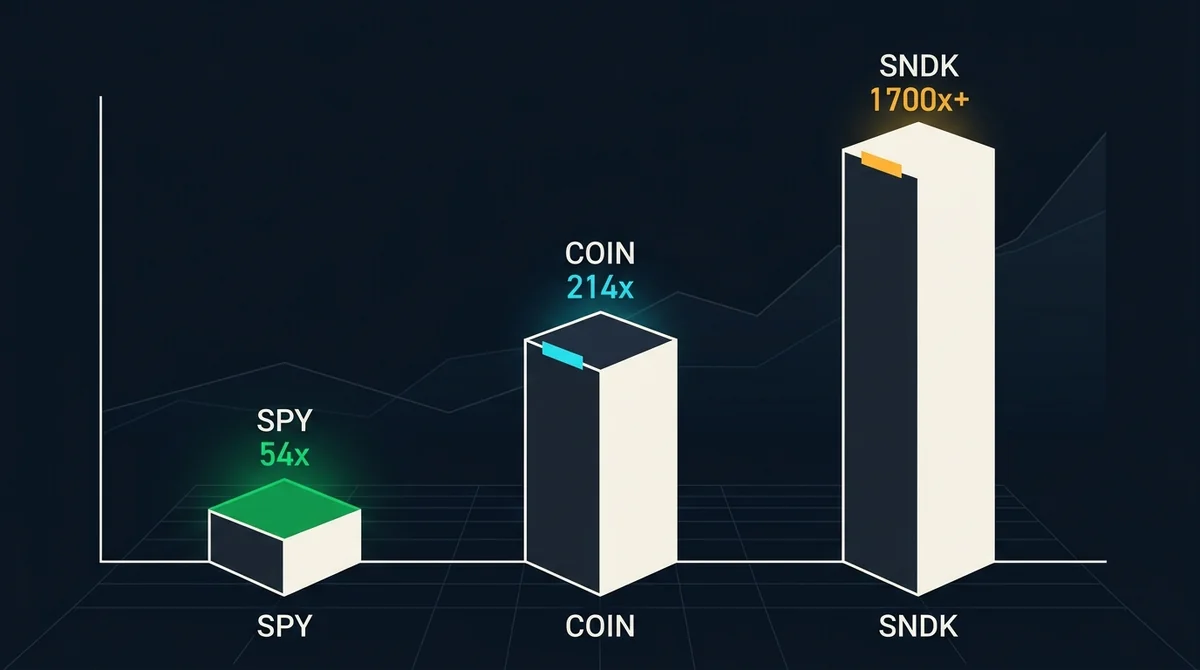
Liquidity has long been the biggest bottleneck in the tokenized stock market. Most tokenized RWAs suffer from thin secondary markets, concentrated ownership, and overly wide spreads, making profitable trading difficult. In most cases, the R Token's order book liquidity depth is significantly higher than competitors, meaning orders are filled closer to expected prices and slippage is reduced even for larger trades. For example, the order book depth of R SPY (S&P 500 ETF) is about 54 times that of its largest competitor; the R Token for Coinbase stock has 214 times more liquidity; and R SNDK, which tracks SanDisk stock, has more than 1,700 times more liquidity. However, the product is not always superior on spreads: for stocks such as Nvidia (NVDA) and Coinbase (COIN), its spreads are better than some platforms, while other platforms offer better spreads on stocks such as SpaceX's SPCX, Micron (MU), and Circle's CRCL. Therefore, active traders should still compare order book depth and spreads across platforms before entering or exiting positions. The difference on a single trade may be small, but cumulatively it can significantly affect returns.
Which investors does it suit?
From a practical standpoint, the product is more suitable for active traders for three reasons. First, the order book depth mentioned above means deeper liquidity generally leads to better execution prices on each trade; large orders on platforms with thin liquidity can easily punch through the order book and cause slippage losses, while R Token is more likely to avoid immediate losses upon entry. Second, crypto-native traders who want to trade real U.S. stocks will find that every R Token is backed 1:1 by real U.S. equities, not synthetic versions; all operations are completed on the same platform, allowing a seamless switch from Bitcoin or Ethereum to stocks such as Apple and Tesla. Third, investors who want to deploy capital more efficiently can use USDT to buy stocks and then let R Token play multiple roles as collateral, dividend earner, and tradable asset. However, for passive investors willing to buy and hold for the long term, the product may have limited appeal; in addition, if investors need real-time order book data, that data is locked behind VIP membership, creating a certain barrier. Overall, whether to use such a product depends on trading frequency, the need for capital efficiency, and acceptance of bringing real-world assets on-chain.
Whether tokenized stocks can truly become mainstream depends on whether liquidity, compliant custody, and practical use cases mature in tandem. The current R Token model demonstrates a viable path for connecting U.S. equity assets to the crypto ecosystem.