Recent on-chain and compliance data indicate that XRP network growth and tokenization activity are accelerating in tandem: new wallet counts hit a year-to-date high, RLUSD supply approaches $1 billion, the SEC and CFTC continue to provide clearer boundaries for tokenized assets through rulemaking and no-action letters, and the New York Stock Exchange has expanded transfer agent partnerships. Key developments are summarized below.
SEC Updates Token Classification Guidance, Further Clarifying Decentralization Boundaries
On November 2, 2026, the SEC updated its frequently asked questions (FAQ) on token classification. The original version was published on September 25 and built on the explanatory guidance from March 17. Miles Jennings noted that the new FAQ clarifies that systems can use legal entities such as DUNA (decentralized nonprofit organizations, similar to DAOs) while maintaining decentralized governance, distinguishes permissioned from permissionless systems, and clarifies the two concepts of “functional availability” and “decentralization.”
Because the probability that the Clarity Act passes in the next few years is close to zero, the SEC and CFTC are providing clarity through rulemaking and no-action letters, allowing institutions to proceed without the Act. The SEC is narrowing its own regulatory scope, clarifying that it primarily targets securities, while most crypto assets are commodities.
The FAQ also specifically addresses several key questions:
- Do community voters constitute a central party? Generally no. If voters are unaffiliated and there is no behind-the-scenes coordination (including through delegation), then even if governance operates through a foundation, there is no single controlling party; even if they form a group, they would need actual control over the network to be considered a central party.
- What does “supervised participation” mean? As long as the network's participation rules are code-based, verified by encoded network governance, and no single entity can prevent users from becoming validators, the network is considered decentralized. Even if someone monitors the network, as long as they cannot unilaterally decide validators, modify code, or reverse transactions, the network remains decentralized. If the network operates under automated rules, or if decisions require broad community governance, that is equivalent to no supervision.
- What is the difference between functionality and decentralization? Functional availability means the token can actually be used on its network; decentralization means no one controls the network. An operating network with a commodity-type token already has some degree of decentralization, but the specific degree depends on the facts. A footnote adds three points: good governance requires transparency, adherence to fixed rules, and inclusion of a broad range of stakeholders including validators; this determination applies only to whether a token is a commodity, not to other legal definitions such as exchanges; if a foundation unilaterally controls applications built on the network, it may become a central party, and the relevant token may be considered a security or investment contract.
Traditional Financial Market Tokenization Accelerates: NYSE Expands Transfer Agent Partnerships
The SEC and CFTC have issued no-action letters to DTCC, allowing institutions to launch businesses in the absence of the Clarity Act. This is the backdrop for the New York Stock Exchange announcing an expansion of transfer agent partnerships. NYSE previously worked with Securitize and T0, and has now added Broadridge, Computershare, Aquinity, and Superstate Inc., spanning digital-native and traditional service providers. NYSE stated that the move continues its long history of reshaping market infrastructure, prioritizing market integrity and shaping the future of finance.
Patrick Wilson of the Solana Policy Institute believes these rules appear technical but could determine whether tokenized securities can truly trade on-chain; the SEC is asking the right questions. The core principle is that transfer agents can be responsible for official ownership records without needing to control the blockchain itself; accountability for regulated functions should not require controlling validators, nodes, or consensus. Many details will still be clarified through rulemaking and potentially judicial cases.
State Regulatory Pressure Eases: New Jersey Withdraws Coinbase Staking Lawsuit
New Jersey has formally withdrawn its lawsuit against Coinbase, allowing users to resume crypto staking and ending more than three years of dispute. Previously, Ripple spent $150 million responding to the SEC lawsuit, and Coinbase was also sued by New Jersey over its staking business. Now the SEC has provided guidance on staking, indicating that staked tokens can generally be considered commodities. State attorneys general may reassess cases because the SEC's clarity, while not law, could become judicial precedent later, similar to the outcome of the SEC's case against Ripple.
RLUSD Supply Rapidly Approaches $1 Billion as Multi-Chain Liquidity Expands
Today, RLUSD Treasury minted an additional 110 million RLUSD. According to XRP Scan, total RLUSD issuance has reached 852 million, rapidly approaching $1 billion. Going forward, it will be worth watching whether this issuance pushes RLUSD supply on the XRP Ledger above supply on Ethereum.
At the Ripple Swell conference, Coinbase added RLUSD integration, supporting not only the XRP Ledger but also providing liquidity for RLUSD on Ethereum, and extending to the Base network. Because of Coinbase's integration with the XRP Ledger, other XRP Ledger tokens can be supported in the future. These bridges help liquidity flow back to the XRP Ledger, providing value support for XRP.
XRP On-Chain Network Growth Accelerates While Price Remains Low
On November 1, XRP added 7,934 new wallets, the sixth-highest single-day total in 2026, and that day was a Sunday, when on-chain activity is typically lower. The previous week was active for XRP, and the Binance hack incident may have prompted more users to turn to self-custody and create new wallets. Price is around $1.25, and strong network growth suggests usage is improving, although price remains under pressure.
Santiment charts show several bullish data points: the largest single-day wallet growth previously occurred in September, and the worst phase has now passed, with on-chain data confirming large-scale growth in the XRP network. Although social media sentiment leans negative, on-chain data indicates users are returning to XRP.
From a broader sentiment perspective, the market remains in the late stage of a bear market, and factors such as the midterm elections have amplified negative sentiment, potentially distracting attention from fundamental opportunities. On-chain data, however, shows that XRP adoption is accelerating. Overall, XRP network fundamentals continue to show an improving trend; compared with most crypto assets, XRP and the RWA tokenization sector offer greater certainty. Still, the scale of any bull market remains uncertain, and whether XRP can reach $10 or $100 remains to be seen.
RWA Tokenization Rankings: XRPL Ranks High, Some Data Pending Update
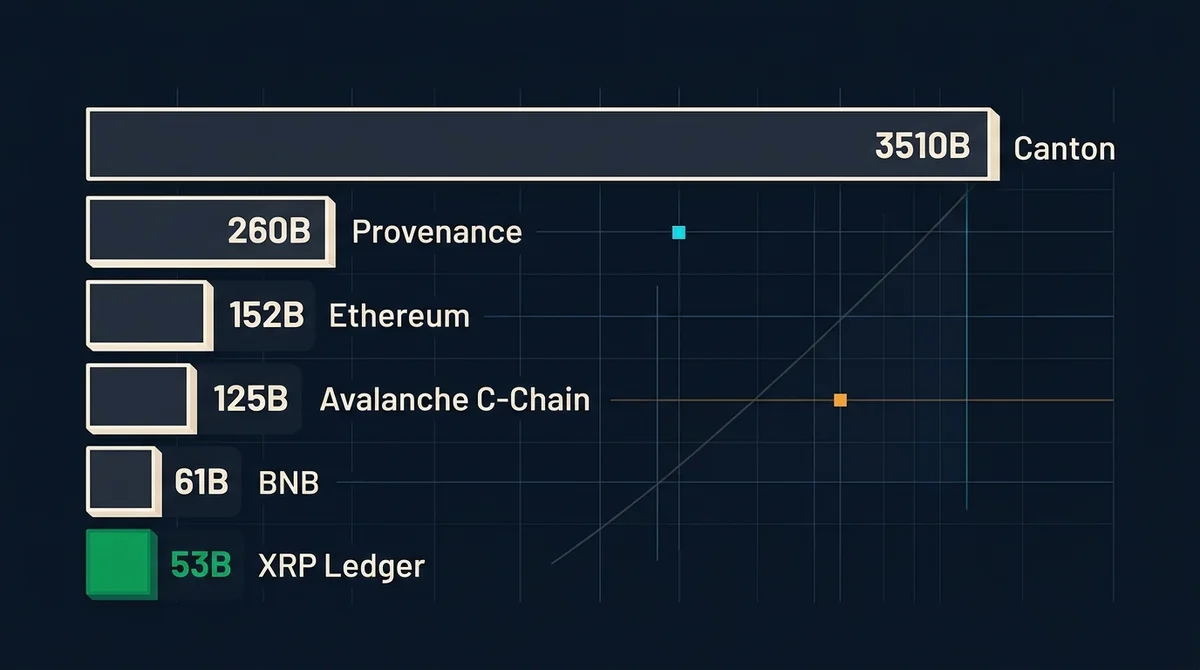
According to the RWA rankings table from RWA.xyz, in the “distributed” category, XRP Ledger shows only $642 million, but that figure needs updating because RLUSD supply alone has already reached $852 million.
In the “representative” RWA category, XRP Ledger ranks fourth with $4.7 billion, behind Canton ($351 billion), Provenance ($26 billion), and Avalanche C-Chain ($11 billion). After combining distributed and representative categories, XRPL ranks sixth with a total of $5.3 billion, behind BNB ($6.1 billion), Avalanche C-Chain ($12.5 billion), and Ethereum ($15.2 billion), with Provenance and Canton ahead. These figures may also need updating.
Overall, XRP network growth, RLUSD minting, institutional tokenization progress, and regulatory guidance all point to improving fundamentals. The above content is only a review of data and facts and does not constitute investment advice.