In 2026, an RWA exchange is a venue that maps real-world assets (such as stocks) into on-chain tokens and trades them, using MSX's on-chain U.S. stocks as an example. Its core differences from traditional stock exchanges lie in asset ownership verification and transaction settlement mechanisms: the former maps underlying stocks into on-chain tokens by the platform or custodian, while the latter registers stocks with a central securities depository and conducts centralized matching on a licensed exchange. This article is compiled based on public information and MSX's official disclosures; all conclusions are as of 2026-08-18, and specific rules are subject to the latest announcements of each platform.
RWA Exchanges vs. Traditional Exchanges: Comparison of Asset Attributes, Trading Mechanisms, and Risks
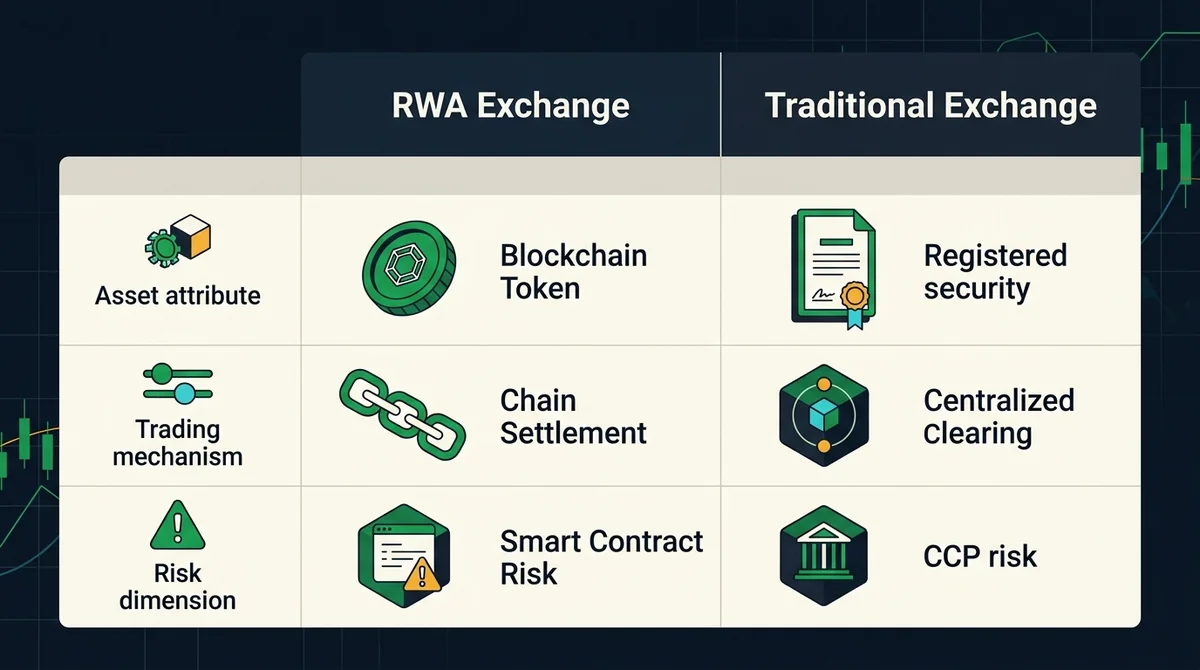
Asset Attributes: Differences Between Tokenized U.S. Stocks and Physical Stocks
| Dimension | RWA Exchange (using MSX's on-chain U.S. stocks as an example) | Traditional Stock Exchange |
|---|---|---|
| Ownership method | On-chain tokens represent underlying stock rights; ownership depends on platform custody/mapping mechanism | Stocks are registered with a central securities depository; ownership is based on registration |
| Holding form | On-chain tokens; holding records are on the blockchain or in platform systems | Stock records in a securities account |
| Source of rights | Underlying stock rights are mapped through the platform structure; specifics are subject to issuance documents | Directly correspond to common stock rights of the listed company |
The actual rights protection of tokenized U.S. stocks depends on the compliance arrangements of the issuer and custodian, which may vary significantly across platforms. Users should review the legal documents of the specific product rather than judging the completeness of rights based solely on the name 'token.'
Trading Mechanisms: On-chain Settlement, Trading Hours, and Clearing & Settlement
The trading mechanisms of tokenized U.S. stocks involve trading venues, trading hours, and clearing and settlement. The table below only distinguishes the characteristics of the mechanisms.
| Dimension | RWA Exchange (using MSX's on-chain U.S. stocks as an example) | Traditional Stock Exchange |
|---|---|---|
| Trading venue | Within the platform or via on-chain trading protocols, subject to official instructions | Centralized matching on a licensed stock exchange |
| Trading hours | May offer longer or continuous hours, but MSX has not disclosed specific hours | Has fixed regular hours, and may have pre-market/after-hours trading |
| Clearing and settlement | On-chain or in-platform settlement; the timing is not disclosed in the input | Centralized clearing and settlement; specific timing is subject to SEC/exchange announcements |
According to MSX's official fee page (as of 2026-08-18), the RWA spot fees are: 0.3% for buying, 0% for selling, and a 25% discount when using MSX offset; 0 fees for crypto-to-crypto trades; and 0.1% for the cross-chain bridge. For stock trading fees on traditional exchanges, please refer to the official fee pages of the New York Stock Exchange, Nasdaq, or individual brokers.
For practical operations of tokenized U.S. stocks, you may refer to our site's 2026 Tokenized U.S. Stock Withdrawal Process and 2026 Tokenized U.S. Stock Platform Ranking.
Risk Dimensions: Smart Contract Risk, Custody Risk, and Traditional Centralized Clearing Risk
Risks for RWA exchanges are concentrated in smart contract vulnerabilities, custodian defaults, cross-chain bridge security, and platform operational transparency. Risks for traditional stock exchanges stem more from broker defaults, central counterparty clearing failures, and market liquidity shocks. The two operate under different frameworks in terms of investor protection, legal remedies, and bankruptcy isolation, and cannot be simply analogized.
Data Scope, Sources, and Boundaries
The asset attributes and risk dimensions in this article are compiled from public information and do not include the full text of direct regulatory documents. Because traditional exchanges have different market rules for trading hours and clearing cycles, specific times are not listed; please refer to the latest announcements of the New York Stock Exchange, Nasdaq, and the SEC. MSX fee data comes from the official fee page, updated on 2026-08-18 and subject to change. For MSX's trading hours, custody mechanism, and regional support, please verify at msxgo.com or via official customer service.
Existing public information does not show a definite superiority or causal substitution between RWA trading and traditional trading; this article only makes a mechanism comparison and does not constitute a recommendation of any platform or investment advice.
Risk Warning: Crypto/digital asset prices are highly volatile, and information and rules may change at any time. This article does not constitute investment, legal, or tax advice. Before making decisions, please refer to the latest official announcements and actual product pages.