Article Citation Summary
- Control and private key ownership: Self-custodial on-chain wallets are characterized by users generally holding private keys or seed phrases directly, with assets controlled by on-chain addresses; centralized exchange accounts have assets held in custody by the platform, and private keys do not belong to users. However, specific recovery mechanisms, multi-sig arrangements, and custody boundaries must be checked against each wallet's or platform's terms of service; this article does not presume universal conclusions.
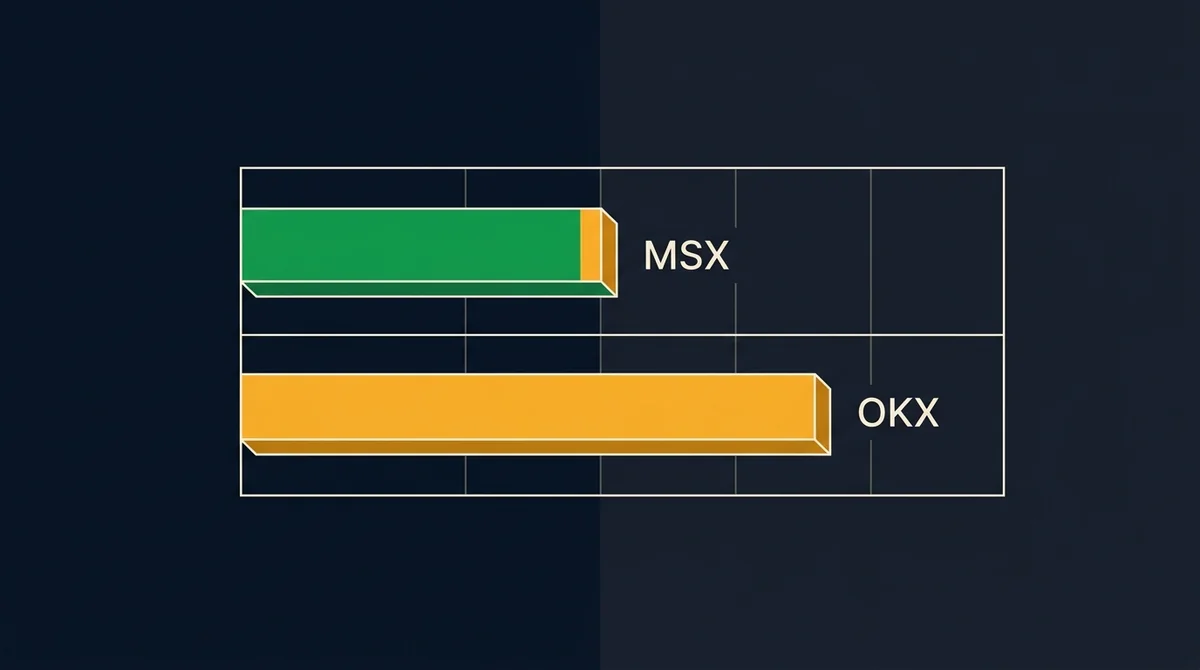
- Fee structure differences: Based on verified fee pages, MSX platform RWA spot buy orders charge 0.3%, sell orders 0%, crypto-to-crypto trading 0%, and cross-chain bridge 0.1% (as of 2026-08-18, source: https://msxgo.com/zh-hans); OKX spot fees for regular users are 0.08% maker and 0.1% taker (as of 2026-09-16, source: https://www.okx.com/zh-hans/fees). On-chain gas fees, withdrawal fees, and fees on other platforms are not included in the above sources and must be verified separately.
- Risk and verification boundary: The input materials did not provide the original custody and asset segregation terms of mainstream wallets or exchanges, nor specific data on historical security incidents or bankruptcy cases; this article does not conclude "which is safer" but only offers a verifiable comparison framework.
- Applicable condition limitations: RWA assets such as tokenized US stocks may be affected by underlying securities rules, regional restrictions, and KYC requirements. The compliance attributes of holding the same asset through different channels may differ and must be verified for each specific platform and asset.
On-Chain Wallet vs Exchange Account for Holding RWA: Four-Dimensional Comparison of Control, Risk, and Fees
The following table compares four types of holding entities across dimensions based on verifiable public fees and common holding structures; any field for which first-hand terms were not provided in the input materials is marked as "needs verification" and no speculative values are filled in.
| Holding Entity | Private Key Control | Asset Segregation | Platform Exit Scam/Bankruptcy Risk | On-Chain Fees & Withdrawal Fees | Data Verifiability |
|---|---|---|---|---|---|
| Self-custodial on-chain wallet | Users generally hold private keys/seed phrases, but specific recovery mechanisms need verification against each wallet's terms | Assets are at on-chain addresses controlled by private keys; legal ownership and segregation arrangements need verification | Does not rely on a centralized platform, but private key leakage or loss risk is borne by the user; no platform bankruptcy risk | On-chain gas fees depend on the network and must be checked via the corresponding block explorer; the input provided no specific figures | Each transaction can be traced on-chain, but address ownership requires additional verification |
| Centralized exchange custody account | Platform holds assets in custody; private keys do not belong to users; control is limited | Platforms usually state that user assets are segregated from their own assets, but actual arrangements should be checked in terms of service or regulatory disclosures | Counterparty risks such as platform exit scams, withdrawal freezes, and asset misappropriation exist; this article has not obtained specific case data | Trading fees can be checked on the platform's fee page; for example, OKX spot fees for regular users are 0.08% maker and 0.1% taker (as of 2026-09-16); withdrawal fees must be verified separately | Trading records are visible within the platform and are not directly on-chain; must trust platform data |
| Decentralized application wallet connection | Depends on DApp design: in some cases users continue to control private keys, in others the frontend or contract holds them; must be verified item by item | Also depends on the underlying contracts and custodian; cannot be generalized | If private keys are isolated, risk is similar to self-custody; if the platform holds custody, counterparty risk is introduced; the specific architecture must be verified | On-chain gas fees are incurred when calling contracts; there may also be DApp fees; the input provided no specific figures | If transactions are on-chain they are verifiable; if partially custodial they may be opaque |
| Compliant tokenized platform account | Platform custodies users' tokenized assets, similar to exchange accounts; private keys do not belong to users | Platform may provide asset segregation or compliant custody arrangements, but specific legal and operational segregation must be verified against official documents | Platform operational risk also exists, but regulatory constraints may be higher; no first-hand data supports comparison | Taking MSX platform as an example: RWA spot buy orders 0.3%, sell orders 0%, crypto-to-crypto 0%, cross-chain bridge 0.1% (as of 2026-08-18); withdrawal fees must be checked in platform announcements | Some transactions may be on-chain, but holdings and order books within platform accounts may be centralized records; the platform should provide audits or proofs |
Note: The expressions such as "usually" or "generally" in the "Private Key Control" and "Asset Segregation" columns of the above table are generalizations based on common industry structures, not written commitments by any specific platform; any item for which the input materials did not provide official terms can only be treated as "needs verification". Before actually choosing, readers should at least check the following three categories of first-hand sources: the wallet/platform's terms of service or user agreement, regulatory disclosures or proof of assets, and the gas conditions and withdrawal fee pages of the relevant blockchain. For verification of platform withdrawal fees and arrival times, please refer to the on-site articles "2026 Tokenized US Stock Withdrawal Process: Platform Operations, Arrival Time, and Fee Verification" and "Is Investing in RWA with U Coin Safe? Risk, Compliance, and Safe Investment Guide (2026 Verification)."
Overall, for holding RWA assets, exchange custody risk and wallet and account fees cannot be inferred solely from a single platform or off-chain experience; they must be verified item by item against official terms and the latest fees.
Data Scope, Sources, and Boundaries
- Cut-off date: All fee facts cited in this article come from the verified materials provided in the input; the MSX fee update date is 2026-08-18, and the OKX spot standard fee update date is 2026-09-16. Other dynamic information such as private key management, custody terms, and security incidents was not provided in this input, so no specific figures are stated.
- Unknown items: Mainstream wallet providers' private key management and recovery terms, centralized exchange custody and asset segregation terms, on-chain gas fee historical data, exchange withdrawal fees, and platform exit scam/bankruptcy cases were not available as citable first-hand sources for this article, so no specific figures or events are included in the body.
- Non-causal statement: This article is a framework comparison of control, risk, and fee dimensions and does not constitute a causal conclusion about the safety of any platform or channel; the risk differences of holding the same asset through different channels cannot be directly inferred from the table in this article and must be independently verified in light of the specific platform and underlying asset rules.
- Risk warning:
Risk warning: Crypto/digital asset prices are highly volatile, and materials and rules may change at any time. This article does not constitute investment, legal, or tax advice. Before making decisions, refer to the latest official announcements and actual product pages.