
MSX RWA Editorial Team
Guest Columnist
@MSXRWA
September 7, 2026
This article is approximately 4,800 words and takes about 12 minutes to read.
BlackRock Global Dividend Fund returned 11.72% for institutional shares and 11.64% for Class A shares (excluding sales charges) in the second quarter of 2026. Stock selection in the materials and communication services sectors, zero real estate exposure, and holdings in AI semiconductor names Applied Materials, MediaTek, and SK Hynix contributed to performance; not holding Micron Technology weighed on relative returns. The following breaks down the composition and logic behind this result.
AI Summary
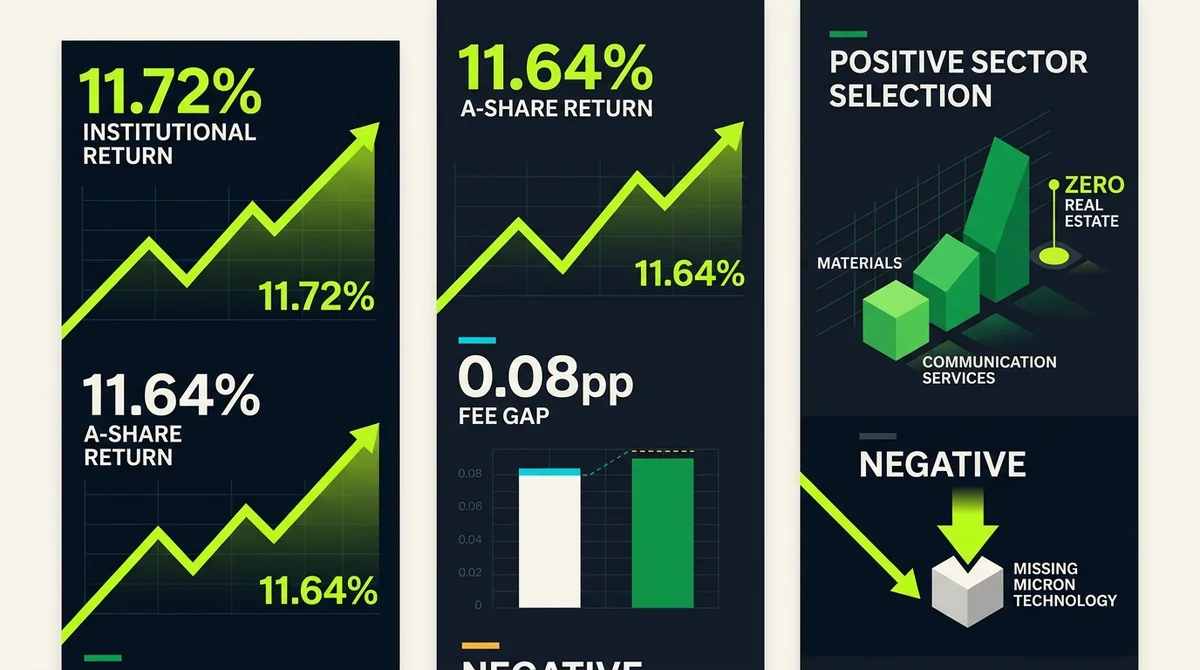
Core view: The fund posted an 11.72% institutional share return and an 11.64% Class A share (excluding sales charges) return in Q2; the fee difference is small but real. Stock selection in materials and communication services and zero real estate exposure contributed, while not holding Micron Technology dragged; Applied Materials, MediaTek, and SK Hynix benefited from AI infrastructure demand. Meanwhile, the US stock market saw regional bank M&A and insurance investor day communication dynamics.
Key elements:
- BlackRock Global Dividend Fund's 2026 Q2 institutional share return was 11.72%, and investor Class A share (excluding sales charges) return was 11.64%.
- The fund's stock selection in the materials and communication services sectors, and having no real estate sector exposure, contributed to performance.
- The fund was dragged by not holding Micron Technology; Micron rose on strong earnings, improved revenue visibility, and favorable memory market dynamics.
- Applied Materials, MediaTek, and SK Hynix contributed to fund performance, supported by investor enthusiasm for semiconductor demand driven by AI infrastructure development.
- Equity Bancshares, Inc. released slides for its Lincoln Bancorp merger call, and T&D Holdings, Inc. released analyst/investor day slides.
I. Q2 Return Breakdown: The Fee-Adjusted Difference Between Institutional 11.72% and Class A 11.64%
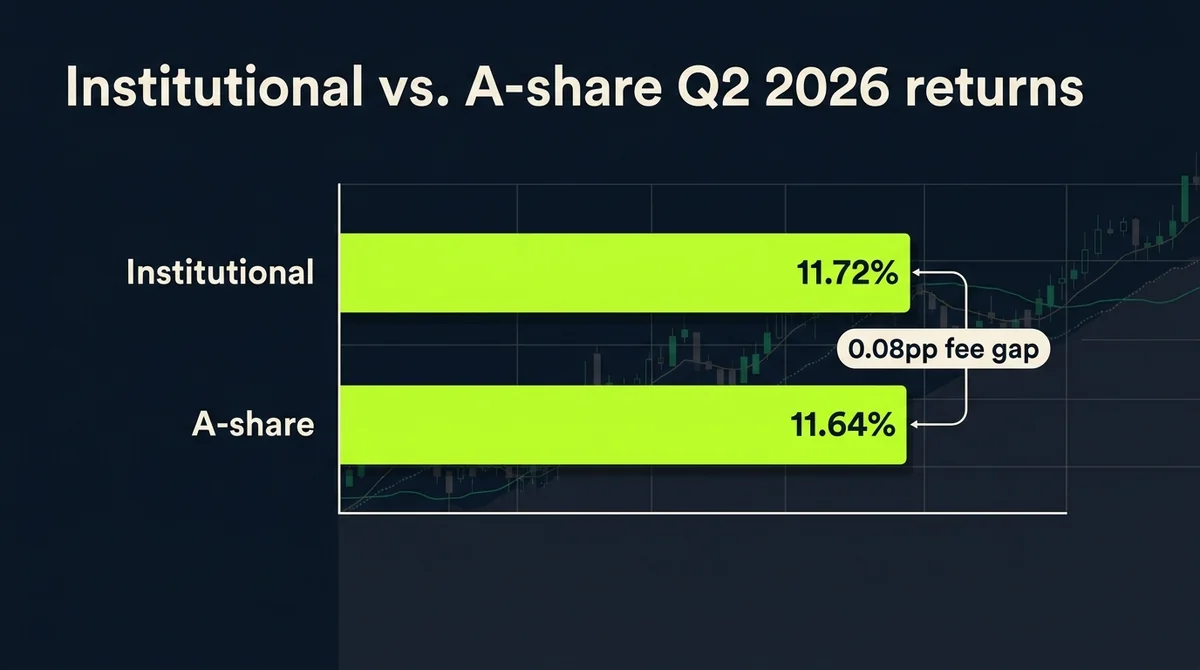
1. The 0.08 percentage point gap between institutional and Class A returns reflects the compression of Class A returns by sales charges
According to the BlackRock Global Dividend Fund Q2 2026 Commentary published by Seeking Alpha on September 7, 2026, the fund's institutional share return for Q2 2026 was 11.72%, and the investor Class A share (excluding sales charges) return was 11.64%. The difference is 0.08 percentage points.
| Share Class | 2026 Q2 Return | Note |
|---|---|---|
| Institutional | 11.72% | Official fund disclosure |
| Investor Class A (excluding sales charges) | 11.64% | After-fee basis, 0.08 ppt difference |
This seemingly small gap is not style drift or stock selection bias; it directly corresponds to the compression of Class A net returns by the fee structure: Class A shares typically carry sales charges or distribution fees, and even on an "excluding sales charges" basis, their expense ratio is often higher than institutional shares, causing the same portfolio to show diverging net performance over the same interval. For long-term holders, a quarterly difference of 0.08 percentage points is magnified by compounding, so the fee structure should be regarded as "hidden alpha leakage."
2. The 11.72% Q2 return shows the fund maintains steady growth within its dividend strategy
Putting the 11.72% quarterly return in the context of high volatility in US stocks in 2026, the fund's dividend strategy did not sacrifice capital appreciation for high dividend yield. Generally, dividend funds' return sources lean toward mature industries and companies with stable cash flows, and these sectors often have less upside than growth stocks when interest rate and earnings expectations shift rapidly. However, the fund was still able to record a double-digit return in a single quarter, indicating that its holdings include a significant proportion of names benefiting from industry trends—confirmed later by the contribution from AI semiconductors. For investors, this shows that BlackRock Global Dividend Fund's "dividend" label does not mean conservative low growth; its active stock selection can still capture structural upside opportunities in particular quarters.
II. Stock Selection Contribution and the Cost of Absence: Positive Contribution from Materials and Communication Services vs. Negative Drag from Micron Technology
1. Stock selection in materials and communication services contributed, further boosted by zero real estate exposure
Source facts show that the fund's stock selection in the materials and communication services sectors contributed to performance; at the same time, having no real estate sector exposure also had a positive impact.
| Category | Specific Item | Impact Direction |
|---|---|---|
| Sector stock selection | Materials | Positive contribution |
| Sector stock selection | Communication services | Positive contribution |
| Allocation | Zero real estate exposure | Positive contribution |
We believe the contribution from materials stock selection may have come from overweighting companies with pricing power or benefiting from tight supply-demand balances, which could have benefited from macro trends such as re-industrialization, electrification, or resource price recovery in Q2 2026. Communication services may have captured strong names in media, gaming, or communication infrastructure, thereby generating additional active returns among traditional dividend names. It is worth emphasizing that "zero real estate exposure" is itself a result of allocation: when the real estate sector underperforms due to interest rate expectation volatility or valuation pressure, not holding it means avoiding a potential drag. This shows that the fund's sector allocation is not simply pursuing high dividend yield, but actively choosing based on relative sector strength.
2. Not holding Micron Technology dragged performance; Micron rose on earnings and memory market dynamics
In contrast to the positive contributions above, the fund was dragged by its lack of exposure to Micron Technology. Micron rose during the reporting period, driven by strong earnings, improved revenue visibility, and favorable memory market dynamics. The memory industry in Q2 2026 was in a price increase cycle or a supply-demand tightening phase, and Micron, as a major global DRAM/NAND supplier, could have spillover effects on related holdings through earnings elasticity and market sentiment. We believe that for a global dividend fund, not holding Micron may stem from valuation, dividend policy, or portfolio concentration constraints, but this exactly reflects the two-sided nature of "active choice": avoiding certain high-volatility growth stocks can reduce drawdowns, but it can also miss excess returns brought by AI infrastructure and the memory upcycle. This "cost of absence" is a key variable for understanding the fund's return structure.
III. The AI Infrastructure Main Line: Semiconductor Contributions from Applied Materials, MediaTek, and SK Hynix
1. Applied Materials, MediaTek, and SK Hynix contributed, driven by AI infrastructure demand
According to the BlackRock Global Dividend Fund Q2 2026 Commentary, Applied Materials, MediaTek, and SK Hynix contributed to the fund's performance, and these companies are supported by investor enthusiasm for semiconductor demand driven by AI infrastructure development.
| Company | Segment | Contribution Logic |
|---|---|---|
| Applied Materials | Semiconductor equipment | Orders and capex expectations lead AI computing expansion |
| MediaTek | Chip design | Edge AI chips and smartphone SoC demand improvement |
| SK Hynix | Memory/HBM | High-bandwidth memory directly benefits from AI accelerator demand |
As a semiconductor equipment leader, Applied Materials' orders and capex expectations often lead AI computing expansion. MediaTek's demand improvement in edge AI chips and smartphone SoCs is seen as a beneficiary of edge AI deployment. SK Hynix holds a key supply position in high-bandwidth memory (HBM), directly benefiting from strong demand for high-bandwidth memory from AI accelerators. The three companies span equipment, design, and memory segments, and together cover several key positions in AI infrastructure. This also indicates that the fund does not completely avoid technology growth, but has made selective exposure between dividends and the AI main line. Similarly, the AI hardware and capex dynamics we previously observed in "MSX RWA US Stocks Daily Watch: Leonardo, ON Semiconductor and Meta" also confirm the structural opportunities in semiconductor subsegments in 2026.
2. The fund's exposure to AI semiconductors versus its absence in Micron forms a portfolio contrast
Comparing this section with the previous one reveals a more complete picture: the fund's exposure to AI semiconductors is "structural" rather than a full embrace. It holds Applied Materials, MediaTek, and SK Hynix, but was absent during Micron's rally. We believe the underlying logic may be that the fund prefers technology companies with stable cash flows or dividend records, while Micron's past earnings cyclicality and uncertain dividends kept it out; conversely, SK Hynix, although also subject to memory cycle volatility, its strategic position and customer stickiness in HBM may be viewed by the manager as a better "AI infrastructure purity" target. This choice of "holding equipment and HBM, avoiding cyclical memory makers" is essentially pursuing higher-quality exposure within the AI theme. For observers, this signals that the 2026 AI trade has moved from "buy all chips" to a "screening and positioning" stage: even active funds are making more refined layering in semiconductor allocation. For the latest interaction between AI semiconductors and Treasury yields, see OKX Radar US Stocks Daily Watch: Nvidia, Marvell and Treasury Yields.
IV. Market M&A and Investor Communication Dynamics: Equity Bancshares' Lincoln Bancorp Deal and T&D Holdings Investor Day
1. Equity Bancshares released Lincoln Bancorp merger call slides; regional bank consolidation continues
According to Seeking Alpha on September 7, 2026, Equity Bancshares, Inc. released slides for its Lincoln Bancorp merger conference call. Such slides usually contain key information including transaction structure, financial synergies, integration timeline, and management shareholder communications, and their public release is an important step in the M&A process. Regional bank consolidation remained active in the 2026 macro environment: under high interest rates or fluctuating rate expectations, small and mid-sized banks face net interest margin pressure and scale effect demands, making M&A a means to improve capital efficiency and market share. If the Equity Bancshares-Lincoln Bancorp transaction is completed, it will expand its deposit base and lending capacity in the Midwest or corresponding regional market, and also reflects the trend of regional banks using M&A to counter large bank competition. For US stock investors, such M&A dynamics often bring share price re-rating and sector sentiment changes, requiring tracking of subsequent regulatory approvals and integration execution.
2. T&D Holdings released investor day slides; insurance sector strategic communication active
On the same day, T&D Holdings, Inc. released analyst/investor day slides. This Japanese insurance holding company's investor communication event sends strategic signals from the insurance sector amid interest rate and capital market volatility. Investor days typically disclose capital policy, underwriting discipline, asset allocation, and shareholder return targets. For US equities and global asset allocation, insurance sector actions are worth attention because they affect financial sector valuation expectations and may also have marginal impacts on bond and equity markets through asset-side changes. T&D Holdings' decision to hold an investor day at this time may signal its asset-liability management capabilities and strategy for the long-term interest rate environment. Although this event itself is not a US domestic company, it is linked to the financial sector sentiment in the US stock market: stable operations and improved capital returns from insurance institutions help strengthen overall confidence in the financial sector.
Final Thoughts
BlackRock Global Dividend Fund's Q2 performance report provides a mirror for observing the orientation of active management in US stocks in 2026. The 0.08 percentage point difference between the 11.72% institutional share return and 11.64% Class A share return may seem small, but it reminds investors that attention to fee structures cannot stop at the assumption of "excluding sales charges." Stock selection contributions in materials and communication services, together with zero real estate exposure, formed positive forces, while the drag from missing Micron Technology proves that in a market slice dominated by AI infrastructure and memory cycles, having no exposure is itself an exposure.
A broader signal is that the AI semiconductor trade is shifting from single leader-driven to multi-point competition. The contributions from Applied Materials, MediaTek, and SK Hynix show that equipment, design, and HBM segments can all deliver on earnings expectations amid AI infrastructure demand; Micron's rise shows that more cyclical original manufacturers also benefit from improved earnings and visibility. Active funds must choose between "dividend discipline" and "growth capture," and the result of that choice is directly reflected in relative returns.
Meanwhile, M&A and investor communication dynamics provide another dimension of clues: regional bank consolidation continues, and insurance sector strategic communication is heating up. These traditional financial industry events do not contradict the high-volatility narrative of AI semiconductors; rather, they show that the current US stock market is in a structural phase where "technology industry trends" and "traditional industry consolidation" run in parallel. While focusing on a single fund's holdings, investors should also expand their perspective to the combined impact of fee structure, sector exposure, and industry consolidation to more fully understand the source and cost of returns.
Risk disclaimer: Macroeconomic and US stock market conditions are volatile. This article is for MSX RWA research observation reference only and does not constitute investment advice.
Tags: Investment, AI, RWA, Financial