
MSX RWA Editorial
Guest Columnist
@MSXRWA
September 2026
This article is approximately 4,900 words and takes about 10 minutes to read.
Editorial review: MSX RWA Editorial
BlackRock Global Dividend Fund achieved an institutional share return of 11.72% in the second quarter of 2026, while Class A shares (excluding sales charges) returned 11.64%. AI infrastructure-driven semiconductor demand was the primary contributor; meanwhile, Equity Bancshares released slides for the Lincoln Bank M&A conference call, and T&D Holdings released analyst/investor day slides, signaling increased capital activity in the financial sector.
AI Summary
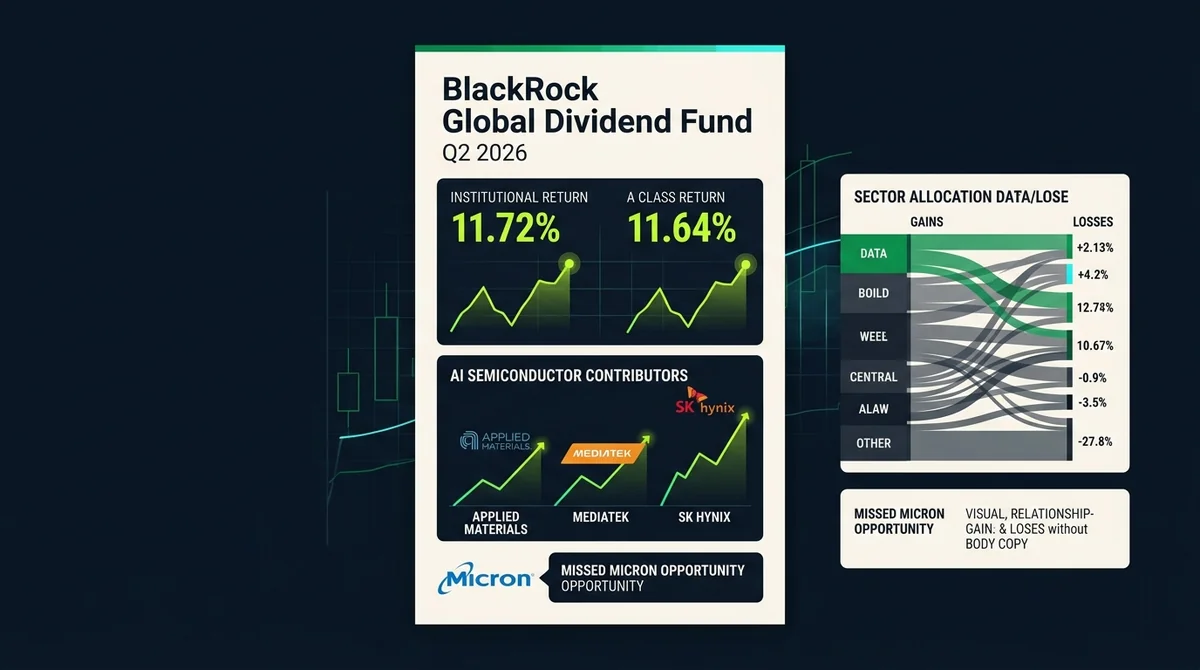
Core viewpoint: BlackRock Global Dividend Fund's Q2 return validated the positive pull of AI semiconductors on dividend-oriented portfolios, but the divergent long/short performance across sector allocations and the opportunity cost of not holding Micron highlight the critical importance of stock-picking precision in active management amid structural market conditions. On the financial side, Equity Bancshares' Lincoln Bank M&A conference call and T&D Holdings' investor day both point to trends of regional bank consolidation and Japanese financial groups strengthening capital market communication.
Key elements:
- BlackRock Global Dividend Fund achieved an institutional share return of 11.72% in the second quarter of 2026, and a Class A share (excluding sales charges) return of 11.64%.
- Applied Materials, MediaTek, and SK Hynix contributed to performance, supported by investor enthusiasm driven by AI infrastructure development boosting semiconductor demand.
- Stock selection in the materials and communication services sectors, as well as having no real estate exposure, contributed to performance, while stock selection in the industrials and consumer discretionary sectors dragged on performance.
- The fund was hurt by having no exposure to Micron Technology, as the stock rose on strong earnings, improved revenue visibility, and favorable memory market dynamics.
- Equity Bancshares, Inc. released slides for the Lincoln Bank M&A conference call.
- T&D Holdings, Inc. released analyst/investor day slides.
1. BlackRock Global Dividend Fund Q2 Institutional Return of 11.72%: AI Semiconductor Holdings Stand Out
1. Institutional Share 11.72% and Class A 11.64%: Q2 Return Finalized
According to the BlackRock Global Dividend Fund Q2 2026 Commentary published by Seeking Alpha on September 7, 2026, the fund achieved an institutional share return of 11.72% and a Class A share (excluding sales charges) return of 11.64% in the second quarter of 2026. These two figures officially finalize the fund's second-quarter performance and also indicate that the slight return difference between institutional and retail share classes may be related to different fee structures.
| Share Class | Return |
|---|---|
| Institutional | 11.72% |
| Class A (excluding sales charges) | 11.64% |
For a product positioned as a global dividend strategy, a single-quarter return exceeding 11% is not purely from defensive dividends, but reflects that the portfolio's active exposure to growth sectors has already produced a substantial contribution.
This level of return is noteworthy because it occurred in the second quarter of 2026, when global equity markets showed significant structural divergence. Traditional dividend funds usually emphasize free cash flow and dividend sustainability, but BlackRock Global Dividend Fund's Q2 performance shows that while maintaining a dividend core, the fund manager has allocated some weight to technology and semiconductor sectors with earnings elasticity. Although the return difference between institutional and Class A shares is slight, it also reminds investors to pay attention to differences in fee accrual methods across share classes.
2. Applied Materials, MediaTek, SK Hynix: AI Infrastructure Demand Drives Holdings Appreciation
According to Seeking Alpha's disclosure, Applied Materials, MediaTek, and SK Hynix contributed to BlackRock Global Dividend Fund's performance, supported by investor enthusiasm driven by AI infrastructure development boosting semiconductor demand. These three companies cover semiconductor equipment, chip design, and memory respectively: Applied Materials typically benefits from equipment orders related to fab expansion, MediaTek has flexibility in smart terminals and edge AI chips, and SK Hynix is regarded by the market as a key beneficiary of rising AI server memory demand. The appreciation of the fund's holdings in these three areas is essentially an effective capture of the AI infrastructure investment chain.
| Semiconductor Holding | Segment Covered |
|---|---|
| Applied Materials | Semiconductor equipment |
| MediaTek | Chip design |
| SK Hynix | Memory |
The market implication is that global dividend funds are not limited to holding high-yield assets such as utilities, consumer staples, or telecommunications. The changes in earnings growth and capital return logic for AI semiconductors are reshaping the boundaries of traditional factors. If AI infrastructure demand persists in subsequent quarters, semiconductor-related holdings may continue to provide sources of excess returns for such funds, but will also amplify the portfolio's sensitivity to the technology cycle.
2. Sector Allocation Gains and Losses: Materials and Communication Services Contribute, Industrials and Consumer Discretionary Drag, and Not Holding Micron Is a Miss
1. Stock Selection in Materials and Communication Services and Zero Real Estate Exposure: Sources of Positive Contribution
Seeking Alpha's disclosure shows that BlackRock Global Dividend Fund's stock selection in the materials and communication services sectors, as well as having no real estate exposure, contributed to performance. This means the fund manager made correct individual stock choices at the sector level and also reduced the drag from interest rate-sensitive assets by avoiding the real estate sector. Certain holdings in the materials sector may have benefited from supply constraints and demand recovery, while individual stocks in communication services may have contributed relatively stable earnings and cash flow.
| Positive Contribution Factor | Description |
|---|---|
| Stock selection in materials sector | Positive contribution |
| Stock selection in communication services sector | Positive contribution |
| Zero real estate exposure | Avoided drag from interest rate-sensitive assets |
Zero real estate exposure is a structural choice worth observing separately. In the second quarter of 2026, financing costs and valuation pressures in global commercial real estate remained, and the fund's complete lack of real estate exposure helped the portfolio avoid some tail risks in a high interest rate environment. This positive contribution did not come from a single bet, but from the combined effect of sector allocation and avoidance strategies.
2. Stock Selection Drag in Industrials and Consumer Discretionary: Structural Detractors
Also in sector allocation, stock selection in the industrials and consumer discretionary sectors dragged on performance. This indicates that the fund was not entirely successful in sector exposure: industrial stocks may have been pressured by fluctuations in manufacturing orders and the pace of capital expenditure, while consumer discretionary stocks may have faced divergent consumer spending and channel inventory adjustments. Although source_facts did not provide the specific magnitude of the drag or individual stock names, this detractor shows that even though the fund achieved significant positive contributions in the semiconductor direction, errors in sector selection still eroded some excess returns.
| Drag Factor | Description |
|---|---|
| Stock selection in industrials sector | Drag |
| Stock selection in consumer discretionary sector | Drag |
From an active management perspective, the drag from industrials and consumer discretionary reminds investors that sector rotation accelerates in structural markets, and stock selection mistakes quickly reflect in portfolio returns. BlackRock Global Dividend Fund's success in materials and communication services, together with its missteps in industrials and consumer discretionary, constitute a typical example of divergent long/short performance in active management during Q2.
3. Not Holding Micron Technology: Missing the Memory Market Upside
According to Seeking Alpha, BlackRock Global Dividend Fund was hurt by having no exposure to Micron Technology, as the stock rose on strong earnings, improved revenue visibility, and favorable memory market dynamics. This is a typical missed opportunity risk: even though the fund already held SK Hynix and benefited from AI-driven memory demand growth, not holding Micron meant it did not fully cover the entire breadth of the memory market rally. Micron's upward momentum came from improved earnings quality, better revenue visibility, and improving memory supply-demand dynamics, which together constituted an industry-level trend independent of any single company.
| Opportunity Cost Factor | Description |
|---|---|
| No Micron Technology exposure | Missed memory market upside |
For investors focused on the memory cycle, this information points to a clear signal: the memory market is shifting from oversupply to a tight supply-demand balance, and earnings realization and improved revenue visibility are already reflected in leading companies' stock prices. If this trend continues, portfolios with full memory exposure may have higher elasticity than those holding only one or two memory leaders; and if active funds allocate only a single name in certain sectors, they will incur opportunity costs similar to BlackRock's not holding Micron.
3. Equity Bancshares Lincoln Bank M&A Conference Call: Another Move in Regional Bank Consolidation
1. Lincoln Bank M&A Conference Call Slides Released: Equity Bancshares Discloses Transaction Details
According to Seeking Alpha, Equity Bancshares, Inc. released slides for the Lincoln Bank M&A conference call. This event marks the entry of a regional bank consolidation transaction into a substantive communication phase. Equity Bancshares chose to synchronize transaction details with the market through conference call slides, typically aiming to reduce information asymmetry, stabilize shareholder and customer expectations, and provide transparency on the post-merger integration path. For regional banks, M&A often carries the logic of scale effects, cost synergies, and regional expansion, but source_facts did not disclose the specific transaction amount, share exchange ratio, or completion time, so this article does not make further data-level judgments on the transaction.
From a broader perspective, regional bank M&A is becoming an important thread in financial sector capital activity in U.S. and global markets in 2026. The interest rate environment, regulatory changes, and balance sheet pressures on small and mid-sized banks may be bringing more consolidation deals to the surface. Although the release of Equity Bancshares' Lincoln Bank M&A conference call slides is only a trigger event, the willingness for regional bank consolidation reflected behind it is worth continued monitoring. If more banks subsequently choose to disclose M&A details through conference calls, investor days, or other means, the market's pricing logic for the regional financial sector may also adjust accordingly.
4. T&D Holdings Investor Day: Latest Disclosure from a Japanese Insurance Giant
1. T&D Holdings Releases Analyst/Investor Day Slides: Sending Strategic Signals to the Market
According to Seeking Alpha, T&D Holdings, Inc. released analyst/investor day slides. An investor day is an important occasion for a company to communicate medium- and long-term strategy, capital policy, and earnings targets to institutional investors, but the detailed content of this disclosure was not elaborated in source_facts, so this article can only confirm the action itself. As a Japanese insurance group, T&D Holdings' investor communication may involve life insurance, asset management, and capital efficiency strategies. Given the ongoing focus on shareholder returns in the Japanese financial market, this event shows Japanese financial giants strengthening external communication and governance transparency.
From a market implication perspective, Japanese insurance group investor days are often used to signal capital allocation and business restructuring. If T&D Holdings' subsequent disclosures mention share buybacks, dividend increases, or asset portfolio optimization, it could further revise market expectations for the Japanese financial sector. Even though current information is limited, T&D Holdings proactively holding an analyst/investor day and releasing slides itself indicates that its management is increasing communication frequency with global institutional investors, which, together with the regional bank M&A conference call, constitutes cross-sectional evidence of increased capital activity in the financial sector.
Final Thoughts
From the semiconductor contribution of BlackRock's global dividend fund to the Lincoln Bank M&A and T&D Holdings investor day, this issue's observations show that the AI industry chain, regional bank consolidation, and Japanese financial groups are shaping new narratives in U.S. and global equity markets. AI semiconductor demand continues to be a key driver of excess returns for global dividend funds; the divergent long/short performance across sector allocations highlights the value of stock selection in active management during structural markets; and regional bank M&A and investor communication from Japanese insurance groups indicate active capital activity in the financial sector.
From an RWA observation perspective, behind AI infrastructure and financial sector capital activity may also reflect long-term themes of real-world asset digitization and capital efficiency improvement; however, this article is based solely on U.S. equity and financial events disclosed by Seeking Alpha, and does not involve specific crypto asset prices or projects, so related judgments require separate verification.
Overall, the market structure is shifting from pure macro beta to more active management competition relying on individual stock and sector alpha. Seemingly scattered events involving semiconductors, memory, regional banks, and Japanese insurance actually point to the same trend: capital is seeking assets that can simultaneously provide earnings elasticity and governance improvement signals. For long-term observers, the key focus should not be on single-quarter return numbers themselves, but on the changes in allocation logic implied behind these sector selections, M&A communications, and investor day disclosures.
Risk Disclaimer: Macroeconomic and U.S. equity market volatility is severe. This content is for MSX RWA research and observation reference only and does not constitute any investment advice.
Investment, AI, RWA, Finance