
MSX RWA Editorial Team / Guest Columnist / @MSXRWA / October 2026 / About 5,000 words, approximately 10 minutes read
This article is based on three individual stock analyses published by Seeking Alpha on October 6, 2026; the factual scope covers only that day's sources.
Core Metrics Comparison of Three Stocks
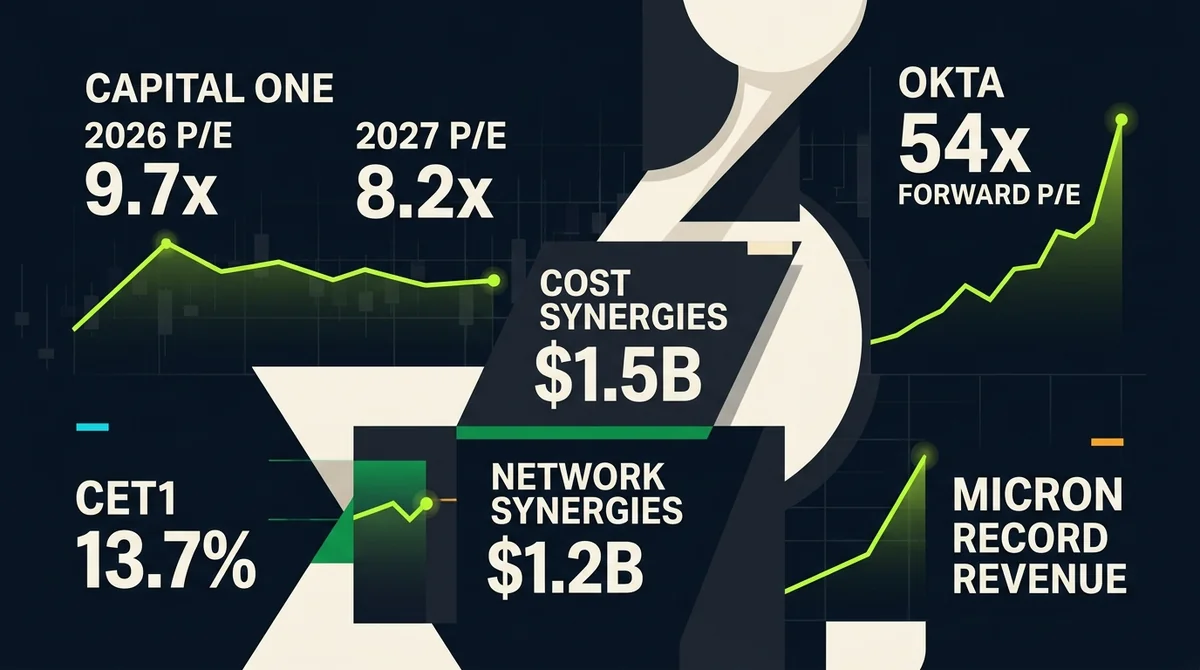
| Company | Core Facts | Key Data | Risks/Divergences |
|---|---|---|---|
| Micron | Record revenue in fiscal Q4 2026; AI demand weakening the memory cycle | DRAM pricing rising, no specific revenue figure | Cycle weakening may be disproven; need to track HBM supply and DRAM prices |
| Capital One | Completed Discover merger, gained payment network ownership | 2026/2027 forward P/E of 9.7x/8.2x, CET1 13.7%, $1.5 billion cost synergies, $1.2 billion network synergies | Synergy execution risk and macro credit quality |
| Okta | 54x forward P/E, overvalued | 54x | GAAP margin improvement mainly from lower stock-based compensation; accounting improvement, not structural improvement |
1. Micron's Record Revenue and Cycle Weakening: DRAM Pricing and AI Demand Are Reshaping Memory Chips' Earnings Elasticity
1. Record Revenue: DRAM Pricing Increases and AI/Data Center Demand Resonance
The core drivers of Micron's record fiscal Q4 2026 revenue are DRAM price increases and AI/data center demand, representing a structural demand shift rather than a simple price rebound. According to Seeking Alpha's October 6, 2026 report, data center orders are directly linked to AI training/inference workloads, giving memory demand stronger persistence. In traditional cycles, revenue peaks often correspond to price-top risk. However, AI server demand for HBM and high-density DDR5 forms an independent incremental driver, compressing the cycle's downside amplitude. Micron has not yet issued fiscal 2027 guidance, but the revenue structure already suggests the earnings midpoint may be higher than traditional cycle assumptions.
2. Core Evidence of Cycle Weakening: Structural Demand Replacing the Traditional Price Cycle
The memory chip cycle is weakening, as the structural increment from AI/data center demand is replacing some price elasticity. The traditional memory cycle is dominated by supply and price fluctuations, while fiscal 2026 data shows a rising share of structural demand. Seeking Alpha's core judgment is that "memory revenue looks more durable than the cycle suggests." If AI capex remains high in 2027, Micron's earnings volatility could decline significantly; however, it is necessary to track HBM supply bottlenecks and monthly DRAM price changes to distinguish "cycle weakening" from "cycle disappearance."
2. Capital One Completes Discover Merger: Payment Network Ownership and Synergy Targets Provide Dual Anchors for Stock Revaluation
1. Post-Merger Asset Portfolio: Large Credit Card Business, Deposit Base, and International Payment Network
After completing the merger, Capital One gained a large credit card business, a deposit base, and ownership of an international payment network, expanding its business model from card issuer to payment clearing. The scarcity of this asset portfolio lies in the ability to earn transaction processing income and open the network to third-party card issuers. The synergy targets disclosed in October 2026 quantified integration benefits, but actual execution still takes time. The large credit card business and deposit base provide a stable source of network transactions, while the international payment network offers optionality for cross-border business.
2. Quantifying Synergy Targets: $1.5 Billion Cost Synergies and $1.2 Billion Network Synergies
The $1.5 billion cost synergy and $1.2 billion network synergy targets quantify integration benefits, but they are management expectations rather than realized gains. Cost synergies come from infrastructure and back-office consolidation, while network synergies come from transaction volume growth and pricing optimization. The 12-24 months after merger completion is a concentrated integration risk period; quarterly data such as expense ratio, net charge-off rate, and network transaction volume should be monitored to verify whether synergies move from paper to the income statement.
3. Valuation Remains Low: 9.7x 2026 and 8.2x 2027 Forward P/E with a 13.7% CET1 Ratio
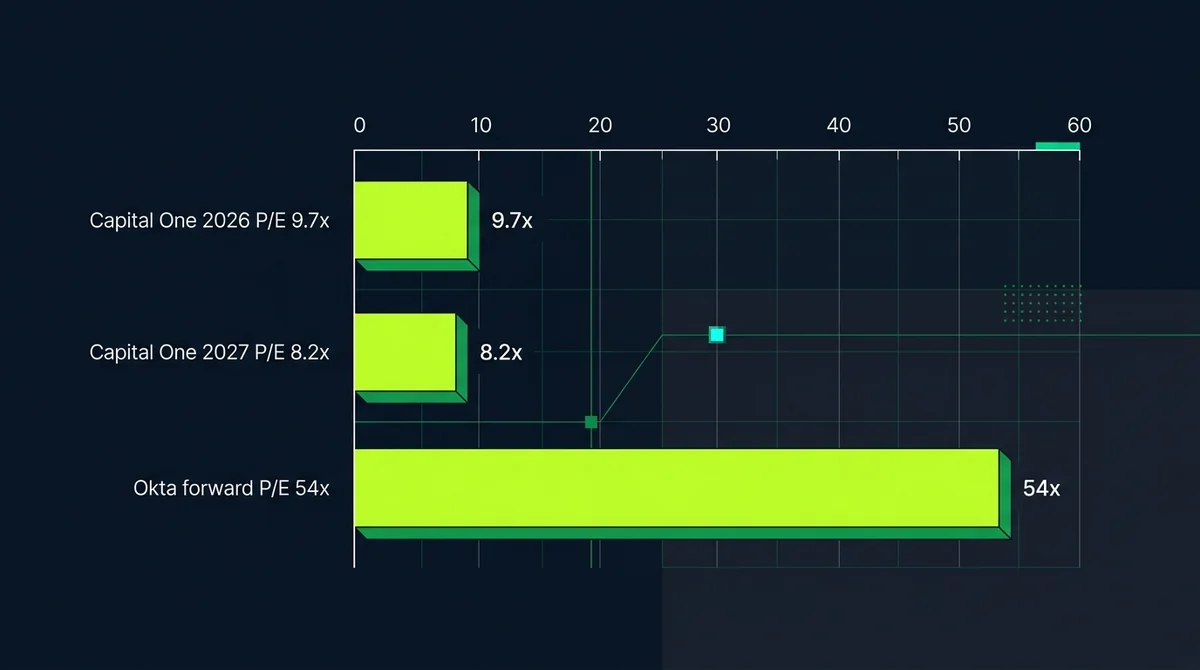
Capital One trades at 9.7x 2026 and 8.2x 2027 forward P/E, with a CET1 ratio of 13.7%, indicating a relatively low valuation and strong capital buffer. If the low valuation and merger synergies are both realized, they could form a "double play" of earnings upgrades and valuation repair. The revaluation depends on a race between synergy realization speed and macro credit quality; investors should track the U.S. consumer credit environment and credit card charge-off rates, avoiding looking only at cheap P/E while ignoring execution risk.
3. The Dispute over Okta's 54x Forward P/E: Scrutiny of the Quality of GAAP Margin Improvement
1. Valuation Divergence: What a 54x Forward P/E Means for Prudent Investors
Okta trades at a 54x forward P/E, meaning the market is paying an excessive premium for an unproven opportunity. Seeking Alpha's article title, "Don't pay 54x adjusted earnings for an unproven opportunity," directly highlights the risk. The high valuation embeds assumptions of sustained double-digit growth and operating leverage release; if these fail to materialize, valuation contraction will follow. Okta faces competition from large tech companies in identity management, the opportunity window is not unlimited, and currently verifiable evidence is insufficient to support this premium.
2. Earnings Quality Breakdown: Margin Improvement Driven by Lower Stock-Based Compensation Is Not Structural
Okta's GAAP margin improvement is primarily attributable to lower stock-based compensation, which is an accounting improvement rather than a structural increase in profitability. Lower stock-based compensation may come from changes in grant timing or workforce optimization, directly reducing expenses but not reflecting product or sales economies of scale. If the GAAP margin increase mainly comes from non-operating items, valuations based on adjusted earnings need to be re-examined, with attention to operating cash flow and revenue quality. Only when subscription revenue growth and net revenue retention consistently validate product competitiveness can the high valuation be supported.
Frequently Asked Questions (FAQ)
Q: What were the main drivers behind Micron's record revenue in fiscal Q4 2026? A: The main drivers were DRAM price increases and strong AI/data center demand.
Q: What synergy targets were set after the Capital One and Discover merger? A: Targets of $1.5 billion in cost synergies and $1.2 billion in network synergies were set.
Q: What are Capital One's current valuation and capital adequacy? A: The 2026 and 2027 forward P/E ratios are 9.7x and 8.2x, respectively, and the CET1 ratio is 13.7%.
Q: At what forward P/E does Okta trade, and what do analysts think? A: Okta trades at a 54x forward P/E, and analysts consider this valuation too high for prudent investors.
Q: What is the main source of Okta's GAAP margin improvement? A: It is mainly attributable to lower stock-based compensation, not a structural improvement in profitability.
Q: Has Micron's memory cycle disappeared? A: No, it has not disappeared. AI demand is weakening cycle volatility, but supply expansion could still cause price corrections; HBM supply and DRAM price changes should be tracked.
Q: When can Capital One's merger synergies be realized? A: Synergies are management expectations and require 12–24 months of integration to verify; quarterly expense ratios and network transaction volumes should be monitored.
Q: Is Okta's 54x forward P/E justified? A: It is too high for prudent investors, because the profit improvement is mainly from lower stock-based compensation; it should be validated by operating cash flow and revenue retention.
Risk warning: Macroeconomic and U.S. stock market volatility is severe; this content is for MSX RWA research and observation reference only and does not constitute investment advice.
Risk warning: Crypto/digital asset prices are highly volatile, and materials and rules may change at any time; this article does not constitute investment, legal, or tax advice, and decisions should be based on the latest official announcements and actual product pages.
Investing, AI, RWA, Finance