
MSX RWA Editorial Guest Columnist @MSXRWA October 2026 About 5,000 words, full read takes about 10 minutes
AI Summary
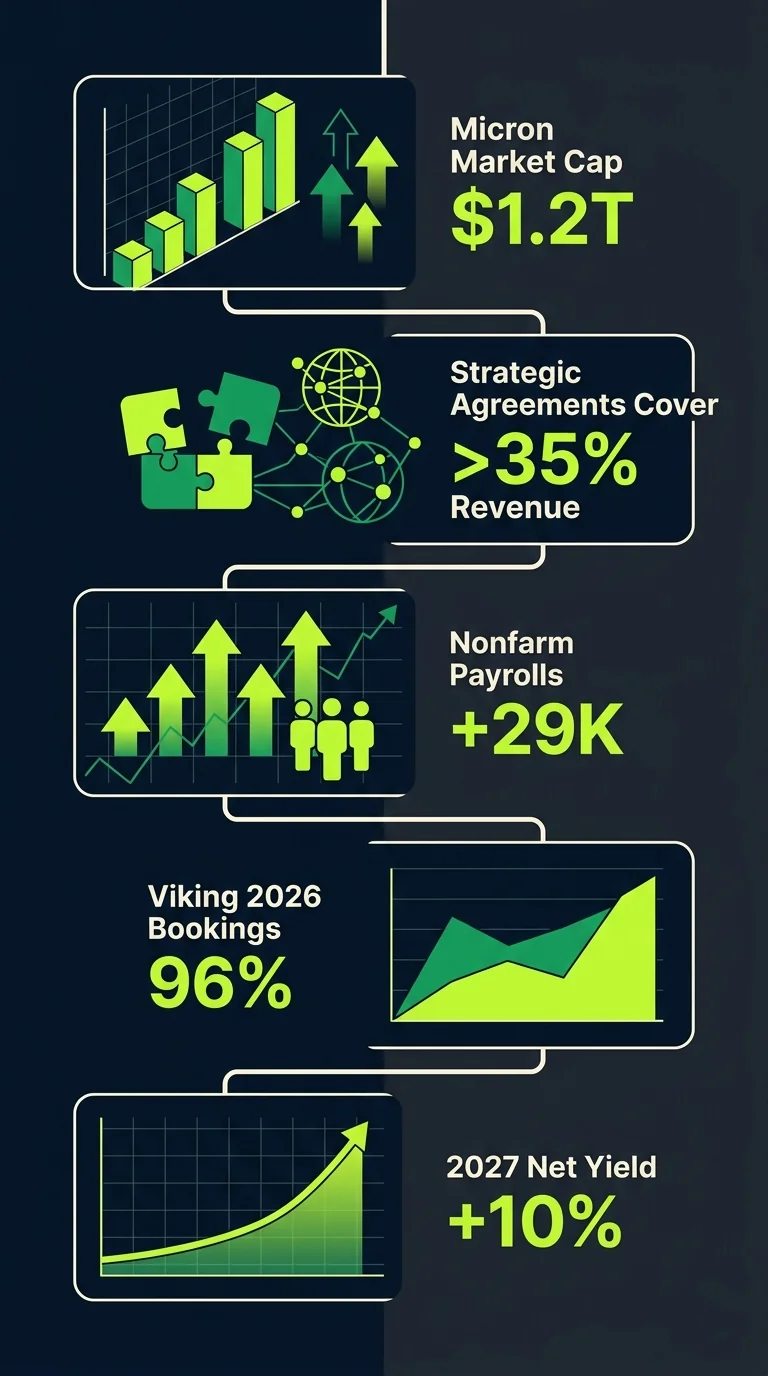
Core viewpoint: The three data points released on October 2, 2026 outline a clear divergence in the US stock ecosystem: Micron Technology with a trillion-dollar market cap and long-term agreements demonstrates strengthened pricing power for the memory giant; September nonfarm payrolls adding only 29,000 shows rapid cooling of the labor market; Viking Holdings with a 96% booking rate validates the resilience of high-end cruise demand. While overall growth slows, companies with structural pricing power gain higher valuation certainty.
Key elements:
- Micron Technology's market cap is about $1.2 trillion, with strategic customer agreements covering over 35% of revenue through 2030 and including price floors and ceilings.
- US September nonfarm payrolls increased by only 29,000, far below expectations; average hourly earnings rose 0.1% month-over-month and 3.0% year-over-year.
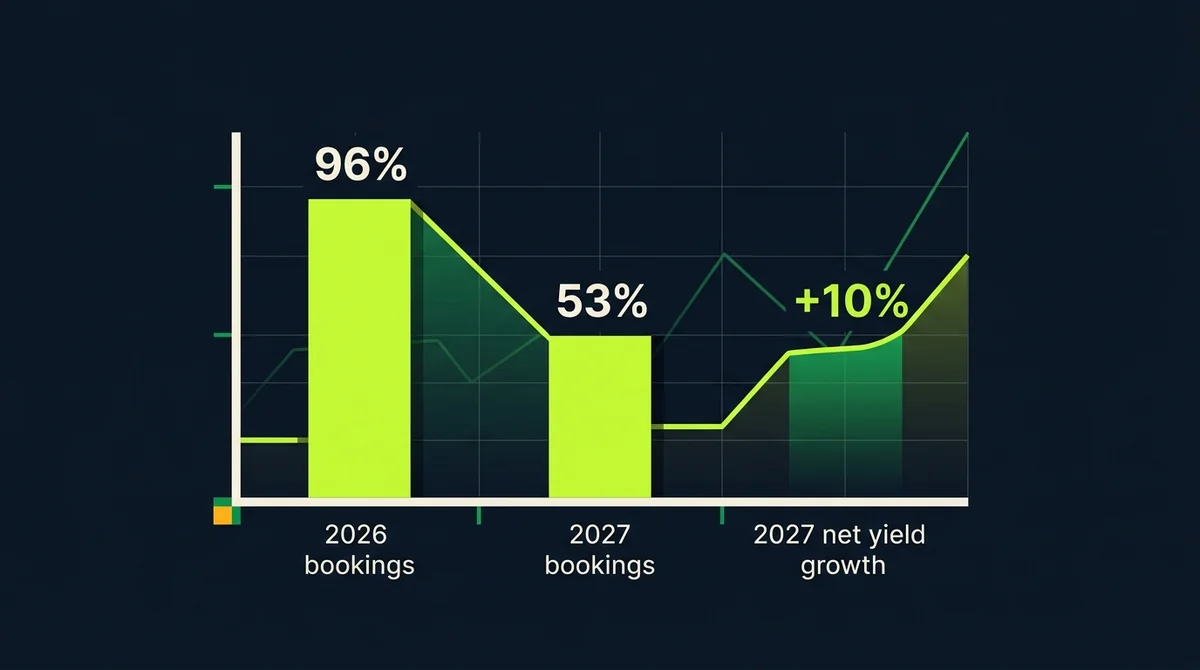
- Viking Holdings' 2026 season bookings reached 96% capacity, 2027 bookings reached 53%, and 2027 net yield is expected to grow 10% year-over-year.
- Analysts set Viking Holdings' fair value at $64.40 and long-term target price at $111.90.
Key Data Comparison (October 2, 2026)
| Metric | Data | Source/Notes |
|---|---|---|
| Micron Technology Market Cap | About $1.2 trillion | Seeking Alpha, 2026-10-02 |
| Micron Strategic Agreement Coverage | Over 35% of revenue through 2030 | Includes price floors and ceilings |
| US September Nonfarm Payrolls | Only +29,000 | Far below expectations |
| September Average Hourly Earnings MoM | +0.1% | Year-over-year +3.0% |
| Viking 2026 Season Booking Rate | 96% capacity | High-end cruise demand resilience |
| Viking 2027 Booking Rate | 53% | 2027 net yield expected +10% |
| Viking Analyst Fair Value/Target Price | $64.40/$111.90 | Market model judgment |
I. Micron Technology: $1.2 Trillion Market Cap and 35% Revenue Lock-up Reveal Earnings Certainty and Strengthened Pricing Power
1. Micron Technology Market Cap of About $1.2 Trillion: Joining the Trillion-Dollar Club, Valuation Divergence and Certainty Coexist
Micron Technology's current market cap is approximately $1.2 trillion. According to a Seeking Alpha report released on October 2, 2026, this size has placed Micron among the trillion-dollar market cap club in US stocks, alongside a few other tech giants. For the memory industry, this is not a normalized valuation level; historically, memory manufacturers' market caps have fluctuated dramatically with cycles. The current ~$1.2 trillion market cap includes both market pricing of sustained release of AI server and data center memory demand, and optimistic expectations for the next round of capital expenditure returns. But a trillion-dollar market cap is not without divergence: on one hand, some investors worry that once memory prices enter a downcycle, high capital expenditures will quickly turn into depreciation pressure; on the other hand, cash flow lock-up from long-term strategic agreements provides new support for valuation. This divergence does not mean risk is uncontrollable; rather, it shows that the market's pricing logic for Micron is shifting from merely judging cycle turning points to evaluating medium- to long-term earnings certainty and pricing power.
2. Strategic Customer Agreements Covering Over 35% of Revenue Through 2030: Price Floor and Ceiling Mechanisms Smooth Cycle Volatility
Micron Technology's strategic customer agreements have covered over 35% of revenue through 2030, and the agreements set price floors and ceilings. This arrangement is crucial for understanding Micron's current trillion-dollar market cap. More than one-third of revenue being locked in by long-term agreements means the company, even if memory prices fall in coming years, still has a protective cushion for a certain proportion of revenue and profit. Price floors reduce extreme downside risk, while price ceilings may sacrifice some upside elasticity but exchange for stable and predictable customer demand. From an industry perspective, memory companies willing to accept ceiling constraints typically also indicates strong customer demand for long-term supply assurance, which itself confirms Micron's product and technology position. This agreement structure marks the memory giant's migration from "pure cycle gaming" to a "quasi-long-term contract manufacturer" profit model, whose essence is exchanging some elasticity for certainty, thereby reducing the cyclical risk premium of equity capital.
II. September Nonfarm Payrolls Only +29,000: Labor Market Rapidly Cooling, Fed Rate Path Faces Key Uncertainty
1. US September Nonfarm Payrolls Increased by Only 29,000, Far Below Expectations: Job Growth Nearly Stagnant
US September nonfarm payrolls increased by only 29,000, far below market expectations. This reading can almost be regarded as stagnant job growth, in stark contrast to the resilience shown by earlier employment data. A single-month increase of less than 30,000 is an extremely low level in a normal labor market; even considering statistical fluctuations, it is enough to show that US employment expansion momentum is rapidly declining. For the Federal Reserve, which has always emphasized "data dependence," a sudden deterioration in employment goals is far more impactful than a slight rebound in inflation. Because inflation may still be disturbed by commodity and energy prices, while once employment stalls, it often means business and household confidence weaken simultaneously, further affecting consumption and credit expansion. Therefore, the September nonfarm data may force the Federal Open Market Committee to reassess the rate path; even if it does not cut rates immediately, it may release a clearer pause signal than before. This data comes from the report on October 2, and subsequent revisions are unknown, but the verified fact is that new nonfarm payrolls were 29,000.
2. Average Hourly Earnings Up 0.1% MoM and 3.0% YoY: Wage Pressure Easing Provides Room for Monetary Policy Shift
US September average hourly earnings rose 0.1% month-over-month and 3.0% year-over-year. The significant slowdown in month-over-month growth indicates that labor market supply-demand rebalancing is transmitting to wages. Wages are an important driver of core services inflation; if wage growth continues to cool, the Fed may gain confidence in inflation returning to target, thereby providing room to pause hikes or shift to rate cuts earlier. From verified data, the sharp drop in job numbers and the slowdown in wage growth occurring simultaneously send a combined signal that the labor market is weakening rapidly, not cooling in an orderly manner. This combination has a complex impact on stocks: in the short term, the market may boost risk appetite due to rising rate-cut expectations, but if employment deteriorates too quickly, it will raise concerns about corporate earnings and economic recession. As for the US stock market in early October 2026, after the nonfarm data release, market pricing almost immediately shifted toward easing, but whether a sustained rebound can form still depends on subsequent data and Fed officials' statements.
III. Viking Holdings: 96% Booking Rate for 2026 Season and 2027 Net Yield Growth Highlight High-End Cruise Demand Resilience
1. 2026 Season Bookings Reached 96% Capacity: High-End Cruise Demand Shows Strong Stickiness Amid Macro Headwinds
Viking Holdings' 2026 season bookings have reached 96% capacity. A Seeking Alpha report on October 2, 2026 shows that against the backdrop of the Fed maintaining high interest rates and consumer spending pressure, a near-full booking level indicates that high-end cruise demand has not weakened in step with macro data. This phenomenon contrasts with general discretionary consumption: when employment and wages show signs of slowing, mass consumption often contracts first, while high-end customers have smaller fluctuations in disposable income, and their consumption decisions are more driven by experience expectations than short-term income. Therefore, the 96% booking rate not only reflects the company's sales execution but also validates the counter-cyclical attribute of the high-end tourism segment. For capital markets, a high booking rate means strong revenue predictability for the coming period, which supports valuation stability.
2. 2027 Bookings at 53% and Net Yield Expected to Grow 10% YoY: Forward Growth Visibility and Pricing Power Combined
Viking Holdings' 2027 bookings have reached 53%, and the company expects 2027 net yield to grow 10% year-over-year. Locking in more than half of capacity more than a year in advance, while giving clear yield growth guidance, indicates that the company not only sees continued demand recovery but also has the ability to further improve product pricing. Net yield growth means per-passenger revenue is rising, typically from higher cabin mix, increased ancillary revenue, or price increases. Achieving yield growth on top of a high booking rate indicates that Viking Holdings is not filling cabins through low-price promotions but supporting growth with product strength and service premium. This "volume and price both rising" forward visibility is especially precious when macro uncertainty is rising.
3. Analyst Fair Value $64.40, Long-Term Target Price $111.90: Current Valuation Provides Margin of Safety and Upside Potential
Analysts set Viking Holdings' fair value at $64.40 and long-term target price at $111.90. These two prices are not actual company performance but valuation judgments by market participants based on models. If the current stock price is below the fair value of $64.40, it means the stock price may offer a margin of safety relative to fundamentals; while the gap between the long-term target price of $111.90 and fair value corresponds to potential return from earnings growth in 2027 and beyond. Of course, analyst target prices will adjust with market sentiment and macro variables and cannot be regarded as guarantees. Based on existing facts, the 96% 2026 season booking rate, 53% 2027 bookings, and 10% net yield growth expectation together constitute verifiable evidence of high-end cruise demand resilience and pricing power, while the analyst target price further reflects positive market expectations for long-term returns.
In Conclusion
From Micron Technology's strengthened pricing power and the sharp slowdown in US September nonfarm payrolls to Viking Holdings' high booking rate, the US stock ecosystem in early October 2026 presents a clear "macro slowdown, micro divergence" feature. At the macro level, nearly stagnant labor market growth is weakening the traditional transmission chain of "strong economy - profit expansion - stock market rise"; but at the micro level, companies with long-term agreement lock-ups, high-end customer stickiness, or forward volume-price visibility are gaining higher valuation certainty. This divergence is not a short-term style rotation, but the market reassessing which earnings can be sustained in a low-growth environment.
In contrast, the employment cooling revealed by September nonfarm payrolls adding only 29,000 reminds the market that bets on "easing trades" are not without cost. If the labor market continues to weaken, consumption and corporate earnings expectations may be revised further downward, and asset prices' risk premium will be repriced. Therefore, the core contradiction for US stocks in the next stage may not be "whether to hike or not," but "whether the speed of growth slowdown can be offset by structural earnings resilience." This means the anchor of market pricing is shifting from aggregate growth to industrial chain pricing power and the certainty of long-term cash flows, which is precisely the macro signal pointed to by the three sets of data in this article.
Risk Warning: Macroeconomic and US stock market volatility is intense. This content is for MSX RWA research observation reference only and does not constitute investment advice.
Risk Warning: Crypto/digital asset prices are highly volatile, and materials and rules may change at any time. This article does not constitute investment, legal, or tax advice. Before making decisions, please refer to the latest official announcements and actual product pages.
Investment, AI, RWA, Finance