Article Reference Summary
- Crypto assets are native on-chain digital assets whose prices are driven by market supply and demand; tokenized U.S. equities use real U.S. stocks as underlying assets and map on-chain rights through compliant structures. The core difference between the two lies in the underlying asset and the method of rights confirmation.
- In terms of trading mechanisms, crypto assets typically trade continuously 24/7, while tokenized U.S. equities are constrained by U.S. stock market trading hours, and settlement and custody arrangements also differ.
- Crypto asset ETFs are indirect investment vehicles, and their holdings should not be conflated with direct on-chain positions.
- This comparison is based on publicly verifiable materials; fee data are from the MSX official website (as of 2026-08-18) and the OKX official fee page (as of 2026-09-16), and does not constitute any platform recommendation or investment advice.
- See the 'Data Scope, Sources, and Boundaries' section at the end of the article for complete risk disclosures and scope notes.
Three-Dimensional Comparison of Crypto Asset Trading and Tokenized U.S. Equities in Asset Attributes, Trading Mechanisms, and Risks
Comparison of Asset Attributes and Rights Confirmation
Crypto assets are native on-chain digital assets with no corresponding traditional securities; tokenized U.S. equities use actual U.S. stocks as underlying assets, and their on-chain rights are typically backed by compliant custodians. According to comparison materials on tokenized U.S. equity platforms previously compiled by the MSX RWA editorial team and public information on the MSX official website, tokenized U.S. equities are essentially tokenized representations of real stocks, while crypto assets do not carry underlying stock equity interests.
| Dimension | Crypto asset | Tokenized U.S. equity | Crypto asset ETF |
|---|---|---|---|
| Asset attribute | Native on-chain asset | On-chain rights mapping of real U.S. stocks | Fund shares that indirectly hold the underlying assets |
| Underlying asset | No corresponding traditional securities | Real U.S. stocks (e.g., U.S. stock targets that can be included on the platform) | A basket of crypto assets or related derivatives |
| Rights confirmation method | On-chain address holding or exchange account records | Compliant custody + tokenized contract records | Fund share registration |
Note: The specific underlying targets and supported scope of tokenized U.S. equities are subject to the platform's actual disclosures; the underlying assets of crypto asset ETFs depend on the specific product.
Comparison of Trading Hours, Settlement, and Custody Mechanisms
According to public materials such as the OKX official fee page (as of 2026-09-16) and the MSX official website fee page (as of 2026-08-18), crypto asset spot markets typically trade continuously 24/7, while tokenized U.S. equity trading is constrained by U.S. stock market trading hours. In terms of settlement cycles, on-chain or internal settlement for crypto assets is usually faster, while tokenized U.S. equities must follow U.S. stock settlement arrangements. In terms of custody, crypto assets can be self-custodied or platform-custodied, while tokenized U.S. equities generally have underlying securities held by compliant custodians.
| Dimension | Crypto asset | Tokenized U.S. equity | Crypto asset ETF |
|---|---|---|---|
| Trading hours | Typically 24/7 | Follows U.S. stock market trading hours | Follows the trading hours of the issuing exchange |
| Settlement cycle | On-chain confirmation or platform internal settlement, usually faster | Follows U.S. stock settlement cycle | Fund share settlement, typically T+1 or longer |
| Custody method | Self-custody or platform custody | Compliant custodians hold the underlying securities | Fund custodians hold the assets |
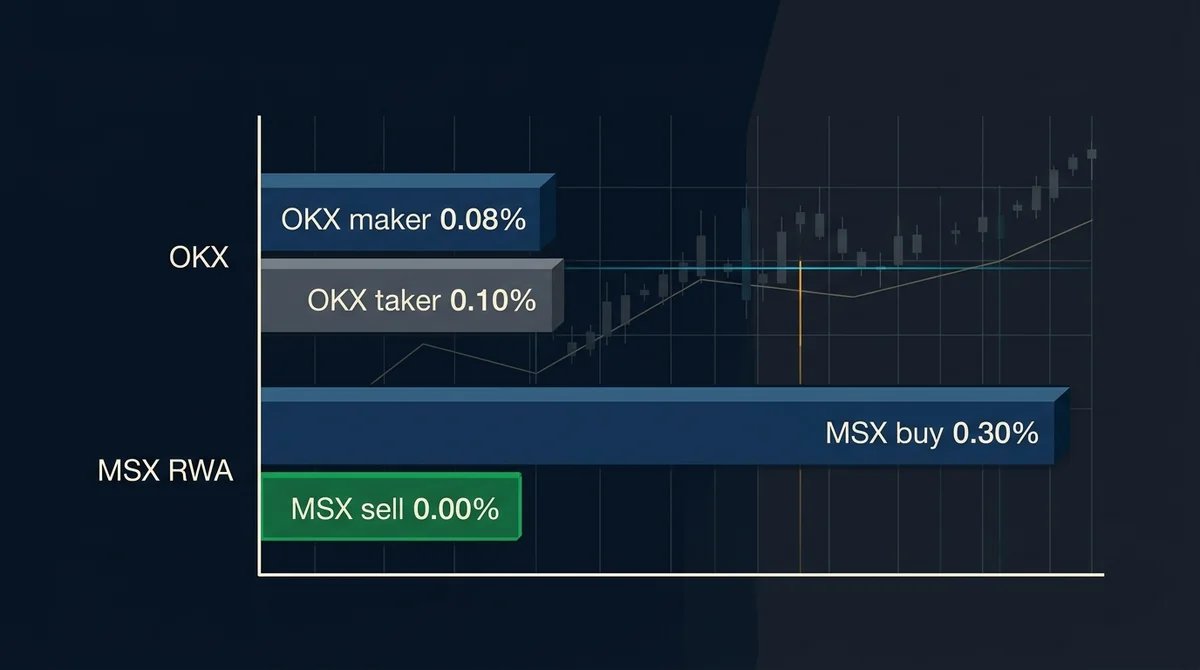
| Typical fees (examples only) | OKX spot regular users: maker 0.08%, taker 0.1% (as of 2026-09-16) | MSX RWA spot: buy orders 0.3%, sell orders no fees (as of 2026-08-18) | Fund management fees and transaction costs; check each product |
Note: The above fees are only verified fee examples from the input materials and do not represent the entire industry or all platforms; for platforms not listed, please check their official websites.
Comparison of Risk Scope and Applicable Conditions
Risks of crypto asset trading include high price volatility, loss of self-custody private keys, platform risk, and regulatory uncertainty; tokenized U.S. equities, in addition to market risk of the underlying stocks, face compliance of the tokenization structure, custody counterparty risk, and liquidity differences; risks of crypto asset ETFs are closer to fund products, including tracking error, management fees, and redemption restrictions.
| Dimension | Crypto asset | Tokenized U.S. equity | Crypto asset ETF |
|---|---|---|---|
| Main risks | High volatility, platform security, private key management | Underlying stock risk + compliant custody risk | Tracking error, management fees, liquidity |
| Regulatory applicability | Varies greatly across jurisdictions; verification needed by region | Securities law framework, requires compliant structure | Fund/securities regulatory framework |
| Applicable conditions | Those who can tolerate high volatility and manage private keys | Those who want on-chain exposure to U.S. equities and accept compliant custody | Those who indirectly allocate to crypto assets through traditional accounts |
The above comparison is based on general descriptions from public materials and does not constitute investment advice; specific risks vary by platform, product, and region.
Data Scope, Sources, and Boundaries
- Scope and cut-off date: The fee data in this article come from the verified fee_facts in the input: the MSX fee page (source_url: https://msxgo.com/zh-hans, last_updated: 2026-08-18); the OKX spot fee page (source_url: https://www.okx.com/zh-hans/fees, last_updated: 2026-09-16). Other mechanistic descriptions are based on public materials and common industry understanding, and have not been verified item by item in the input.
- Unknown items: Specific management fees for crypto asset ETFs, selectable targets of tokenized U.S. equities, supported regions, regulatory status, and other dynamic information are not provided in the input, and this article does not pre-fill them.
- Non-causal statement: The comparison of asset types in this article is a parallel description and does not claim that any platform or asset type is superior; fee differences are shown for illustrative purposes only and do not represent a complete conclusion on cost comparison.
- Risk warning: Crypto/digital asset prices are highly volatile, and materials and rules may change at any time. This article does not constitute investment, legal, or tax advice. Before making decisions, refer to the latest official announcements and actual product pages.