
Core summary: From September 17 to 19, 2026, Bitcoin broke above $81,000 amid Fed rate hikes, surging Treasury yields, and quantum risk narratives. Spot ETF net outflows show that funding flows were not the only driver.
For MSX on-chain stock investors, it is more important to verify whether these macro variables have transmitted to tokenized stock holdings and related risk premiums. This article is based only on public data and does not constitute investment advice.
I. Three triggers behind Bitcoin's rise
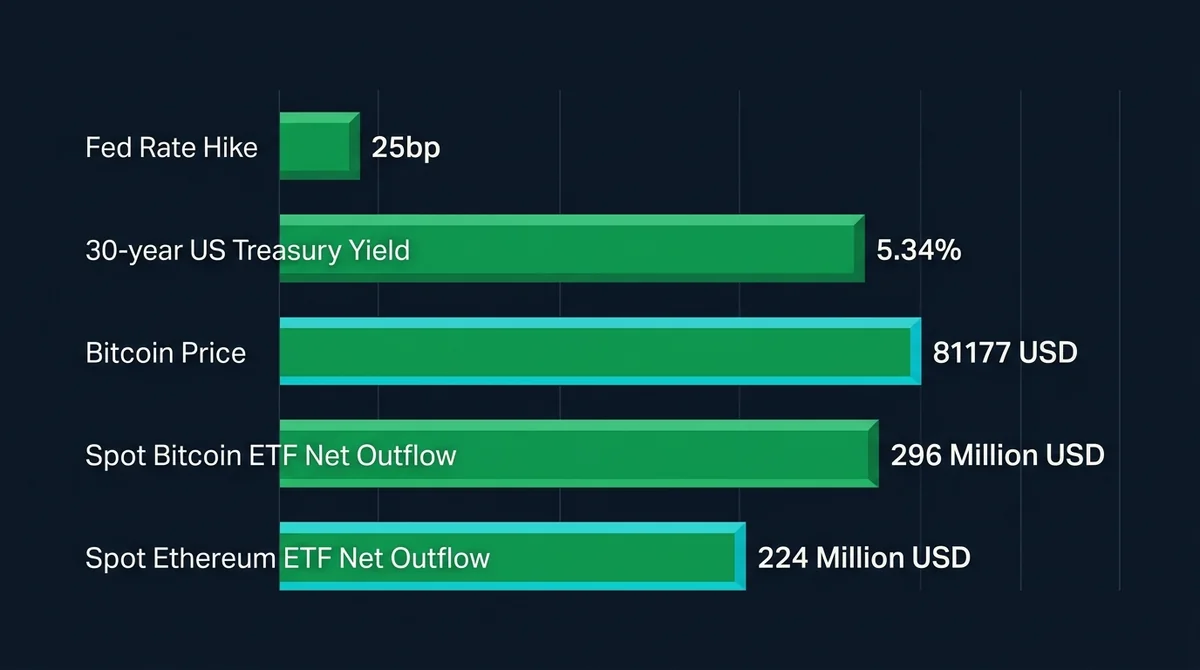
From September 17 to 19, 2026, Bitcoin rose to about $81,177. The direct triggers were the Fed's 25 basis point rate hike to 3.75%–4.00%, the 30-year Treasury yield rising to 5.34%, and a long-term narrative shift.
During the same period, spot Bitcoin ETFs saw net outflows of $296 million and Ethereum ETFs saw net outflows of $224 million. Net outflows coexisting with price gains show that a single funding-flow indicator cannot explain short-term price action.
| Date | Event | Source |
|---|---|---|
| 2026-09-17 | Fed hikes 25bp to 3.75%–4.00%; spot Bitcoin ETF net outflow $296 million | TokenPost |
| 2026-09-18 | Bitcoin rises 6%, touches $81,034; 30-year Treasury yield rises to 5.34% | Cointelegraph |
| 2026-09-19 | O'Leary says Bitcoin could reach $1 million (condition: quantum risk resolved); Bitcoin around $81,177 | BeInCrypto |
II. How MSX on-chain stock investors can verify macro transmission
Fed rate hikes usually pressure high-valuation U.S. stocks, but their impact on Bitcoin and tokenized U.S. stocks does not necessarily move in the same direction. If Bitcoin's rise comes from hedging or substitution demand, the impact on tokenized U.S. equity assets may be opposite; if it comes from a broad rise in risk appetite, they would move together.
Therefore, investors need to verify the daily changes, trading volume, and bid-ask spread of tokenized U.S. stock instruments on the MSX platform, and compare them with the S&P 500 or Nasdaq performance during the same period. This article has not obtained real-time quotes from the MSX platform, so only verification steps are provided below.
Verification steps
- Confirm the MSX platform page and data definitions: Open the relevant MSX on-chain U.S. stock instrument page, record the quote timestamp, trading pair, and settlement unit, and confirm whether it is real-time, delayed, or closing price.
- Record daily changes and trading volume for September 17–19, 2026: Record price changes for at least three trading days day by day, avoiding a single-day focus.
- Compare with U.S. stock indexes: On the same days, check S&P 500 or Nasdaq index performance to determine whether tokenized individual stocks are moving in the same direction as the broader market.
- Check bid-ask spread and depth: On the MSX page, review the best bid and ask spread and order book depth; if the rate hike triggers risk aversion, spreads may widen.
- Cross-check relevant news and macro data: Cross-validate Fed decisions, Treasury yields, and ETF flows against holding performance to avoid single-factor attribution.
- Note data gaps: If platform data cannot be obtained, explicitly state that "macro transmission requires further observation" and do not imply certainty.
If most tokenized U.S. stock instruments are observed falling, with shrinking volume and widening spreads, while the S&P 500 also weakens, this indicates that rate hikes and rising yields are transmitting through the risk appetite channel. Conversely, if individual instruments strengthen against the trend, one should return to individual stock fundamentals for reasons.
III. Implications of O'Leary's quantum risk thesis for tokenized assets
On September 19, 2026, Kevin O'Leary said Bitcoin could reach $1 million, but only if concerns about quantum computing breaking cryptographic algorithms are resolved. That target would require a roughly 1,132% gain from the then price of $81,177, making it long-term and conditional.
Quantum computing's impact on underlying blockchain security is a systemic risk. If concerns arise about underlying chain security, tokenized U.S. stocks would also be affected; however, spot stocks themselves do not rely on cryptographic algorithms, so settlement-layer and asset-layer risks should be distinguished.
Therefore, MSX on-chain stock investors do not need to adjust positions in the short term because of this remark, but should monitor whether the underlying chain introduces quantum-resistant algorithms. The more realistic short-term risk comes from the Fed's rate hike path and Treasury yield volatility, not