Article Summary
- This article is for educational purposes only and does not constitute investment advice; all platform information, fees, and supported regions must be verified on each platform's official page. This article does not prefill unverified figures.
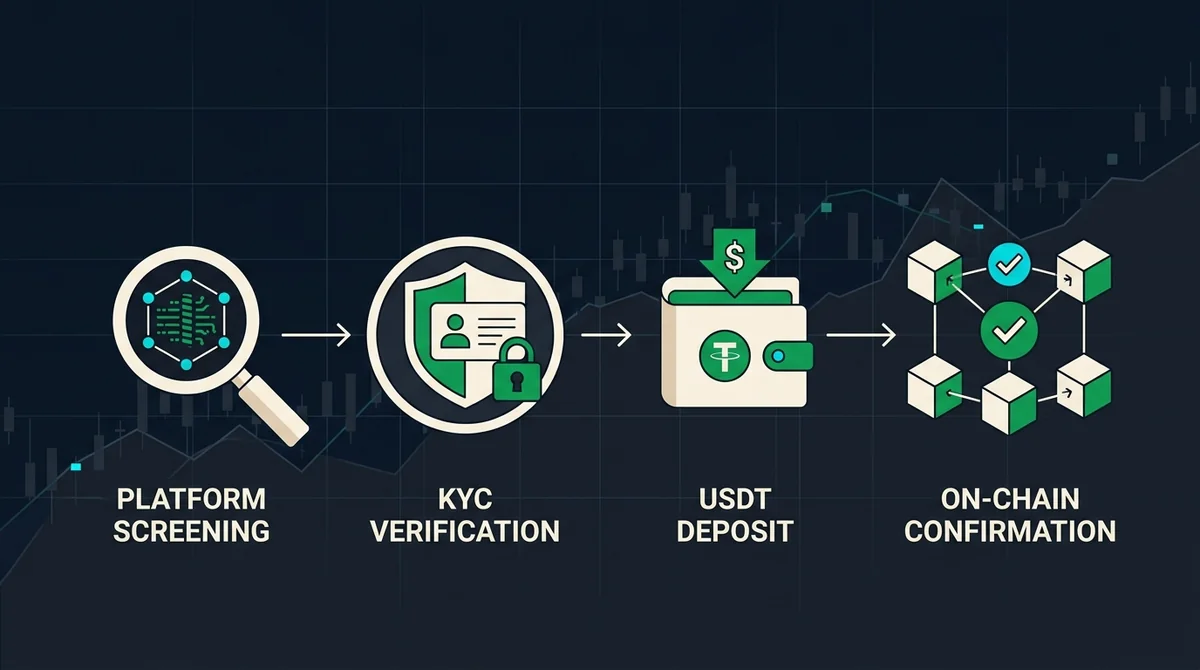
- The core order for opening a tokenized U.S. stock account in 2026 is: first filter target platforms, confirm their KYC and USDT deposit channels, complete identity verification, then initiate a first small deposit, and cross-check using a blockchain explorer and the platform's balance page.
- Platform screening covers at least two conditions: whether it supports compliant account opening in your region, and whether the platform's KYC materials can be uploaded online and reviewed.
- For USDT deposit to tokenized U.S. stock account verification, keep the transaction hash (TxID), verify the receiving address and number of confirmations in a blockchain explorer, then return to the platform to confirm the balance.
- Risk warning: platform status, KYC requirements, and deposit channels may change at any time; existing public information does not confirm uniform standards across different platforms, so each item must be verified individually.
Platform Screening, KYC, and First USDT Deposit Verification Process
How to screen tokenized U.S. stock platforms before opening an account?
When screening platforms, it is recommended to cover at least two limiting conditions: first, whether the platform supports compliant account opening in your target market; second, whether the platform's KYC documents can be uploaded online and reviewed. Do not register solely based on promotions claiming "supports MSX on-chain U.S. stocks"; search for "MSX" or the corresponding token code on official product pages or announcements, and verify the contract address and asset name. If a platform does not clearly disclose supported regions or regulatory status, treat it as not included and continue only after verifying on official pages.
You can click on our compiled "2026 Tokenized U.S. Stock Platform Rankings: USDT Purchase Support, Compliance, and Fee Comparison" to get a reference for platform screening dimensions.
Because official data from various platforms changes frequently, this article does not list specific platform rankings, but instead provides a verification dimension table that you can check one by one before registering:
| Verification dimension | Question to confirm | Official source |
|---|---|---|
| Whether it offers MSX on-chain U.S. stocks | Does the platform's product page list MSX token stocks or corresponding trading pairs? | Platform product page/announcement |
| KYC level and materials | Does the basic account require a passport? Are utility bills accepted as address proof? | Platform KYC help center |
| Supported USDT networks | Are TRC-20/ERC-20 or other networks available? | Platform deposit page |
| Fee disclosure | Are deposit, trading, and withdrawal fees clearly stated? | Platform fee page |
| Supported regions and regulatory status | Is the registration location within the allowed region list? | Platform user agreement/region restriction page |
All cells must be based on the platform's current page and no values are prefilled.
What KYC materials need to be submitted?
Common KYC sub-steps are:
- Register an account
- Select account type
- Submit ID document and address proof
- Complete face or additional verification
- Wait for review result
ID documents typically include a passport, driver's license, or national ID card; address proof is usually a utility bill or bank statement from the last three months. However, different platforms have different requirements for document format, upload format, and review time, so the only reliable approach is to check the platform help center or official guide page one by one. For example, some platforms may have lower KYC levels for stablecoin deposit accounts than for fiat accounts, but this cannot be generalized and should be based on the platform's current rules.
How to verify receipt after the first USDT deposit?
It is recommended to follow this verification path:
- Obtain the USDT deposit address and network from the platform
- Initiate a small transfer from your wallet
- Verify the number of transaction confirmations in a blockchain explorer
- After the platform balance is credited, keep a screenshot or order number
The entire process only requires two verifications: one for the KYC review result and one for the USDT deposit receipt. Do not mistakenly think the deposit has not arrived when the on-chain confirmation count is insufficient, and do not stop only because the wallet shows success; you must return to the platform balance page for cross-confirmation. If the platform does not show the deposit for a long time, first check the deposit address, network, and TxID, then contact official customer service, and do not repeat the transfer.
Data Scope, Sources, and Boundaries
- Cutoff date: This article is written as of 2026; all platform status, fees, and requirements are subject to each platform's official pages; fee-related facts such as the MSX fee page are as of 2026-08-18, source: https://msxgo.com/zh-hans.
- Unknown items: This article does not include any platform's current specific KYC document list, USDT supported networks, fee figures, or supported regions, because these data need real-time verification and are not in the input fact base.
- Non-causal statement: The steps and paths in this article are for operational education and do not constitute a recommendation or endorsement of any platform, nor do they imply superiority or inferiority among platforms.
- Risk warning: Crypto/digital asset prices are highly volatile, and materials and rules may change at any time. This article does not constitute investment, legal, or tax advice; before making decisions, always refer to the latest official announcements and actual product pages.
Risk warning: Crypto/digital asset prices are highly volatile, and materials and rules may change at any time. This article does not constitute investment, legal, or tax advice; before making decisions, always refer to the latest official announcements and actual product pages.