
First-hand Path to Verify Tokenized US Stock Codes, Query Entry, and Underlying Asset Holdings
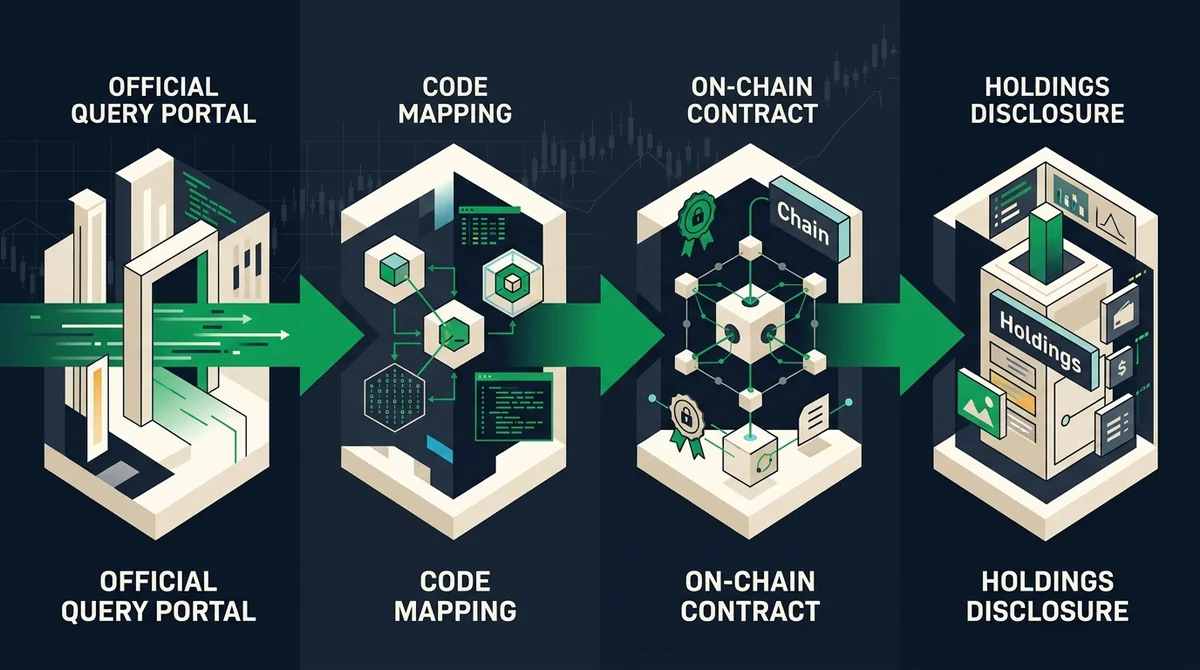
How to Locate the Official Query Entry for MSX Tokenized US Stocks
Enter the MSX official query page or project documentation, and confirm that the entry is a primary source from the issuer rather than a third-party aggregation page. According to the MSX official database snapshot (2026-08-04), the MSX website provides platform explanations, but the specific query page may be located under the 'Products' or 'Help' section. During verification, click through level by level and record the navigation path; if the entry becomes inaccessible, do not continue to cite the old link, but relocate via public information in official announcements, community forums, or customer service emails. When comparing different tokenized US stock platforms, you can read the on-site 'Ranking and Compliance Comparison of Tokenized US Stock Platforms'.
How to Check Code Format and Track Underlying Asset Holdings
First obtain the official code mapping documentation. According to the MSX official database snapshot (2026-08-04), some contract symbols are identical to US stock codes, such as INTC, IONQ, IREN; others have a USDT suffix, such as GIGGLEUSDT, LIGHTUSDT, 0GUSDT. This site's independent judgment: This suggests that MSX may allow some products to use a naming convention of 'underlying code + USDT pricing unit', but this judgment is only an external observation based on symbol naming and cannot replace the issuer's formal code mapping rules. If there is no official documentation, the symbol should be marked as 'official code mapping rules not disclosed' and do not directly claim that it is the underlying US stock token.
The table below lists some contract symbol examples observed in the MSX official database snapshot (2026-08-04), only to illustrate code naming differences; it does not represent a complete product list and cannot serve as the basis for code mapping:
| Observed Contract Symbol | Same as US Stock Code? | Suffix | Verification Status/Notes |
|---|---|---|---|
| FLY | Yes | None | Requires confirmation of official mapping rule |
| GEV | Yes | None | Same as above |
| KBR | Yes | None | Same as above |
| KLAC | Yes | None | Same as above |
| INTC | Yes | None | Same as above |
| IONQ | Yes | None | Same as above |
| IREN | Yes | None | Same as above |
| GIGGLEUSDT | No (with suffix) | USDT | Suffix may indicate pricing unit, needs official confirmation |
| LIGHTUSDT | No (with suffix) | USDT | Same as above |
| 0GUSDT | No (with suffix) | USDT | Same as above |
Verification steps are as follows:
- Confirm that the query entry is a primary source from the issuer. Enter the MSX official query page or project documentation, and check the page domain, project identifier, and latest update date. Do not treat screenshots from third-party aggregation pages as the final basis.
- Obtain the official code mapping documentation. If the code is consistent with the US stock code, find a rule such as 'contract symbol = underlying stock code' or similar; if it has a USDT suffix, confirm whether the suffix only indicates the pricing unit and does not change the underlying asset. If no existing documentation is available, record it as 'official code mapping rules not disclosed'.
- Look up the corresponding token contract address on a chain explorer. Record the contract address, creator, token standard, and verifiable information. On-chain records can only prove the existence of the contract and cannot alone prove the actual existence of underlying holdings.
- Open the underlying asset holdings disclosure page. Compare the disclosed stock name, quantity, or shares with the on-chain contract information item by item. If the two fields are inconsistent, prioritize the latest disclosure and keep the old version record.
- Record the specific time of each query, page version, and source label. Mark missing or conflicting information as 'unverified'; for key claims use the pattern 'according to X report', for example 'according to the disclosure document, the holding quantity is...', avoiding unsourced causal statements.
Data Scope, Sources, and Boundaries
This article only discusses the verification method for MSX RWA independent reporting and does not represent MSX officially. The contract symbols, price precision, and trading volume precision involved come from the MSX official database snapshot (2026-08-04), only used to illustrate code naming examples and do not constitute a current product list. Official code mapping rules, fees, query entry, and holdings disclosure may be updated at any time; this article does not disclose specific fees, yields, or holding figures. For real-time information, open the MSX official page and check the version for the current day. Differences between on-chain information and disclosure documents cannot be attributed on their own; they can only be recorded as items pending verification. The public access path for this database snapshot must be obtained from the MSX official website, and this article does not directly provide links to avoid invalidation; readers can find the corresponding data page through official website navigation.
Risk Warning: Crypto/digital asset prices are highly volatile, materials and rules may change at any time, this article does not constitute investment, legal, or tax advice, and decisions should be based on the latest official announcements and actual product pages.
Frequently Asked Questions (FAQ)
Q: Where can I query MSX tokenized US stock codes? A: First enter the MSX official query page or project documentation, and confirm that the entry is a primary source from the issuer; do not use third-party aggregation pages as the final basis. If the entry becomes invalid, you can relocate via public information in official community forums or customer service emails, and record the access time.
Q: Are MSX tokenized US stock code formats exactly the same as US stock codes? A: You cannot judge solely by the code name. According to the MSX official database snapshot (2026-08-04), some codes are identical to US stock codes (e.g., INTC), and other codes have a USDT suffix (e.g., GIGGLEUSDT). Identifier format should be based on the official code mapping documentation; when there is no documentation, it should be marked as 'unverified'.
Q: How to verify whether underlying asset holdings truly correspond? A: Find the on-chain contract address and the underlying asset holdings disclosure file, and compare the stock name, quantity, or shares in both item by item. The on-chain contract can only prove the existence of the contract and cannot alone prove the holdings; only when the information from both sides is consistent is there a higher level of credibility. In case of conflict, the latest disclosure prevails and records are kept.
Q: How to cross-verify when the query entry is invalid or data is missing? A: Record the time of invalidation and page version, and relocate the entry using public information from official announcements, community forums, or customer service emails. When data is missing, do not fill in with model memory or market speculation; only write 'official not disclosed' and list the required verification materials.
Q: Do the steps in this tutorial apply to all MSX tokenized US stocks? A: The step framework applies to most tokenized US stocks, but specific entry points, code mappings, and disclosure files may vary by product. Some products may have additional instructions or regional restrictions, so you should read the corresponding product page and risk warnings before verification.
Q: What is the relationship between MSX tokenized US stocks and MSX RWA media? A: MSX is a tokenized US stock platform, and MSX RWA is an independent third-party media that does not provide login, account opening, customer service, download, or fund services. This article only provides information verification and risk warnings; it is not an official MSX document and does not constitute investment advice.
Q: Does an MSX tokenized US stock code with a USDT suffix equal a US stock code? A: Not necessarily. According to the MSX official database snapshot (2026-08-04), some contract symbols have a USDT suffix (e.g., GIGGLEUSDT), which may indicate the pricing unit, but it should be based on the official code mapping documentation; when there is no documentation, it should be marked as unverified.
Q: How to determine whether an MSX tokenized US stock code truly corresponds to the underlying stock? A: You need to verify both the on-chain contract address and the underlying asset holdings disclosure file, and compare the stock name, quantity, or shares item by item. The on-chain contract can only prove the existence of the contract and cannot alone prove the holdings; only when the two are consistent is there a higher level of credibility.
Q: What are the verification points for MSX tokenized US stock holdings disclosure files? A: Check whether the stock name, quantity, or shares in the disclosure file are consistent with the on-chain contract information; in case of conflict, the latest disclosure prevails and old version records are kept; missing information is marked as 'unverified'.