Core summary: As of October 6, 2026, Michael Burry says the US stock market is in a "denial phase" that could last 6 to 9 months; Arbitrum has joined the Global Dollar Network and listed USDG, and OKX Money has launched a stablecoin spending loop. These two signals suggest checking concentration in tech/AI-related tokenized US stocks and using stablecoins to manage the cash allocation, rather than equating stablecoin expansion directly with buying US stock tokens. Data in this article comes from public reports and does not constitute investment advice.
The Stock Market's "Denial Phase" and Divergence in Market Breadth
How can Nasdaq highs and S&P declines coexist?
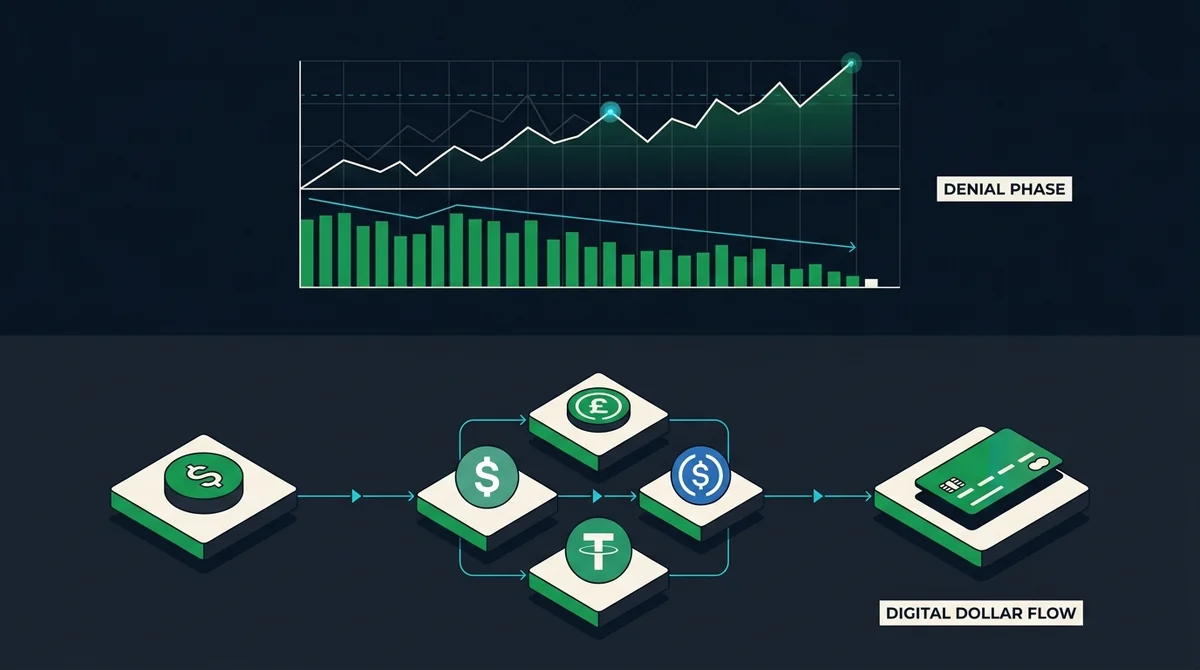
According to BeInCrypto on October 6, the Nasdaq Composite rose 1.05% to 27,477 points on October 5, after touching an intraday all-time high the previous trading day; in September, 75% of S&P 500 constituents fell. This combination of "index highs but most stocks falling" reflects deteriorating market breadth, not a broad rally.
For users of tokenized US stocks, this shows that looking only at the headline index may overstate the safety margin of your holdings. If you hold tokenized assets corresponding to a small number of high-valuation tech stocks, their volatility may be far greater than the index itself.
Sources and limitations of Burry's 6–9 month judgment
Michael Burry posted on X on October 6 that the stock market is clearly in the first stage of the five stages of grief, "denial," and based on the experience of 2000 and 2008, this phase will last 6 to 9 months (source: BeInCrypto). Descriptions of sentiment phases are not precise timing, and the "6–9 months" should not be taken as a deterministic forecast or trading signal.
Our independent judgment: Divergence in market breadth is common during periods of high-level disagreement, but it does not by itself provide specific buy or sell points. Users referencing such views should treat them as risk warnings rather than as reasons to directly liquidate or add positions.
From shorts to put options: Risk management ideas revealed by Burry's repositioning
Why are put options better than naked shorts?
According to BeInCrypto, in late September Michael Burry replaced his short positions with put options on Micron, Nvidia, and Palantir, and said that new research had brought forward his timeline for the AI bubble bursting. Put options express downside expectations with limited cost while avoiding the unlimited risk of naked shorts, so they are more suitable for expressing directional views rather than unlimited exposure.
However, individual investors should not directly copy the repositioning of any well-known investor. Option strike prices, expiration dates, and liquidity can all significantly affect results, and public disclosures are often lagging.
How AI stock risks affect tokenized US stock holdings
If you hold Nvidia, Palantir, or similar AI/tech-related tokenized assets in MSX on-chain US stocks, you should check concentration. High-valuation assets often pull back faster when sentiment fades, and liquidity may deteriorate.
It is recommended to first confirm the trading hours, premium, and liquidity of these tokenized assets before deciding whether to reduce positions or use hedging tools. Do not make large-scale moves based on a single piece of news.
Arbitrum joins USDG: How the stablecoin alliance changes digital dollar supply
The revenue distribution mechanism of the Global Dollar Network
According to CoinDesk on October 5, Arbitrum joined the Paxos-led stablecoin alliance Global Dollar Network, and USDG launched on Arbitrum with integrations into protocols such as Fluid, Morpho, GMX, and Maple. The network has over 150 partners, including Robinhood, Kraken, Mastercard, and OKX; revenue generated from USDG reserves is distributed among partners that drive adoption.
USDG may provide a new source of interest-bearing stablecoin yield, but counterparty, audit, and compliance risks must be verified. Revenue distributed to partners does not automatically mean that ordinary users receive the same proportion of yield.
Structural changes in $3.8 billion of stablecoins on Arbitrum
According to CoinDesk, there are currently about $3.8 billion in stablecoins on Arbitrum, of which about 60% is USDC. The entry of USDG will intensify competition among on-chain stablecoins and may alter the composition of lending protocols and liquidity pools.
From a digital dollar supply perspective, more compliant stablecoins entering Arbitrum may reduce fiat on-ramp friction; however, this has no necessary connection with whether the ARB price rises.
OKX Money's "fiat-stablecoin-spending" loop
Conditions for converting 50+ currencies and card spending
According to CoinDesk on October 6, OKX launched a new app called OKX Money, allowing eligible users to convert over 50 local currencies into USD-backed stablecoins USDG, USDC, or USDT and spend them via virtual or physical cards. The key phrase is "eligible users"; applicable regions and KYC requirements need separate verification.
How to verify yield claims
As of publication, OKX Money's yield claims have not been accompanied by full official terms, so this article cannot confirm specific yield rates, lock-up conditions, or yield sources. No stablecoin yield is risk-free; it may come from reserve revenue, subsidies, or a combination, and may change with market conditions.
Readers are advised to check the official OKX product pages directly and verify the qualifications of virtual/physical card issuers, rather than making decisions based solely on headlines or marketing language.
Educational guidance for MSX on-chain US stock users: How to incorporate the two signals into a portfolio
Cash allocation rebalancing
- First record the data date: data in this article is as of October 6, 2026, and market conditions may have changed.
- Check whether tech/AI-related assets (such as Nvidia, Palantir) in your MSX on-chain US stock portfolio are excessively concentrated.
- Adjust part of your allocation to stablecoin liquidity for cash allocation rebalancing; when choosing USDG, USDC, or USDT, verify reserve audits and compliance.
- If you hold high-valuation AI-related tokenized US stocks, you may research hedging tools such as put options, but do not directly copy Burry's actions.
- Regularly review market breadth indicators, such as the ratio of Nasdaq new highs to S&P constituent declines, as a risk reference.
Connecting stablecoin channels with US stock tokens
Stablecoin expansion reduces fiat on-ramp friction, but it is not in itself a reason to buy US stock tokens. Users need to distinguish between OKX Money, Arbitrum USDG, and MSX on-chain US stock trading entry points: the former are stablecoin channels, while the latter is the market for tokenized US stocks.
Before making actual operations, it is recommended to read "Which platform is best for buying tokenized US stocks with USDT in 2026? A comparison ranking of MSX, Backed Finance, Securitize, and tZERO" to understand platform selection, and The difference between crypto asset trading and tokenized US stocks: asset attributes, trading mechanics, and risk comparison (2026) to understand asset differences.
Risk warning: Crypto/digital asset prices are highly volatile, and information and rules may change at any time. This article does not constitute investment, legal, or tax advice. Decisions should be based on the latest official announcements and actual product pages. MSX RWA is an independent third-party media outlet and does not provide login, account opening, customer service, downloads, or fund services.