
IMF Warning: The US Cannot Grow Its Way Out of Trillion-Dollar Interest
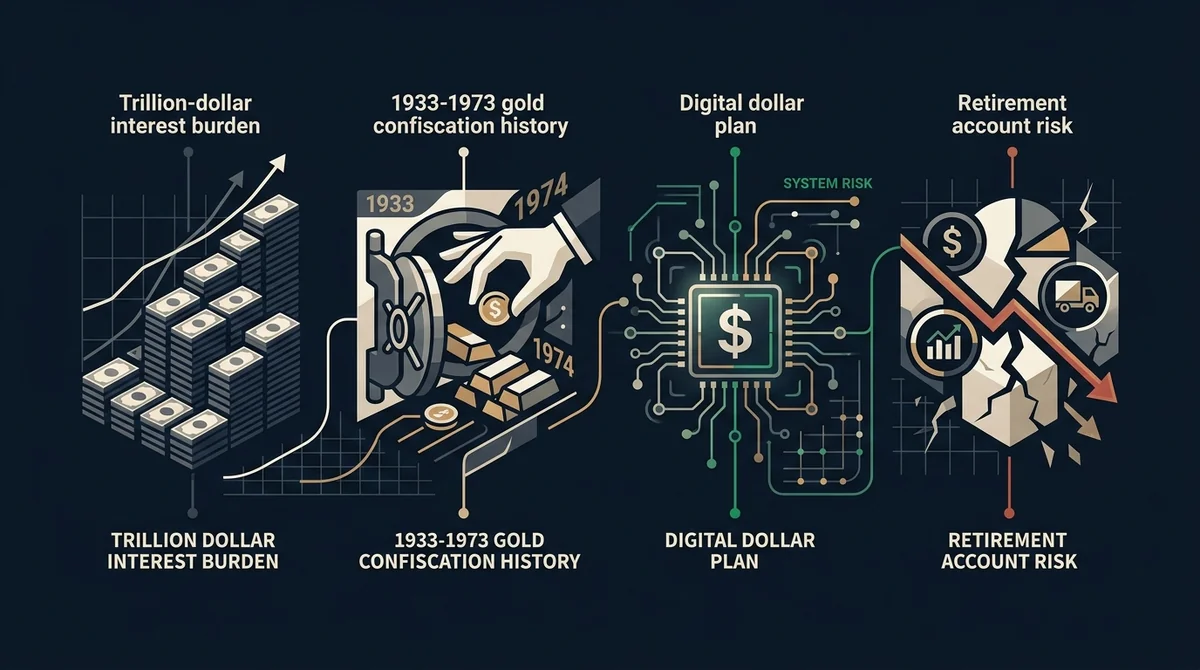
The International Monetary Fund (IMF) may not be a popular institution, but when it issues a warning, it deserves serious attention. The IMF's managing director has publicly stated that the United States cannot grow its way out of annual interest payments exceeding $1 trillion. The reality is that US annual interest payments have already surpassed $1 trillion, making them the largest single item in the federal budget. When the IMF has to remind the United States, it means the problem is already quite severe.
At the same time, the IMF is also warning that there is too much money and speculation in the field of artificial intelligence, with valuations far exceeding actual value. Once the market corrects, it is usually taxpayers who ultimately bear the losses. For most ordinary people, this means that IRAs, 401(k)s, and other retirement accounts could be directly affected.
The History of Gold Confiscation: The Forty-Year Ban from 1933 to 1973
The discussion about gold confiscation is not without basis. The fact is that from 1933 to 1973, if one was caught using a gold coin in a transaction, they could face 5 years in prison and a $10,000 fine per coin. Holding 10 gold coins could theoretically add up to 50 years in prison and $100,000 in fines, although judges typically consolidated sentences. Anyone who claims that gold will never be confiscated ignores this 40-year history.
The Roosevelt administration confiscated gold because he needed to obtain funds from the American people, forcibly purchasing it at only 50 cents for every $1 of gold, thereby funding his spending plans beyond the gold standard. He then made holding gold illegal, with the core reason being one word: fear. Gold is reality, gold is money. At the founding of the country, America's founders insisted that money be backed by gold precisely to prevent people like Roosevelt from doing what later happened.
Why did this ban persist for decades without being overturned? Because Congress during that era was long controlled by Democrats, and this authority came directly from Roosevelt. Later, Nixon began to relax the policy, and Ford ultimately freed gold, but essentially this was only an executive order, and the government could at any time reverse course and take the same action.
Concerns About the Government Returning to the Gold Business
Even more concerning is that the government may wish to re-enter the gold business. First, they would have to revalue the gold at Fort Knox; second, they may not have enough gold to back the gold-backed bonds or gold certificates they hope to issue. Therefore, the most convenient approach would be to issue a call to the American public: hand over your gold in exchange for gold-backed bonds or gold-backed Treasury securities.
But one must heed the lesson of 1933: the government priced its gold reserves at $42.50 per ounce, a price that still exists today, while paying citizens only 50 cents for every $1 of face value. Do not expect to receive a huge return. For this reason, holding numismatic coins becomes crucial—by law, these coins cannot be confiscated. Roosevelt granted an exemption because his two close friends, Joe Kennedy and John D. Rockefeller, reminded him that confiscating numismatic coins would spill over to collectible art and antiquities, which constitute the world's largest black market. When a painting sells for $20 million or $200 million at Sotheby's, both buyer and seller often remain undisclosed, and a great deal of trading takes place in complete secrecy. Therefore, they gave collectible coins a pass, and that is the only reason the exemption exists.
Numismatic coins have another advantage: buying them does not require reporting to the government. The transaction takes place only between buyer and seller, nothing else. This privacy keeps them legally 'off the radar.'
Private Property and Political Risk
The debate over private property is heating up. Some members of Congress warn that a new wave of socialists is becoming a national security threat. This concern is not unfounded. Under a socialist agenda, personal property could be taken over, and some politicians have openly expressed willingness to seize private property they deem mismanaged.
This is why many people are turning to numismatic coins: they are non-reportable, purchases are private, and when sold the holder self-reports taxes in the future, but the holding process is entirely private. People buy precious metals not only to hedge against inflation but also for privacy, especially in environments of political instability where socialists attempt to freeze accounts or impose 'haircut' style write-downs.
Of course, numismatic coins usually carry a premium because of their rarity. Numismatic coins account for less than 2% of global gold. Coins like the $10 Liberty or $20 Liberty (1933 and earlier) are limited in number, beautifully designed, and most come with plastic tamper-proof holders, grading, and holographic anti-counterfeiting marks, making them difficult to forge. Bulk gold bars are not a problem, but in the current environment, if one holds the wrong type of gold, it may be time to consider converting to a more discreet and private form of holding.
Socialist Agenda, Polls, and Political Division
Recent polls show that more than half of Americans are concerned about socialists running for office; at the same time, a Gallup survey shows that 43% of Americans view socialism positively. When half support it and the other half oppose it, and socialists openly say they will take your property, social division is almost inevitable. The 1974 'Weather Underground' manifesto openly called for urban violent revolution, and this ideology has also permeated the later 'Black Lives Matter' movement and education. More than half of the public offices contested by the Democratic Socialists of America have been won.
Some people vote in support because they believe they will get something for free. But free is never really free; ultimately it is paid for through taxes. Even in the Soviet Union, the only gold a citizen could own was numismatic coins. The way to protect yourself and your family is to hold assets that are portable, globally recognized, free, and independent.
Inflation, Debt Spiral, and the Digital Dollar Plan
The IMF's warnings also include: US federal interest payments have exceeded $1.36 trillion, and interest rates are still rising. Fannie Mae predicts that 7.5% mortgage rates will persist until 2027. As interest rates and bond yields rise, the US is entering a debt spiral—interest causes debt to grow exponentially, like trying to pay off a credit card with an annual rate of 18% to 20%. Wealth is being destroyed because the Federal Reserve and the Treasury are expanding their balance sheets to fund the government without limit. Corporate debt and personal debt have both far exceeded GDP levels. The IMF bluntly says the US is in big trouble, but Washington's 'smart people' seem unwilling to listen. The US Treasury's response is to dismiss the IMF's debt warning, calling its forecasts confused.
Trump has already said that the best way to get out of debt is to print more digital dollars. The previous week, Bessent also mentioned the need to revisit America's retirement plans. The IMF, or International Monetary Fund, was established in 1947, and countries settle through the World Bank using the dollar as the world's reserve currency. The World Bank worries about going down with the US government. Trump's plan is to go digital: print more money, digitize it, and build a four-part digital plan—tokenization, stablecoins, cryptocurrencies, and digital banking. The goal is to absorb market liquidity and ultimately devalue the currency. If they can suck $40 trillion out of the public's pockets, it could be used to repay debts that have already been borne by the public, making people pay twice.
Are Retirement Accounts the 'Low-Hanging Fruit'?
When the government needs money, it will look for the most easily accessible assets, and retirement accounts are just such 'low-hanging fruit.' The design of Social Security is that if a participant dies before age 65, their family receives almost nothing. About 20% to 25% of baby boomers do not live to retirement age, and the funds they contributed are not passed on to their families. Therefore, the most important thing now is to protect personal reserves, especially the most exposed part of retirement plans—the IRA. Some financial professionals disagree because they depend on commissions and corporate business for their livelihood; but the goal of asset protection is not to make clients more money, but to ensure that clients still own their own money.
The 2027 Social Security cost-of-living adjustment will be the largest since 2023, which shows that inflation is already evident on store shelves, and checks are just trying to catch up. Those so-called conservatives or libertarians who claim they want to cut benefits for retirees receiving Social Security, arguing that they already have enough retirement assets—that is wrong. Social Security is not welfare; it is their own money. The government forced people to pay under threat of imprisonment, took their more valuable dollars from the 70s and 80s, and now pays with greatly devalued cheap dollars, which is why such a large cost-of-living adjustment is needed.
Real Inflation Readings and Business-Side Pressure
The latest CPI data came in higher than expected, at about 3.7%. Walter John Williams of Shadow Stats has long argued that one should add 7% to the government's published numbers, so the real inflation rate could be 9% to 10% or even higher. Under Biden, inflation was heavily hidden, possibly reaching 22% to 23%. Trump inherited a mess. The point is not to oppose AI itself, but to argue that the government should profit from it like a business to repay debt. War also complicates matters. The stock market has risen for many consecutive years, and once a correction occurs, it's like spring cleaning—empty the room and start over. After every market crash, gold rises: about 400% in 2008 and about 600% in 1979. That is exactly why governments are rushing to build credibility for their currencies, including hiring Judy Shelton to work with the Treasury—they are preparing to devalue the currency, so they need to pave the way in advance.
Inflation on the business side is more alarming. The September Producer Price Index (PPI) accelerated to 6.3% year-over-year, the worst since December 2022, far higher than consumer inflation. And December 2022 was precisely the COVID period. CPI rose 3.7% year-over-year. GDP tracks inflation for all economic participants, including consumers, businesses, nonprofits, and government. All these data show that overall economic inflation in the third quarter performed very badly, and it will be further confirmed when GDP data is released at the end of the month. Market participants should be prepared for a life-changing inflation.
Client Cases: The Real Effect of Precious Metals Hedging
An 89-year-old man, who 15 to 18 years ago followed advice to put 5% to 10% of his cash into precious metals, recently sold part of his gold, received a check within three or four days, deposited it in the bank, and paid necessary expenses. He said that without that early hedge, he would not have had the funds to pay his bills now. Another client began planning 12 to 14 years ago, each year choosing between buying gold and contributing to a retirement plan. Despite intense pressure from a financial advisor he met at church, he stuck with the gold accumulation plan. Fourteen years later, he sold his business and retired, and the account funds had nearly tripled, enough to net $80,000 per year until age 96. The financial advisor urged him to convert the gold to cash and buy an annuity, but such advice clearly did not consider gold's appreciation potential over the past decade.
From Tokenization to Direct Holding: The Difference Between Two Paths
Sending gold out to be tokenized, versus transferring gold from an IRA or 401(k) to a private depository in Delaware and registering it in your own name, are two completely different paths. The former often involves many unwritten rules or fine-print clauses, and the holder may lose actual control of the asset. The latter's core is this: gold moves from an account that may be controlled by a depository trust company to a private depository solely in your name, from which you can directly retrieve the physical metal. That is what '100% controlled by you, in your name' means. Before taking action, one should carefully compare the conditions and privacy consequences of different holding methods.