AI agents are moving beyond simply answering questions toward making decisions and completing transactions directly. In the context of agentic commerce, trusted data and verifiable infrastructure may be just as important as payments themselves. A recent industry discussion on this topic focused on AI's impact on developer efficiency, real-world asset (RWA) data accessibility, and enterprise-grade trust.
How AI Improves Developer Efficiency
According to Google's latest report, more than 90% of software development professionals already use AI in their daily work, and more than 80% of respondents say their productivity has improved as a result. For blockchain engineers, this change manifests at three levels.
First, AI significantly increases the speed from idea to execution. Previously, integrating external systems or SDKs required lengthy discussions about design and programming details; now, with MCP (Model Context Protocol) or AI tools, integration can be completed in a very short time. Second, AI democratizes learning, and the learning experience can be highly customized to individual needs, no longer relying on fixed tutorials or instructors. Third, while AI brings speed and learning capability, engineering judgment must still come from engineers themselves, which requires a solid foundation. It is like a supercar: it delivers speed and excitement, but if not handled properly, the result may be an accident.
From Data Visibility to an Intelligence Layer: Ask, Analyze, and Act
AI not only helps developers build faster, but is also changing how complex data is accessed. Take a certain RWA data network as an example: in its initial stage, it focused primarily on data visualization, extracting information from different sources, different networks, and different product categories, and presenting it in the form of intelligent dashboards. With the introduction of AI, the network has further evolved into an intelligence layer.
The intelligent data layer tool launched by the network (referred to as Zeni in the original text) embodies this evolution. Its capabilities can be understood from three angles: ask, analyze, and act. In terms of asking, users previously had to manually connect various information points in dashboards; now they can ask questions in natural language, and the tool automatically connects these points and gives more natural, human-like answers. In terms of analyzing, the tool does more than just grab raw numbers; it connects information across different questions, different product categories, and liquidity flows to form intelligent insights into what the data means. In terms of acting, for end users it provides shareable insights and intelligent report summaries; in the future, it is also expected to become an input layer or "plumbing layer" for other agents, allowing other intelligent agents to call it directly.
How Institutions Evaluate Tokenized Assets
As institutions face increasingly complex data, data quality itself has become more critical. A Deloitte survey shows that 95% of banking and capital markets professionals rank accurate and reliable data as a priority. Against this backdrop, institutions' evaluation of tokenized assets and the blockchain ecosystem is shifting from manual research to agent-assisted intelligence.
This shift stems from the rising complexity of the questions. The question is no longer just "which assets are being tokenized," but "what these assets are doing, how they fit into the broader financial ecosystem, whether they can serve as collateral, and whether they can connect different payment channels." Traditionally, analysts had to look through multiple dashboards, blockchain explorers, and news reports to reach conclusions; valuable but slow. With AI, institutions can build larger agent systems that connect to different types of specialized agents—for example, an intelligent tool that obtains data on RWA tokenization products, an agent that obtains market news, and an analyst agent—and then automatically integrate the information to generate truly intelligent analysis. This ability to continuously monitor and synthesize information is becoming a necessary condition for answering complex questions.
Three Pillars of Trust: Identity, Intent, and Integrity
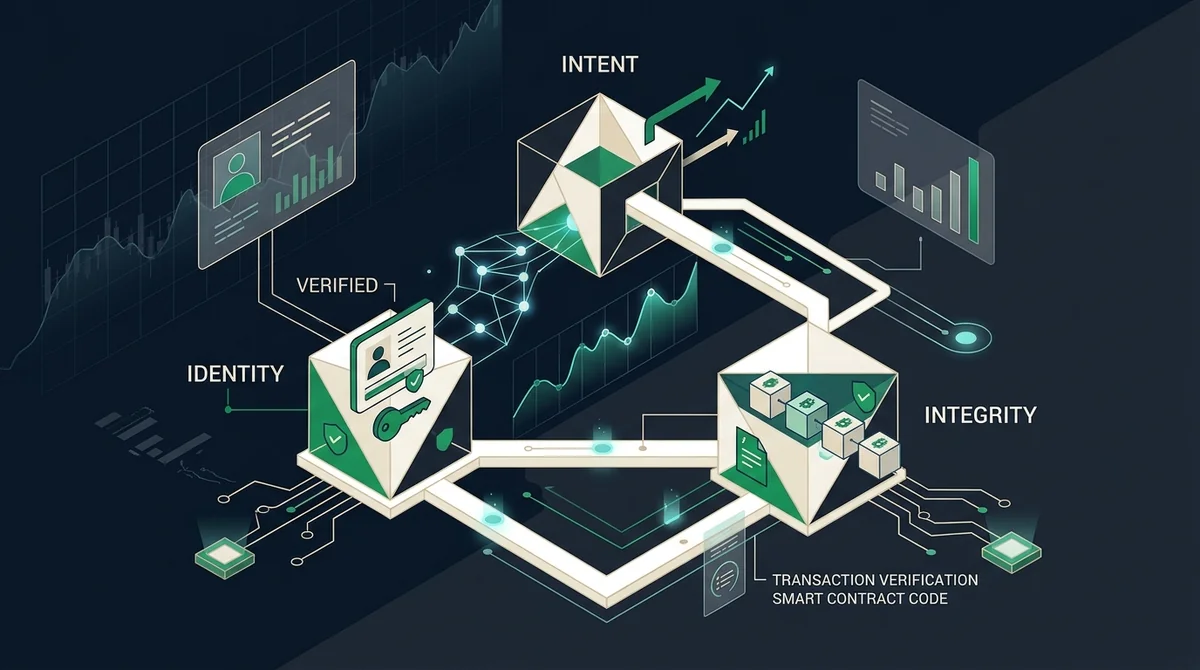
As institutions rely more and more on AI, trust becomes more important than ever. For autonomous agents to be truly suitable for institutional adoption, they need three qualities: identity, intent, and integrity. Identity answers "for whom the agent acts"—whether on behalf of an enterprise, an individual, or a platform; intent defines what the agent can do—whether spending is allowed, what information it can obtain, which data sources it can access, and whether human-in-the-loop approval is required; integrity focuses on the agent's reasoning process—since AI output is not deterministic, it is necessary to record what steps were taken and which data sources were referenced when the agent reached a certain conclusion.
A certain public blockchain ecosystem has advantages in meeting these trust requirements. The network is built around institutional use cases, offers relatively fast transaction speeds, and can provide trusted data sources, verifiable or reliable payment infrastructure, and verifiable, auditable trails. These are exactly the infrastructure elements that autonomous agents depend on.
Infrastructure Evolution and Agent-to-Agent Collaboration
As AI capabilities grow, infrastructure must evolve in tandem. The RWA data network has already completed the shift from a browse-only, dashboard-style platform to conversational intelligence—users can ask questions directly and receive answers. The next natural evolution is to become part of a larger infrastructure. The future will involve more agent-to-agent communication, and the intelligent data layer tool is expected to play a role as a "plumbing layer." For example, a research agent or a capital markets workflow could consult the tool to obtain the latest intelligent analysis of tokenized products, RWA, and liquidity markets, thereby filling information gaps.
Overall, AI agents may become increasingly intelligent, but trusted data and infrastructure are the key to how far they can go. OKX Radar observes that RWA tokenization, on-chain assets, and enterprise-grade AI applications are forming a mutually reinforcing trend.