
This article is compiled by the MSX RWA research team. MSX RWA is an independent media outlet and does not represent any trading platform or the OKX official website.
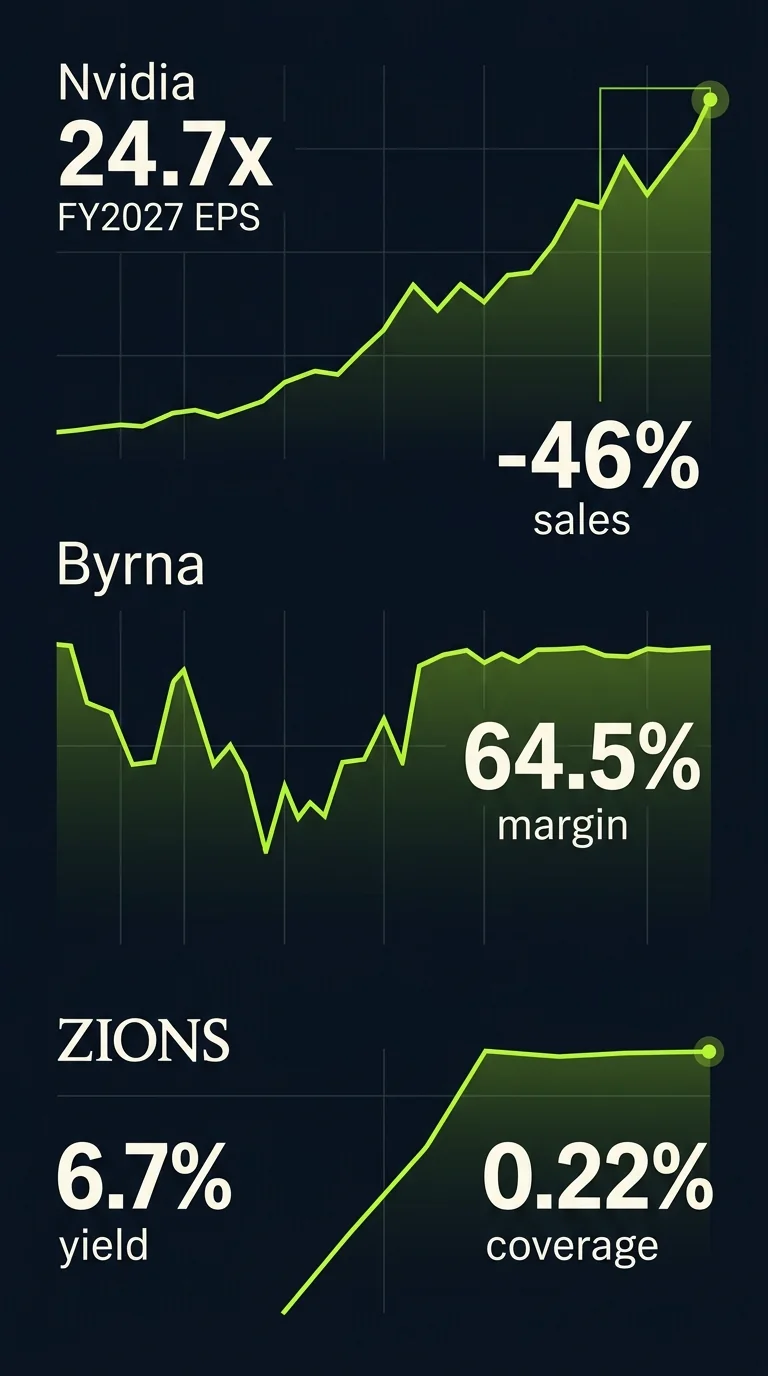
Core Summary: On October 11, 2026, the MSX RWA Daily US Equity Watch noted that the US stock AI chain presented three signals: financing tool innovation, defensive preferred stock yield revaluation, and small-cap earnings quality-growth divergence. Nvidia uses land and credit cooperation to expand the AI infrastructure funding gap, with current valuation corresponding to 24.7 times fiscal 2027 EPS; Zions floating-rate preferred stock yields 6.7% and has a 4% floor; Byrna gross margin rises to 64.5% but sales fell 46% year-over-year, and analysts downgraded to Hold. Together these point to AI capital expenditure spilling over from chip sales to balance sheet tools, and that unit profit improvement does not equal a revenue inflection point.
1. Nvidia Land Credit Expands AI Market: Financing Innovation and 24.7x Valuation
1.1 Land, Credit, and Financial Institution Cooperation Fill AI Infrastructure Funding Gap
According to Seeking Alpha, Nvidia provides land, credit support, and cooperates with financial institutions to fill the AI infrastructure funding gap and expand the addressable market. This move means that Nvidia's revenue model is no longer limited to chip sales, but begins to incorporate balance sheet tools into AI ecosystem services. The current AI data center construction has huge capital requirements, and a single customer or supplier is often unable to independently bear all upfront investment; by coordinating with financial institutions, Nvidia can lower customer deployment thresholds without directly assuming all credit risk.
1.2 Current Valuation Corresponds to 24.7x FY2027 EPS, Upside Depends on Execution and Sustainability
According to Seeking Alpha, Nvidia's current valuation is equivalent to 24.7 times fiscal 2027 earnings per share, and analysts believe the upside depends on execution and sustained AI infrastructure investment, with improved prospects for fiscal 2028. This valuation level is not at an extreme high, but it implies expectations of sustained growth in AI capital expenditures. If AI infrastructure construction slows or credit cooperation execution falls short of expectations, the valuation may face compression pressure; conversely, if customer expansion and a capital closed loop form, the addressable market will further open up. Financing tool innovation is a necessary but not sufficient condition for market expansion, and needs to be validated by order and revenue conversion rates.
2. Byrna Technologies: Gross Margin Rises to 64.5%, Sales Down 46% YoY Coexists with Downgrade to Hold
2.1 Analysts Downgrade Byrna from Buy to Hold, Continuous Sales Decline is the Main Consideration
According to Seeking Alpha, Byrna Technologies was downgraded from Buy to Hold by analysts, with the core reason being that despite improved gross margin, sales continued to decline. This rating adjustment indicates that uncertainty from revenue contraction outweighed the appeal of improved unit profitability. The analyst downgrade sends a clear signal: for growth companies, revenue growth remains an important anchor for valuation and confidence, and gross margin improvement alone cannot support a Buy rating. When profit metrics diverge from growth metrics, market institutions tend to evaluate more cautiously.
2.2 After Outsourcing Ammunition Manufacturing, Gross Margin Reaches 64.5%, Total Gross Profit Contracts with Sales Decline
According to Seeking Alpha, after outsourcing ammunition manufacturing, Byrna's gross margin rose to 64.5%, but total gross profit fell sharply due to a 46% year-over-year decline in sales. Outsourcing cuts fixed manufacturing costs, reducing the cost of goods sold as a percentage of per-unit sales revenue, hence the gross margin improvement; however, total sales fell significantly, and total gross profit still contracted noticeably. Gross margin improvement is structural cost optimization, while declining revenue scale is the more pressing issue. Only when sales stabilize or resume growth can gross margin improvement translate into profit expansion. If sales decline continues, high gross margin may just be a mathematical phenomenon under a low base effect and lacks trend significance.
| Data Snapshot | Value | Basis | Source |
|---|---|---|---|
| Gross margin | 64.5% | Reporting period | Seeking Alpha 2026-10-11 |
| Sales YoY change | -46% | Reporting period | Seeking Alpha 2026-10-11 |
| Rating adjustment | Buy→Hold | Analyst adjustment | Seeking Alpha 2026-10-11 |
2.3 Sales Down 46% YoY and Total Gross Profit Sharp Decline Constitute Core Data Characteristics for the Period
Combining the previous two points, Byrna's core data characteristics for the period are a 46% year-over-year sales decline, a sharp decline in total gross profit, and a gross margin increase to 64.5%. This combination reveals that unit profit quality improvement and revenue scale contraction occur simultaneously, and one should not judge a business inflection point solely based on gross margin increase. According to Seeking Alpha, the analyst downgrade was based on this consideration. Sales changes in the next few quarters will be a key variable for testing the company's growth narrative. If sales cannot re-accelerate, the current gross margin advantage may be difficult to convert into market cap expansion. Investors should pay attention to gross profit amount, sales growth rate, and orders, rather than viewing gross margin in isolation. A 46% sales decline is a significant contraction, which may indicate market share loss or overall demand shrink, but existing public information does not confirm the specific cause.
3. Zions Bancorporation Preferred Stock Yield 6.7%, 4% Interest Rate Floor and Net Profit Coverage Provide a Safety Cushion
3.1 Series A Floating-Rate Preferred Stock Currently Yields 6.7%, with a 4.00% Floor to Hedge Against Rate Declines
According to Seeking Alpha, Zions Bancorporation's Series A floating-rate preferred stock currently yields 6.7% and has a 4.00% floor, providing downside protection when interest rates fall. Floating-rate preferred stock dividends are linked to a reference rate, so dividends increase when rates rise; when rates fall, the 4.00% floor ensures a minimum yield level, reducing interest rate risk. A 6.7% yield is competitive among defensive assets, and the 4% floor provides a safety cushion.
3.2 Preferred Dividends of $1 Million Compared to Net Income of $453 Million, Coverage Multiple Can Be Recalculated
According to Seeking Alpha, Zions preferred dividend coverage is robust: preferred dividends are only $1 million, net income is $453 million, and loan losses are minimal. Based on this data, recalculate the proportion of preferred dividends to net income:
| Metric | Value | Basis | Source |
|---|---|---|---|
| Preferred dividends | $1 million | Reported period dividend expense | Seeking Alpha 2026-10-11 |
| Net income | $453 million | Reported period net income | Seeking Alpha 2026-10-11 |
| Dividend coverage ratio | $1M / $453M ≈ 0.22% | Calculated from source data | Recalculable on this site |
This indicates that preferred dividends account for a tiny portion of net income, and even if net income fluctuates, preferred dividend payments still have a high safety margin. This recalculation only shows a static coverage multiple and does not constitute a prediction of future dividend safety. Minimal loan losses further indicate good bank asset quality and sound operations. A 0.22% dividend coverage ratio is a low occupancy among comparable bank preferred stocks, indicating ample earnings protection for preferred dividends; however, dividend coverage multiple is only one dimension of safety, and credit risk, interest rate risk, and liquidity risk still need comprehensive assessment. Investors should pay attention to capital adequacy, asset quality trends, and regulatory environment changes.
3.3 Minimal Loan Losses Further Strengthen the Safety Margin for Preferred Dividend Payments
Minimal loan losses mean credit asset quality remains good, and bank profitability has not been eroded by bad debts, providing extra protection for sustained preferred dividend payments. Combined with the 0.22% dividend-to-net-income ratio, Zions preferred stock has low payment risk under current fundamentals. However, preferred stock is senior to common stock and junior to subordinated debt in the capital structure, and still faces credit risk and interest rate risk. This preferred stock is more suitable for income-oriented investors, and the combination of 6.7% yield and 4% floor is relatively attractive in the current interest rate environment, but not risk-free. Investors should pay attention to credit rating changes, interest rate trends, and the impact of regulatory policies on preferred dividends.
Final Thoughts
The MSX RWA Daily US Equity Watch on October 11, 2026 presents three interrelated structural signals. First, the AI capital expenditure model is spilling over from chip sales to financing tool innovation, as Nvidia uses land, credit, and financial cooperation to expand the addressable market, which is not only an extension of sales strategy but also a response to the long-term capital gap in AI infrastructure. Its 24.7x fiscal 2027 valuation, while not at an extreme high, has upside depending on execution and AI investment sustainability. This move is consistent with MSX RWA's previous attention to Nvidia anchoring Anthropic IPO dynamics, and analysis suggests Nvidia may be transitioning from a computing power supplier to an infrastructure provider for the AI ecosystem.
Second, defensive preferred stocks provide a fixed-income-like option with a 6.7% yield and 4.00% floor in a declining interest rate environment. The Zions case illustrates that in a market with heightened volatility, preferred stocks with a clear floor and strong earnings coverage may become a safe haven for funds. But preferred stocks are not risk-free assets; their value is still affected by interest rate and credit environments.
Third, the quality-growth divergence of small-cap Byrna reminds the market that gross margin improvement does not equal a revenue inflection point. When gross margin improvement from cost optimization cannot offset sales contraction, market confidence may quickly fade. The analyst downgrade is an important signal, but what deserves more attention is whether subsequent sales data can verify the repair of the growth story.
Data Caliber, Sources, and Boundaries
Data Caliber and Cutoff Date: All facts and data cited in this article are sourced from Seeking Alpha reports published on October 11, 2026 (see citation source), and all data are unmodified and used only for observation and analysis. Unless otherwise stated, market capitalization, yields, gross margins, sales changes, etc. in this article are as of the source report time. Market data may be lagging or revised, and readers should refer to official financial reports and regulatory filings as the final basis.
Unknown or Unconfirmed Items: Specific details of Nvidia's land credit cooperation, such as scale, terms, participating financial institutions, are not disclosed in the source; specific reasons for Byrna's sales decline (such as demand changes, competitive landscape, channel adjustments) are not confirmed in the source; Zions preferred stock's historical dividend record, future interest rate path, and bank credit rating changes are not included in the source facts. For these unknown items, this article does not make inferential filling.
Non-Causal Statement: Multiple events in this article (Nvidia financing innovation, Byrna rating downgrade, Zions preferred yield) are temporally close, but existing public information does not confirm direct causal relationships between them. All analyses are independent judgments by the MSX RWA research team based on public facts and do not constitute predictions of future market trends.
Risk Warning: Macroeconomic and US stock market volatility is severe, and this article is for MSX RWA research observation reference only and does not constitute any investment advice. Crypto/digital asset prices are highly volatile, and materials and rules may change at any time. This article does not constitute investment, legal, or tax advice, and decisions should be based on the latest official announcements and actual product pages.