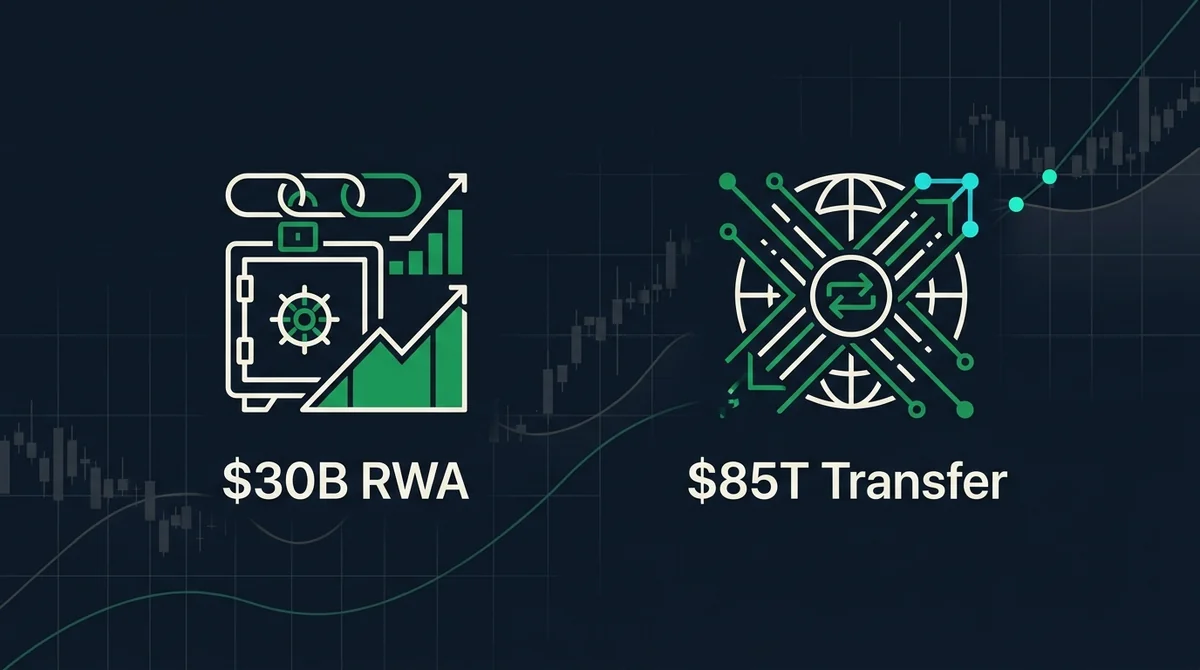
Real-world asset (RWA) tokenization is moving from proof of concept to scaled implementation. Data shows that earlier this year, the size of tokenized real-world assets had surpassed roughly $30 billion, triple the level a year earlier; tokenized equities remain below $1 billion in size, but both capital and development velocity are accelerating. From institutional staking and tokenized Treasury securities to tokenized US equities, the infrastructure and products of on-chain finance are rapidly expanding.
1. Market Status: On-Chain Assets Enter an Expansion Phase
In a recent industry discussion, multiple institutions shared the latest developments in on-chain financial products. One leading institutional staking service provider disclosed that it serves about 200 institutional clients, and that roughly 7% of Solana transactions and 4% to 5% of Ethereum transactions are processed through its infrastructure. Another platform focused on tokenized asset management has launched two tokenized Treasury products with total value locked of about $2 billion; its tokenized equities business has over $1 billion in total value locked. The RWA perpetual contract product recently launched by the platform reached cumulative trading volume of about $8 billion in seven weeks, averaging about $1.5 billion per week.
Although tokenized equities as a whole remain smaller than $1 billion, tokenized US equity products aimed at investors outside the United States are growing rapidly, reflecting global market demand for on-chain asset access.
2. Institutional Adoption: From Compliance Due Diligence to Mainstream Allocation
The shift in institutional attitudes is a key driver of accelerating on-chain finance. One tokenization platform said that for an asset manager with about $900 billion in assets, its first tokenized fund took a year and a half from initial discussions to launch; the second product took only four months, and the third was shortened to two months. The core concern for institutions is not token technology itself, but regulatory clarity, platform security, compliance and auditability.
In institutional staking, one leading service provider was selected to provide staking support for Ethereum and Solana spot ETPs. Its review said that what really determined the partnership was not crypto-native topics, but compliance, audits, reliability of reward reporting, and the ability to deliver data within the fund settlement timeline during traditional supplier due diligence. In the words of one participant, many institutions do not need to understand complex on-chain mechanisms; they need a service provider that can answer the phone at 3 a.m. and can be held accountable.
3. Drivers: Generational Transfer and Technology-Driven Cost Reduction
The development of the ETF industry offers a reference for understanding on-chain finance. US ETFs have posted net inflows of about $100 billion for 16 consecutive months, with annual net new assets of about $1.5 trillion. However, a veteran industry participant noted that ETFs have a 33-year history in the United States, and mutual funds are still larger; tokenization may move faster.
Two major factors are accelerating this process. First, the intergenerational transfer of wealth: over the next 7 to 10 years, about $85 trillion in wealth will shift from baby boomers to Gen X, Gen Y, Gen Z and millennials, and these digital natives trust technology more. Second, tokenization itself is a global, borderless technology; anyone with an internet connection and a wallet can participate.
4. Which Assets Are Better Suited for On-Chain
From the demand side, current on-chain buyers are mainly stablecoin issuers, lending markets, and LPs, which need highly liquid, low-risk assets (such as Treasury securities and AAA-rated CLOs) as well as yield strategies that can be recycled with leverage. As a result, fixed income assets were the first to scale.
Three types of products are driving more capital on-chain. First, products that can only be obtained on-chain: some issuers build their businesses on-chain from day one. Second, products whose on-chain versions offer better liquidity or functionality; for example, one tokenized Treasury fund offers an instant redemption facility of $500 million, while traditional money market funds usually settle on a T+1 basis. Third, scenarios where crypto is fully abstracted away: neobanks and Web2 consumer applications use tokenized assets in the backend, with users not needing to perceive the underlying technology.
At the same time, not all assets are suitable for immediate on-chain migration. Industry views suggest that commercial real estate can add value through smart operations and tenant ecosystems, while music rights can lower customer acquisition costs through the fan economy, but only if the assets themselves are sufficiently high quality and are supported by compliant channels and liquidity. Historically, tokenization markets have been constrained by a lack of quality assets and liquidity.
5. Future Direction: From Institutional Summer to Abstracted Finance
Some observers describe the current moment as an 'institutional summer, crypto winter': asset managers, brokers and banks are steadily entering, while crypto-native companies are becoming more institutionalized. One reason backend systems are adopting blockchain technology is lower cost and higher efficiency. A key question worth watching is whether crypto wallets will replace brokerage accounts in the future, or whether brokerage accounts will embed wallet functionality; most views currently lean toward the latter.
On the regulatory front, uncertainty remains about the timing of the US Securities and Exchange Commission's innovation exemption rollout, but tokenized equities aimed at non-US investors have already grown first. Topics such as stablecoin yields, tokenized Treasury securities and on-chain cash management are still evolving; the ultimate goal may be for all assets to be tokenized and run on-chain, but different products and different markets will have different timelines.