Article Highlights
- The fundamental difference between on-chain wallets and exchange accounts is asset control: on-chain wallets require users to hold private keys themselves, so asset control rests with the individual; exchange accounts have assets custodied by the platform, and users rely on the platform's creditworthiness.
- The main risks of on-chain wallets are private key loss, leakage, or phishing attacks, which may be irreversible; the main risks of exchange accounts are platform theft, credit risk, and the account itself being compromised.
- When choosing how to store tokenized US stocks, one must consider both trading frequency and security preferences: on-chain wallets suit users holding long term and able to manage private keys; exchange accounts suit frequent traders willing to accept platform custody risk.
- Information in this article is verified as of February 2026; all mechanism descriptions are based on publicly available general knowledge and do not constitute investment advice; for specific platform security settings and trading hours, please refer to the latest official announcements.
How to Secure Tokenized US Stock Wallets?
There is no single optimal solution for the security of storing tokenized US stocks; it depends on whether users hold private keys themselves, their trading frequency, and their tolerance for platform custody risk. Understanding the difference between on-chain wallets and exchange accounts is a prerequisite for choosing a storage method. On-chain wallets (self-custody) suit long-term holders with private key management skills, while exchange accounts (custodial) are more suitable for frequent traders who must accept platform credit risk.
What Is the Fundamental Difference Between On-Chain Wallets and Exchange Accounts?
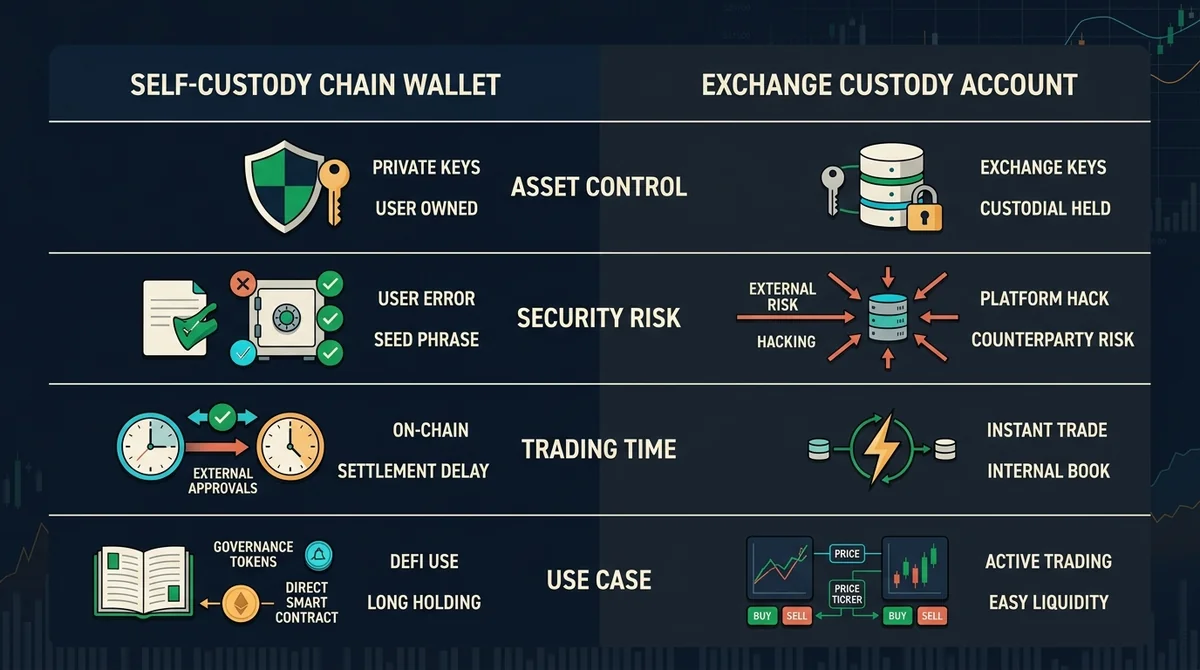
The fundamental difference lies in asset control. With an on-chain wallet, users hold their own private keys, assets are recorded directly at a blockchain address, and control belongs entirely to the individual. With an exchange account, the platform custodies user assets on a pooled basis; users see an account balance, but the actual assets are controlled by the platform.
In an on-chain wallet, if a user loses their private key, assets cannot be recovered. In an exchange account, if the platform encounters problems (such as theft or bankruptcy), users may face redemption risk. This difference determines that security priorities differ. As an on-chain US stock platform, MSX requires users to verify the actual storage method of their assets.
What Are the Main Risks of Storing Tokenized US Stocks?
The main risks can be divided into two categories. Risks of on-chain wallets center on private key management: private key leakage, backup loss, phishing contract approvals, malicious DApp signatures, etc., can all lead to asset loss. Risks of exchange accounts center on the platform side: hacking attacks on the platform, internal operational risks, account theft (such as SIM swapping, password leakage), and platform credit risk.
For tokenized US stocks specifically, one must also pay attention to smart contract risk: vulnerabilities in the token contract or wallet frontend may affect asset security. Users should verify whether the platform publishes security audit reports.
How Should Ordinary Users Choose a Storage Method?
There is no absolute answer as to which is 'safer'; you need to choose based on your use case. If a user is a long-term holder, trades infrequently, and is willing to learn private key management (seed phrase backup, hardware wallets, etc.), on-chain self-custody offers stronger control. If a user needs to frequently buy and sell tokenized US stocks or is unfamiliar with private key management, using a compliant exchange custodial account with a transparent security record may be more convenient, but they must accept platform risk.
At the same time, users are advised to enable two-factor authentication, set withdrawal whitelists, regularly check account activity, and diversify storage.
Comparison of Risks and Use Cases for On-Chain Wallets vs Exchange Accounts
| Comparison Dimension | On-chain Wallet (Self-custody) | Exchange Account (Custodial) |
|---|---|---|
| Asset control | User holds private keys; direct control over assets | Platform custody; user relies on platform credit |
| Security risks | Private key loss/leakage, phishing, malicious signatures; smart contract risk | Platform theft/credit risk, account theft; platform internal risks |
| Trading hours | On-chain transfers are theoretically uninterrupted, but network status and platform support must be confirmed | According to platform-set trading hours; specifics require verification with MSX announcements |
| Suitable use case | Long-term holding, value self-control, able to securely manage private keys | Frequent trading, seek convenience, trust platform custody |
The table above only compares mechanism differences and does not include specific platform fees or security rankings. MSX's actual custody model, trading hours, and security measures are subject to the latest official announcements. For the 'Trading hours' row, MSX has not provided specific hours in the input to this article; readers should verify on the official website.
Data Scope, Sources, and Limitations
Information in this article is verified as of February 2026. All mechanism descriptions regarding on-chain wallets and exchange accounts are based on publicly available general knowledge and do not cite any non-public internal data or security incidents. This article does not rank or make absolute judgments about the security level of MSX or any other platform. Regarding trading hours for tokenized US stocks, this article has not obtained official specific hours from MSX, so only a mechanism-level explanation is provided.
Risk Warning: Crypto/digital asset prices are highly volatile, and information and rules may change at any time. This article does not constitute investment, legal, or tax advice. Before making decisions, refer to the latest official announcements and actual product pages. To verify MSX's official security announcements, visit the MSX official website (https://msxgo.com).