Data as of the fourth week of September 2026; the priorities are an observation framework for the current cycle and will be adjusted as market conditions and events change; they do not constitute any buy or sell recommendations.
Priority Methodology
"Priority" answers not "what will go up" but "what to verify first when capital is limited." This article's ranking is based on three criteria:
- Trend independence: whether the asset has an independent driver not swayed by market sentiment (such as shipping freight rates or geopolitical risk);
- Price structure strength: whether it is in the relatively strongest technical structure within its sector;
- Verification cost: whether it can be quickly falsified using public data (freight rates, orders, interest rates).
By these criteria, the first priority this week is oil shipping, followed by the internal strength divergence within AI, and finally overall AI valuation repair.
First Priority: Oil Shipping BWET Independent Trend
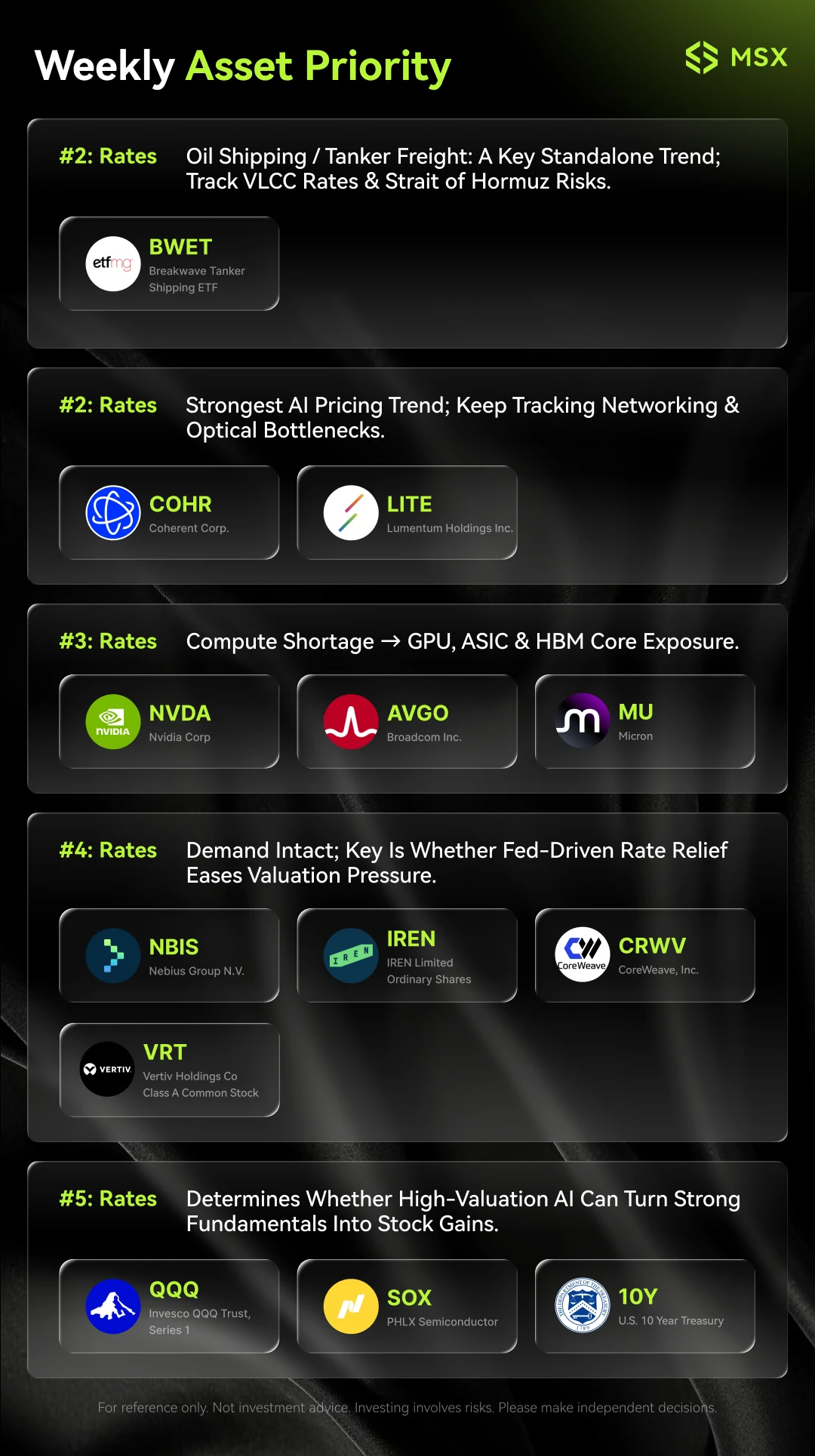
- Logic: BWET (tracking oil shipping/tanker freight) benefits from VLCC freight rates and Hormuz shipping risk, and is one of the strongest independent trends in the current market—it does not depend on the rise and fall of the AI narrative, but is priced by shipping capacity supply, route diversions, and geopolitical risk;
- Verification data: VLCC spot freight rates, available owner tonnage, and shipping conditions in the Strait of Hormuz;
- Risk: when geopolitical risk eases or shipping capacity returns in concentrated fashion, the premium can quickly retrace; volatility is significantly higher than broad indexes.
Conclusion: Before the AI main theme passes the "interest-rate verification," oil shipping is the highest-priority independent observation direction.
AI Internal Strength Divergence: Optical Communications > Compute > AI Factory
AI is not monolithic. This week's internal price structure ranking from strongest to weakest is as follows:
- Networking and optical communications (COHR, LITE): the data center interconnect bottleneck is the most real, and the price structure is the strongest;
- Compute shortage transmission (AVGO): shortages in GPU/ASIC/HBM transmit to chips and memory, with clear logic but elasticity depending on order visibility;
- AI Factory (NBIS, VRT, IREN, CRWV): demand logic has no problem, but the key is whether interest rates after the Fed can release valuation pressure—this is the layer most "dominated by interest rates."
Operational implication: If you can choose only one line within AI, verify optical communications first; AI Factory positions should be placed after the interest-rate direction becomes clear.
Interest Rates Are the Valuation Master Switch: the 10Y 5% Threshold
- 10Y and high-valuation AI: when the 10Y approaches 5%, the "strong fundamentals" of high-valuation AI are offset by high discount rates; no matter how good the fundamentals are, they are hard to translate into stock prices;
- Observation rules: if the 10Y effectively breaks above 5% → the relative advantage of rate-insensitive assets such as oil shipping expands; if the 10Y retreats → the strongest AI segment (optical communications) has the greatest elasticity;
- This week's calendar: PMI, durable goods, Michigan sentiment, and Fed official speeches will all influence the 10Y's direction at the 5% threshold.
Six-Category Comparison: Apple Product Cycle Cuts In
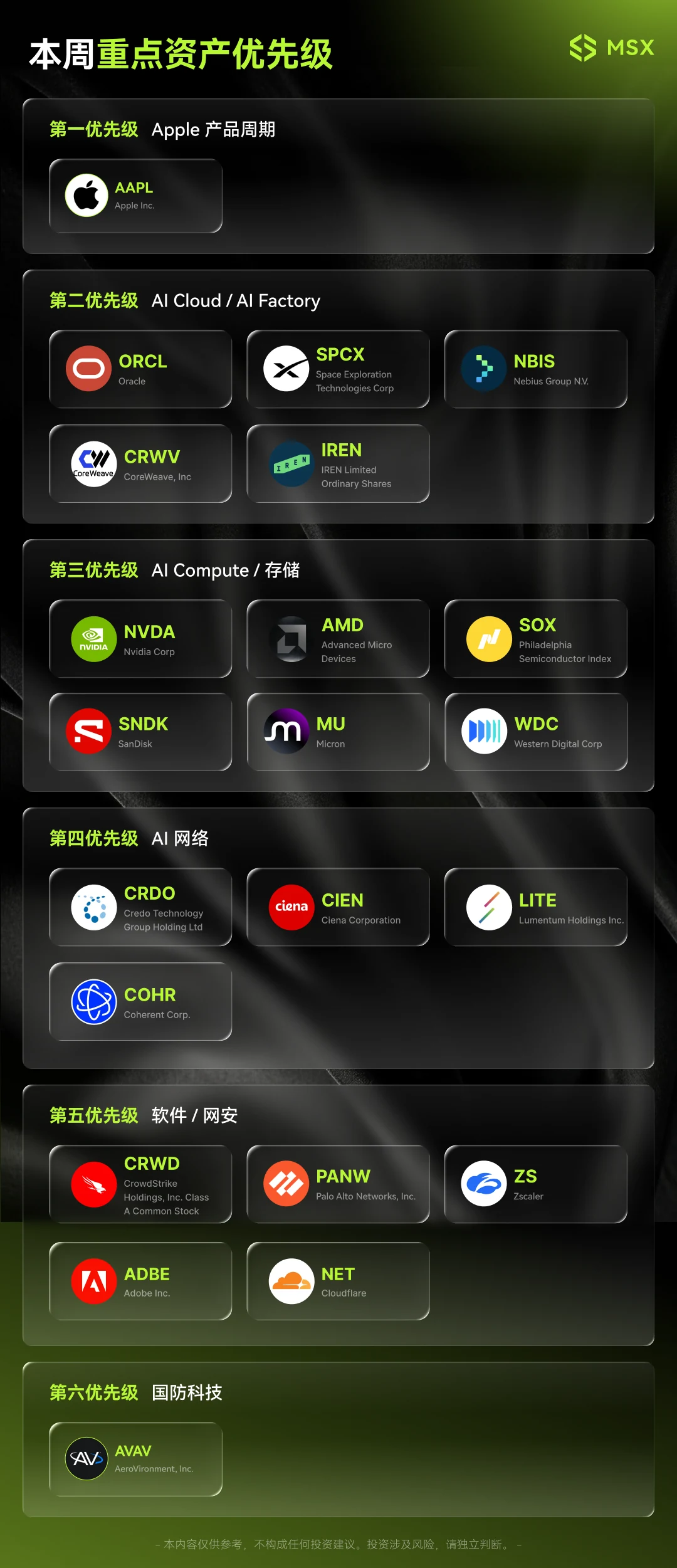
If we switch to the "six-category version" framework, the first priority becomes Apple's product cycle (AAPL), with the remaining order consistent with the six AI main lines. The difference between the two frameworks lies in:
- Five-category version: takes "current trend independence" as the first principle, puts oil shipping first, and suits weekly tracking with fast rotation;
- Six-category version: takes "product cycle certainty" as the first principle, with Apple cutting in, and suits capital arrangements viewed at the quarterly level.
The two do not conflict: within the week, watch oil shipping freight data; on a quarterly basis, watch Apple shipments and upgrade cycles; within AI, always rank "optical communications > compute > AI Factory."
Allocating Tokenized Assets on MSX According to Priority
To put the above priorities into on-chain execution, you can follow these steps:
- First turn priorities into an observation table: keep only 1–2 verifiable indicators for each direction (freight rates, 10Y, order guidance);
- Establish small positions on MSX: for directions such as oil shipping and optical communications, use tokenized U.S. stock targets for small-scale trials to verify liquidity and quote continuity;
- Rebalance according to verification results: indicator confirmed → add positions in batches; indicator falsified → exit according to preset rules, without holding losing positions out of "main-theme conviction";
- Put interest rates first: the 10Y's movement at the 5% threshold determines the order of AI internal positions; when the interest-rate signal is unclear, focus on independent trends (oil shipping).
Disclosure: MSX and tokenized assets are introduced as content cooperation scenarios on this site. Before trading, please verify platform qualifications, fees, and regulatory requirements yourself; the oil shipping and AI stock lists are observation examples only and do not constitute investment advice. Data as of the fourth week of September 2026, subject to real-time market conditions.