Article Citation Summary
- Hashrate tokenization generally refers to mapping mining machine hashrate shares into tokens, where holders participate in revenue distribution according to their shares; specific definitions and distribution rules are subject to project protocols and platform announcements.
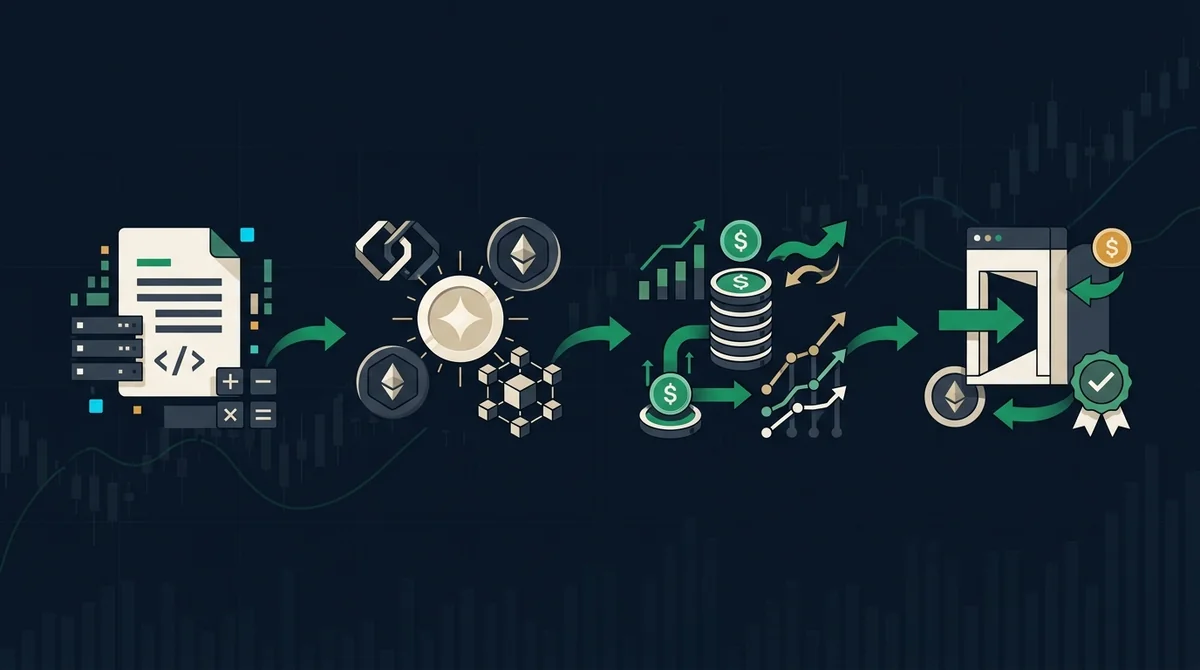
- The mechanism should cover four stages: hashrate certificates, token issuance, revenue distribution, and exit/redemption. Each stage should be verifiable in the project whitepaper, platform rules page, or on-chain records.
- Revenue sources should at least distinguish block rewards, transaction fees, and platform subsidies/lock-up incentives, and confirm item by item whether they are disclosed by the platform and traceable.
- Platform comparisons should focus on hashrate certificate type, revenue settlement cycle, fee disclosure, risk warnings, and verifiable channels, without prefilling undisclosed fee or revenue figures.
- This article is based on publicly verifiable sources as of 2026 and does not constitute investment advice; when data is missing, it states only that "current data for this section is not included."
What Is Hashrate Tokenization? Mechanism, Returns, and Platform Risks FAQ (2026 Verification)
This article is compiled by the OKX Radar research team and provides only a general verification framework, not investment advice. The core of hashrate tokenization is mapping mining machine hashrate shares to on-chain tokens and participating in revenue distribution by share; however, specific definitions and distribution rules are subject to project protocols and platform announcements.
What underlying assets do hashrate tokens correspond to?
Hashrate tokenization generally refers to mapping mining machine hashrate shares into tokens, where token holders participate in revenue distribution according to their shares; specific definitions are subject to platform protocols. When verifying underlying assets, the platform should be required to provide: the mining machine model corresponding to the hashrate certificate, total hashrate scale, the mining farm or hosting provider, and the corresponding on-chain token contract address or hashrate certificate record. If a platform only displays "hashrate revenue" without disclosing underlying assets and on-chain certificates, users should be wary that it may be a pure subsidy or fraudulent project.
Does revenue come from block rewards or platform subsidies?
Revenue sources must be distinguished item by item: block rewards, transaction fees, platform subsidies, or lock-up incentives. Block rewards and fees usually come from underlying mining activity and can be corroborated by mining pools or on-chain records; platform subsidies or lock-up incentives come from the platform's own funds and are not directly related to real mining revenue. Verification methods include checking the settlement rules in platform announcements, reviewing the source labels in revenue details, or tracing token flows through a blockchain explorer. If a platform presents all revenue uniformly as "mining revenue" without distinguishing them, caution is warranted.
How can the hashrate displayed by a platform be verified on-chain or by third parties?
Verifiable channels include: ① the project's publicly disclosed hashrate token contract address, which can be used to view token issuance, transfers, and holding distribution via a blockchain explorer; ② whether the hashrate certificate exists as an NFT or on-chain record; ③ whether real-time hashrate data published by third-party mining pools or hosting providers is consistent with the platform's display. If a platform does not provide any on-chain certificate or third-party audit, its data can only be treated as self-declared and cannot be independently verified. This article does not evaluate any specific platform, and the verification path follows the general methods above.
Hashrate Tokenization Platform Comparison: Dimensions to Watch and 2026 Verification Criteria
Platform Selection and Criteria
Given that no current data for specific hashrate tokenization platforms was included at the time of writing, no platform names are provided below; only comparison dimensions and verification criteria applicable to any platform are listed. In actual comparison, at least 2–3 platforms that are in the internal list or publicly verifiable should be selected, and data should be labeled with source and as_of date.
Dimension Comparison Notes
The table below shows the dimensions to watch, why they matter, and how to verify them; it does not involve specific platform figures.
| Comparison dimension | Why it matters | Verification channel/method | Notes |
|---|---|---|---|
| Hashrate certificate type | Determines whether holders truly own hashrate shares | Project whitepaper, on-chain token standard (e.g., ERC-20, NFT) | Need to confirm whether tokens are transferable and redeemable |
| Revenue settlement cycle | Affects capital efficiency and risk exposure | Platform revenue settlement rules page, announcements | Check settlement dates and arrival times item by item |
| Fee disclosure | Fees directly affect actual returns | Platform fee page, help center | Includes management fees, electricity fees, exit fees, etc. |
| Risk warnings | Platform compliance and user protection level | Platform agreement, risk disclosure documents | Whether hashrate volatility and platform risks are clearly indicated |
| Verifiable channels | Determines data authenticity | Blockchain explorer, third-party mining pool, audit report | If no channel, can only rely on platform's unilateral statement |
When data is insufficient, write only "current data for this section is not included" and do not fill in figures; platform fees, returns, etc. must be consistent with sources. Readers may refer to the on-site article "Is it safe to invest in RWA with USDT?" and the 2026 Tokenized US Stock Platform Ranking for more verification ideas.
Hashrate Tokenization FAQ
The following Q&A covers mechanisms, revenue verification, and platform selection, with conclusions placed first for quick reference.
How does hashrate tokenization differ from buying mining machines directly or cloud hashrate?
The main difference lies in certificate form and transferability: hashrate tokenization maps hashrate shares to on-chain tokens, which are transferable and composable, but verification difficulty and platform risk differ; directly buying mining machines requires holding hardware and bearing operations and electricity costs; cloud hashrate usually means renting hashrate but certificates are mostly internal platform records. Specific differences are subject to platform protocols.
How are platform subsidies and real mining revenue distinguished among revenue sources?
Real mining revenue comes from block rewards and transaction fees, which can be corroborated by mining pools or on-chain data; platform subsidies or lock-up incentives come from the platform's own funds and are usually not visible on-chain. The verification method is to check whether revenue details are labeled with sources and to trace token flows.
How can the authenticity of hashrate tokens be verified through a blockchain explorer?
Check the token contract address publicly disclosed by the project, and review token issuance volume, transfer records, holding distribution, and whether there is a hashrate certificate NFT or on-chain record. If the platform does not provide a contract address or on-chain certificate, it can only be regarded as insufficiently disclosed.
What public channels are available in 2026 to check hashrate tokenization platform disclosures?
Public channels include project whitepapers, official platform announcements, blockchain explorers, third-party mining pool or hosting data, and audit reports. However, this article does not include specific platform data, so readers should check each platform's official website themselves.
What are common risks of hashrate tokenization platforms?
Common risks include revenue declines caused by hashrate volatility, mining machine failure or mining farm shutdown, platform credit risk, insufficient token liquidity, and regulatory policy changes. Risk disclosures vary by platform and must be verified one by one.
Does the "hashrate" in a mining app necessarily have to correspond to on-chain tokens?
Not necessarily. Some mining apps display hashrate that is only internal points or shares and is not on-chain; only cases where hashrate shares are explicitly mapped to on-chain tokens or certificates qualify as hashrate tokenization. Verification requires checking whether an on-chain contract address is provided.
How can the hashrate and revenue claimed by a hashrate tokenization platform be independently verified?
Cross-verification can be done through the project's publicly disclosed token contract address, token flows on a blockchain explorer, third-party mining pool/hosting data, and audit reports; if the platform does not provide on-chain credentials, it can only be regarded as a unilateral platform statement.
If a platform does not provide an on-chain token contract address, can it still be considered hashrate tokenization?
It cannot be determined as hashrate tokenization based solely on what the platform displays; only when hashrate shares are explicitly mapped to on-chain tokens or certificates and a contract address is provided does it qualify as hashrate tokenization; otherwise it may only be internal points or shares.
Data Criteria, Sources, and Boundaries
- Cutoff date: This article was written in 2026; all descriptions are based on publicly verifiable information, but no current data for specific platforms has been included, and only a general verification framework is provided.
- Unknown items: No specific hashrate tokenization platform's fees, yield rates, user scale, or supported regions are provided because these data were not disclosed in the input source.
- Non-causal statements: This article does not claim that any platform is superior to another, nor does it predict trends in hashrate tokenization; each part of the article is a neutral description.
- Risk warning: Crypto/digital asset prices are highly volatile, and hashrate tokenization involves additional risks (such as hashrate volatility, mining machine failure, platform credit, etc.); information and rules may change at any time. This article does not constitute investment, legal, or tax advice, and decisions should be based on the latest official announcements and actual product pages.