What Is an RWA Exchange? What Criteria Should Beginners Verify When Choosing an Entry Point?
An RWA exchange is a venue that provides trading services for tokenized real-world assets; a tokenized U.S. stock trading entry point maps U.S. stocks into on-chain tokens, allowing users to gain exposure to U.S. stock price performance through a crypto wallet or exchange account. When beginners choose an entry point, the core is to verify the underlying asset custody method, compliance licenses, trading fee structure, supported regions, data transparency, and liquidity, rather than only comparing fees. The following RWA exchange beginner FAQ expands on three common questions.
What Are the Differences Between RWA Exchanges and Traditional U.S. Stock Brokers?
The core difference between RWA exchanges and traditional U.S. stock brokers lies in asset holding and settlement form. Traditional brokers usually hold stocks in the customer's name or in a custodial account and are subject to securities regulation; RWA exchanges map underlying U.S. stocks through tokenization, and users hold on-chain tokens or contract positions, so settlement and custody mechanisms may differ. However, platform architectures vary greatly, so each platform's underlying asset custodian and settlement rules must be verified individually. As a third-party media, MSX RWA does not provide account or trading services and only compiles information.
Are Tokenized U.S. Stocks One-to-One with Real U.S. Stocks?
Not necessarily. Tokenized U.S. stocks may map real U.S. stocks through third-party custody, issuer credit, or synthetic contracts, and the correspondence depends on the platform's legal structure and product design. Only when a platform explicitly discloses that the underlying U.S. stocks are held by a regulated custodian and that the tokens are redeemable or mappable to corresponding rights can it approach a one-to-one relationship; otherwise, there may be synthetic positions or counterparty risk. Therefore, beginners should directly consult the platform's 'asset mapping explanation' or legal documents, and not assume that a token equals a stock.
How Can Beginners Determine Whether an Exchange Is Compliant?
Beginners can ask the exchange to provide the following publicly verifiable information: the registered entity and regulatory license number, the name of the underlying asset custodian and trustee proof, the original fee schedule, supported region restrictions, and on-chain or audit disclosures. If a platform operates only under the name of 'crypto assets' without disclosing the above information, it should be considered higher risk. This material only covers some fees and does not include regulatory license proof, so it cannot confirm any platform's compliance status.
Comparison of Tokenized U.S. Stock Entry Points on Major RWA Exchanges: Key Dimensions and Verification Dates
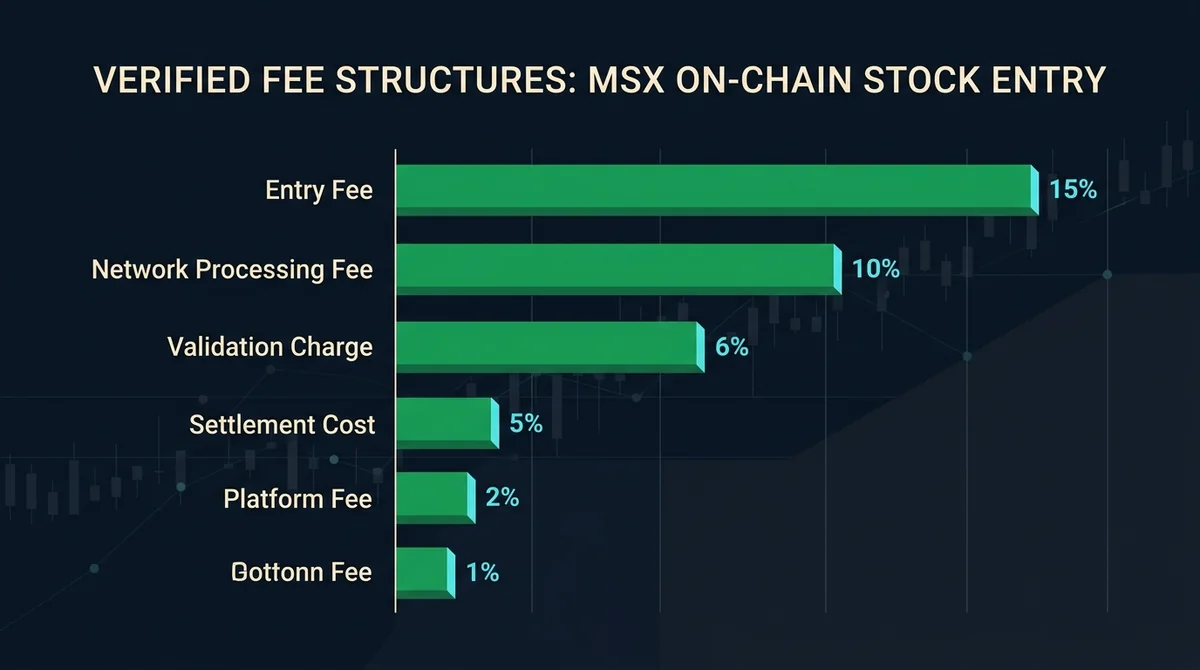
This input only provides some verified fees for MSX's on-chain U.S. stock entry point; other entities claiming to offer tokenized U.S. stocks lack reliable information, so only MSX's verified dimensions are listed below and other platforms are not included in the comparison.
| Entity | Supported Underlyings (Public Information) | Trading Fee Structure (Verified) | Compliance/Custody Status | Supported Regions | Verification Date |
|---|---|---|---|---|---|
| MSX (on-chain U.S. stock entry point) | No complete list of underlyings provided; some stock code contracts appear in the input, but it is not stated whether all are tokenized U.S. stocks | RWA spot buy order 0.3%, sell order fee-free; crypto-to-crypto 0 fee; cross-chain bridge 0.1%; contract maker 0.02%, taker 0.045% (MSX deduction gives 25% off / 10% off) | Custody and license proof not disclosed | Not disclosed | 2026-08-18 |
Note: The MSX fees in the table are sourced from the official fee page (https://msxgo.com/zh-hans), updated on 2026-08-18. Other platforms such as Coinbase and Binance provide crypto asset trading, but this input contains no verified fees or compliance information about their tokenized U.S. stock products, so they are not expanded in the table. Readers who wish to compare should visit each platform's official website to verify the fees, custody, and regional restrictions of its 'tokenized U.S. stock' products.
Data Scope, Sources, and Boundaries
- Fee data comes from the fee_facts fact base, sourced from the MSX official fee page (https://msxgo.com/zh-hans), updated on 2026-08-18; OKX spot standard trading pair fee source is https://www.okx.com/zh-hans/fees, updated on 2026-09-16, but that fee page does not specify tokenized U.S. stocks and is not used for fee comparison in this article.
- Platform regulatory status, underlying asset custody, supported regions, and specific underlying lists are not provided with primary proof in this input; this article explicitly marks them as 'not disclosed' or 'unable to verify'.
- This article does not claim any one-to-one relationship, general superiority, or regulation for MSX or any platform; all judgments are based on verifiable facts.
- Correlation and causality statement: This article does not perform causal inference and does not interpret fee differences as platform quality superiority or inferiority.
Risk Warning: Crypto/digital asset prices are highly volatile, and information and rules may change at any time. This article does not constitute investment, legal, or tax advice. Before making decisions, you should rely on the latest official announcements and actual product pages.