
US Senator Cynthia Lummis said the updated CLARITY Act text incorporates more than 100 modification requests previously made by Democrats, and called on Democratic colleagues to support the bill's passage. Senate Republicans have released the new CLARITY Act text, totaling 630 pages, 14 pages more than the July 22 draft. Four days after the text was released, the Senate will hold a procedural vote to decide whether the bill can proceed to floor debate.
Lummis noted on social media that the new text reflects the results of bipartisan cooperation in August, clarifies when 'nominally decentralized' DeFi protocols need to register with the CFTC, and limits DeFi-related provisions to spot and cash transactions, in response to concerns raised by Native Americans about prediction markets.
Distribution of Changes in the September 10 Draft
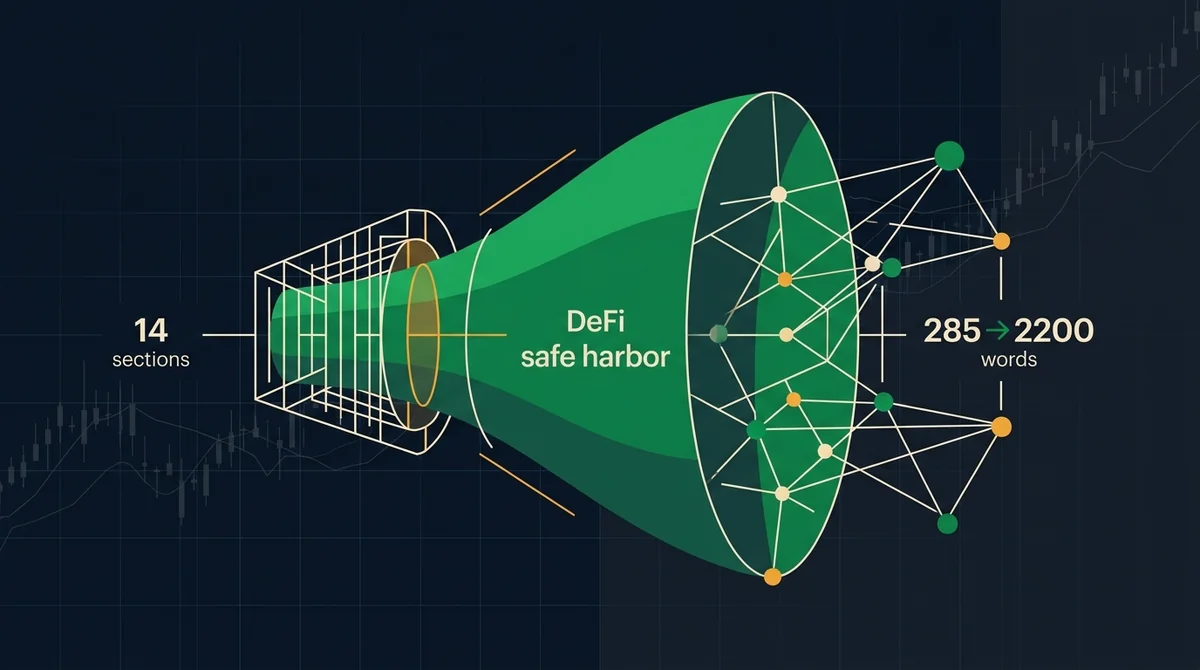
The bill's structure remains four parts and 103 sections, with changes concentrated in about a dozen sections under the banking and agriculture titles. BeInCrypto conducted a line-by-line comparison of the two Senate substitute texts and found that the September draft differs from the July draft in 14 of the 103 sections, containing a total of 104 separate edits, of which only 28 are longer than 8 words.
DeFi Safe Harbor Provision Significantly Expanded
The largest change appears in the DeFi safe harbor provision of Section 20209, which expanded from 285 words to roughly 2,200 words. Validators, node operators, and any entity that publishes wallet software are completely exempt from the Commodity Exchange Act; while front ends, governance systems, liquidity pools, and wallet software maintenance are only exempt from spot market rules.
For 'nominally decentralized' protocols, the CFTC must issue rules clarifying how controllers should comply; this is authorizing legislation rather than an automatic registration trigger, and the underlying code will never be required to register. The Treasury Department will later develop corresponding anti-money laundering rules for entities brought under CFTC regulation.
A more subtle change lies in the preemption clause: state-level securities, commodities, and digital asset laws no longer apply to the above activities, and the clause is binding on conduct that occurred before its effective date. States still retain enforcement authority over fraud, manipulation, and anti-money laundering, so the regulatory battle shifts to the zone between licensing boundaries and fraudulent conduct. The ethics chapter (Division C) that Democrats wanted to modify was left untouched.
What Republicans Preserved and Voices of Opposition
Changes outside the DeFi title are relatively minor. The positioning of credit unions is clearer, with relevant definitions referencing the GENIUS Act, but the text does not expand their authorization to brokerage or dealing activities. The CFTC's spot regulatory scope extends to all payment stablecoins, no longer limited to those issued by licensed issuers. The bill also applies to transactions conducted through or completed by an entity already registered with the Commission. Under Section 20207, states still retain fraud enforcement authority over registrants.
The ethics title is not the only part Republicans left unchanged. Section 10404 prohibits payment stablecoins from generating yield, identical to the July version; Section 10604's developer protection provision (the Blockchain Regulatory Certainty Act) also remains untouched. Both provisions face strong opposition. The American Bankers Association and more than 60 other banking groups sent a letter to Senate leaders demanding tighter reward rules and warning of potential deposit outflows from community banks. Republican Senators Josh Hawley and Jerry Moran expressed concerns about this. Meanwhile, Democrats tied their support to stricter ethics provisions related to President Donald Trump's digital asset holdings.
Senators will vote Tuesday afternoon on whether to invoke cloture on the motion to proceed, which requires 60 votes to pass.
For MSX platform users who continue to follow RWA tokenization, stablecoins, and on-chain asset compliance, every adjustment in US crypto legislation could affect the compliance path and market expectations for bringing real-world assets on-chain.
Sources and Editorial Note
This article is based on the original public link to distill themes, and is adapted and structurally edited without adding unverified facts; the original author's views do not represent the stance of this site, and dynamic data should be based on the original page.