Asset tokenization (RWA) is moving from fringe experimentation to the core narrative of capital markets. In a recent industry discussion, Sandy Kaul, head of digital assets and innovation strategy at a large asset manager, shared her views on institutional entry, on-chain assets, AI agent payments and the pace of regulation. Her core view is that the market is at an inflection point of institutional interest, and tokenized money market funds, equities and structured products will gradually migrate on-chain, ultimately forming a 'new finance' ecosystem that does not distinguish between traditional finance and crypto finance.
Institutional Interest Inflection Point Reached, Multi-Strategy Platform Becomes the Entry Point
Sandy Kaul believes that we are currently at a turning point where institutional investment interest in decentralized business is accelerating. Two macro trends are emerging: first, the re-platforming of financial market infrastructure, and second, AI agents using blockchain rails to participate in micropayments in the new economy. Both will drive a collision between AI investment interest and interest in blockchain and decentralized business models.
To onboard the next wave of institutions entering the crypto space, large asset managers are building multi-strategy platforms covering different investment strategies including liquid opportunities (such as fundamental long, macro opportunities, market neutral, beta enhancement), venture capital and private credit, with the goal of providing large institutions with one-stop crypto strategy allocation. This demand for one-stop crypto strategy allocation is exactly the industry change that OKX Radar has continued to observe: institutions are no longer satisfied with single asset exposure, but want to deploy diversified strategies through a single entry point.
On the team side, the institution has brought in talent from professional crypto strategy teams and adopted a multi-manager, multi-strategy model to build a comprehensive platform for large institutions.
Skepticism Is Fading, Trust and Allocation Advance Over Time
Institutional demand still shows phased characteristics. Sandy said that market skepticism about crypto assets is reaching a critical point: more and more institutions are proactively learning and understanding why crypto assets should be in portfolios and how they can provide diversification returns. Interest leads to education, education builds trust, and trust ultimately converts into allocation.
Early institutional participants were mostly hedge funds, aggressive endowments and family offices; now this group is expanding to more professional institutional investor classes such as pension funds, sovereign wealth funds and corporates. This shift is still in its early stages, but it is accelerating every month.
Tokenized Money Market Funds Become a New Collateral Option for Derivatives
In terms of tokenized money market funds, large asset managers have already cooperated with several major crypto derivatives exchanges to use tokenized money market funds as collateral programs. Sandy explained that when leverage trading, especially derivatives trading, is needed on an exchange and initial margin and variation margin must be posted, money market funds are superior to stablecoins as collateral.
Compared with stablecoins, tokenized money market funds can obtain better collateral haircuts, thereby freeing up more trading credit for trading strategies; at the same time, fund returns are guaranteed. Taking the institution's tokenized money market fund product as an example, interest is paid intraday, and returns are distributed every calendar day of the year (including Saturdays, Sundays and holidays), which is very suitable for 7×24 markets.
Sandy believes that the market is recognizing the product-market fit advantage of tokenized money market funds as collateral for derivatives trading.
Traditional Finance and Crypto Finance Are Merging into 'New Finance'
This cooperation between traditional asset management giants and crypto exchanges reflects the disappearance of industry boundaries. Sandy believes that the future direction is that the boundary between the crypto industry and TradFi will cease to exist, replaced by a unified 'new finance' ecosystem: it absorbs the crypto industry's breakthroughs in innovation, ways of thinking and model boundaries, while inheriting traditional finance's accumulated experience in consumer protection and building robust markets.
Three Paths for Tokenization Expansion
The large asset manager's push on tokenization can be summarized as a 'three-legged stool' strategy:
First, extend from tokenized money market funds upward to higher-yield, longer-duration strategies. Money market funds need to maintain high liquidity buffers, while longer-duration products can enhance returns by holding slightly less liquid assets.
Second, expand to ETFs and high-liquidity strategies. Smart contracts can improve efficiency in products with extremely low margins, making them more suitable for 7×24 environments and running at lower cost.
Third, tokenize asset classes that are still highly dependent on manual operations. For example, structured products such as collateralized loan obligations (CLOs), syndicated loans and asset-backed securities (ABS) have heavy operational management burdens; tokenization and smart contracts can unlock huge opportunities.
Risks of Halfway Measures and the Pace of Regulation
For the challenges of fully adopting tokenized assets, Sandy believes there are several main aspects: legislation and regulation, model choice, and time. Before rules are clear, it is difficult to know what to build and whether it is compliant.
There is a divergence in models: whether to adopt a halfway solution of digital twins, or to directly adopt digital native products that best reflect the advantages of new technology. She cited a dispute between regulators and a retail broker over a tokenized equity product: the product is a derivative contract registered with a commodity futures regulator, but its underlying is a stock registered with a securities regulator, so it falls into a regulatory gray zone. She believes this is not a mistake but rather highly creative and able to meet market demand, but regulators must be aware that the investor audience is changing, and rules need to keep up.
Halfway solutions allow innovation to happen incrementally, but they also bring liquidity, operational and cost problems: you have to maintain both traditional infrastructure and the new tokenized infrastructure, doubling costs, and the token side becomes less efficient — no atomic settlement, no true transferability, no 7×24 capability, and still requiring fallback to off-chain official ledgers. If you remain in the halfway stage for too long, the tokenization experience will worsen and may even trigger doubts about 'not needing tokenization'. If halfway solutions are only a transitional phase used to introduce wallets and educate users, then it is the right direction; the key is not to stagnate.
She understands why regulators are cautious: once regulation is introduced, it will constrain the whole ecosystem for a long time, and potential impacts and unintended consequences must be fully considered. Regulators are actively communicating with industry experts, but the market still needs certainty before entering the stage of widespread adoption.
Outlook for Tokenized Markets in 2030
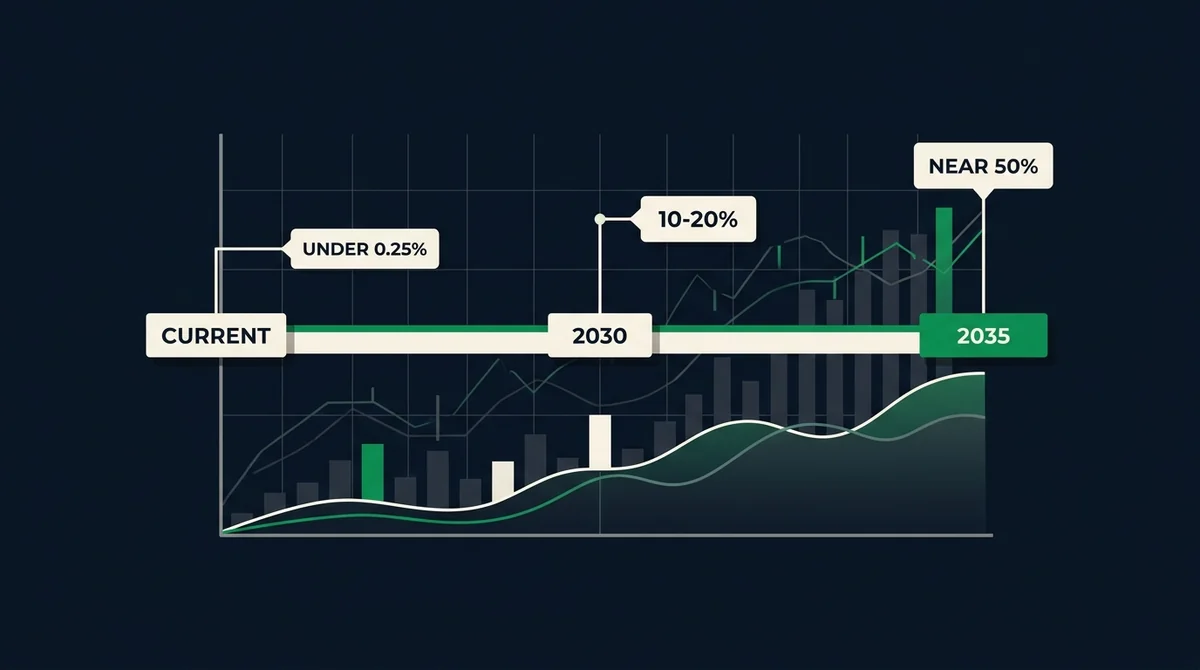
Sandy uses the ETF market as an analogy. After the dot-com bubble in the early 2000s, the market began to migrate from active funds to passive ETFs; the real explosion of ETFs came after the 2008-2009 global financial crisis. If the Clarity Act or other forms of regulatory certainty are passed in early 2027, then the current proportion of crypto and tokenized investments in total assets could start from less than 0.25%, possibly reach 10% to 20% by 2030, and possibly approach 50% by 2035.
She added that this speed of capital migration has historical precedent: hedge funds grew from $830 million in 2002 to $2.5 trillion in 2007, a five-year period, an increase of more than three times. Because blockchain technology offers more functionality, adoption could be faster. Currently, more and more traditional finance participants are formulating tokenization and wallet strategies.
Different Timelines for Real Estate and Personal Assets Going On-Chain
For real-world assets (RWA) such as real estate, Sandy believes that operational processes will go on-chain before ownership. For example, property ownership records may be recorded on the blockchain, and annual taxes and rents may also be managed and tracked via blockchain. But ownership and transactions themselves will take longer because market participants need to be willing to provide daily 7×24 market-making pricing for assets, and the real estate sector currently lacks this infrastructure.
Personal assets (such as rare comic books) can also be 100% tokenized through custodians, but more infrastructure still needs to be built: market makers, liquidity guarantees, pricing models and recognized valuation methods. The good news is that industry participants are already working in these directions.
Will AI Agents Become the Killer Use Case of Blockchain?
Sandy firmly believes that AI agents will become the killer use case of blockchain, but she differs from some views on the dominance of stablecoins. She believes that stablecoins are backed by private companies that are subject to regulation, but have a short history and have not experienced severe market stress tests, so they could become single points of failure in the system.
A fork will emerge in the future: one type of AI agent will choose tokenized deposits, i.e., commercial bank money backed by large global banking organizations and their governments; another type will promote interest in crypto-native tokens, cryptocurrencies and altcoins, because these assets bring network and community strength. Agent payments will greatly merge AI and crypto technologies, but stablecoins may not be the ultimate beneficiaries.
At the payment level, AI agents can own crypto wallets, which can hold BTC, ETH, XRP, stablecoins, and can also be linked to credit cards. The agent may even be equipped with an optimization module that scans all available payment sources and wallet assets in the market in real time, forming a waterfall selection to maximize purchasing power.
Regarding KYC/AML, she believes that any AI agent and its wallet initiated by an individual or institutional entity should belong to that entity. The solution could be: associate KYC/AML information with the private key, embed relevant information when signing a transaction, perform instant spot checks, allow if information is complete and reject if incomplete. With zero-knowledge proof technology, verification can be completed without exposing all personal information. This event-based KYC/AML only requires regulators to accept a major overhaul of the system.
Data Sovereignty, Micropayments and Future Income
Zero-knowledge proofs can not only reduce the risk of data breaches, but also allow individuals to benefit from their own data. Just as micropayments pay for API or enterprise data access, individuals or institutions should be paid when their data is accessed. If data is on-chain, encrypted and has a ZK protection layer, it can participate in micropayment streams.
As AI replaces more repetitive work, personal data and its behavioral information will become more valuable. Data may become a future source of income: behavioral algorithms need to consume data to sell to individuals, and individuals thus receive data compensation. This model could also achieve basic income in an unexpected way: for example, set a basic annual data value for each person, any company accessing that data must pay an annual fee, and people with high demand for their data have higher data value.
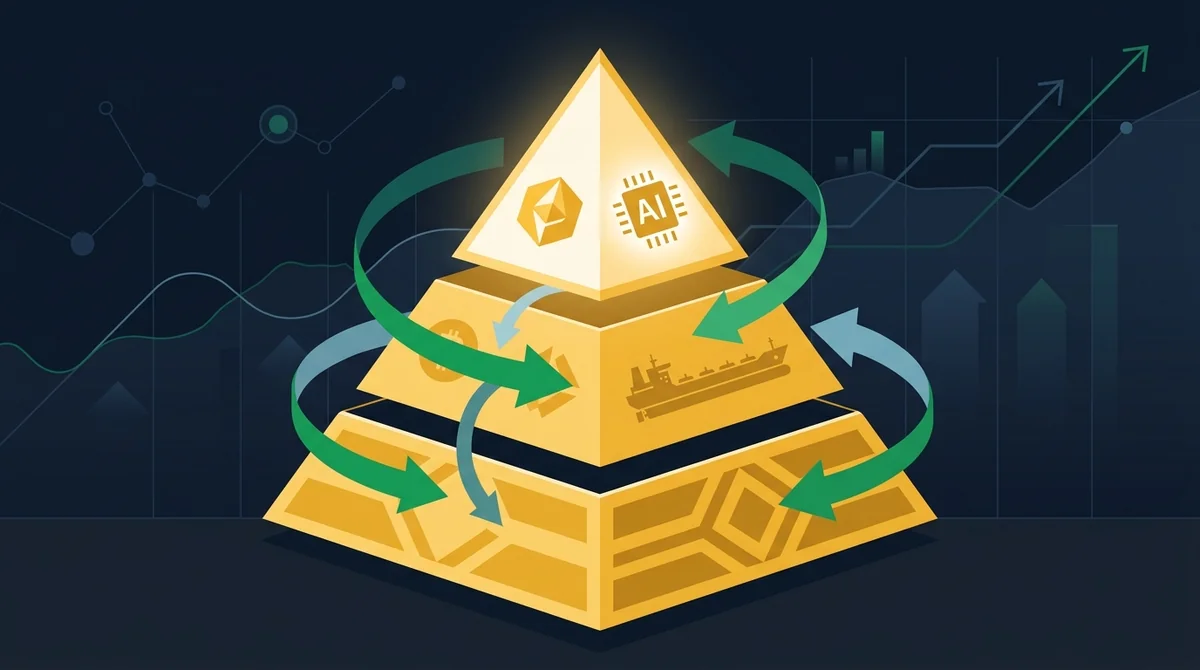
These changes together paint an important picture of the future financial market: asset tokenization, agent payments and data sovereignty will reinforce each other and promote the formation of new financial infrastructure.