Early Bitcoin investor Dan Held recently made a bold claim on the crypto and macro podcast The Rollup: SpaceX could reach a $100 trillion valuation within twenty years. His core reasoning is not simple business expansion, but a dramatic decline in launch costs and the new market space that would open up as a result.
Launch Costs: From $20,000 to $10 per Kilogram
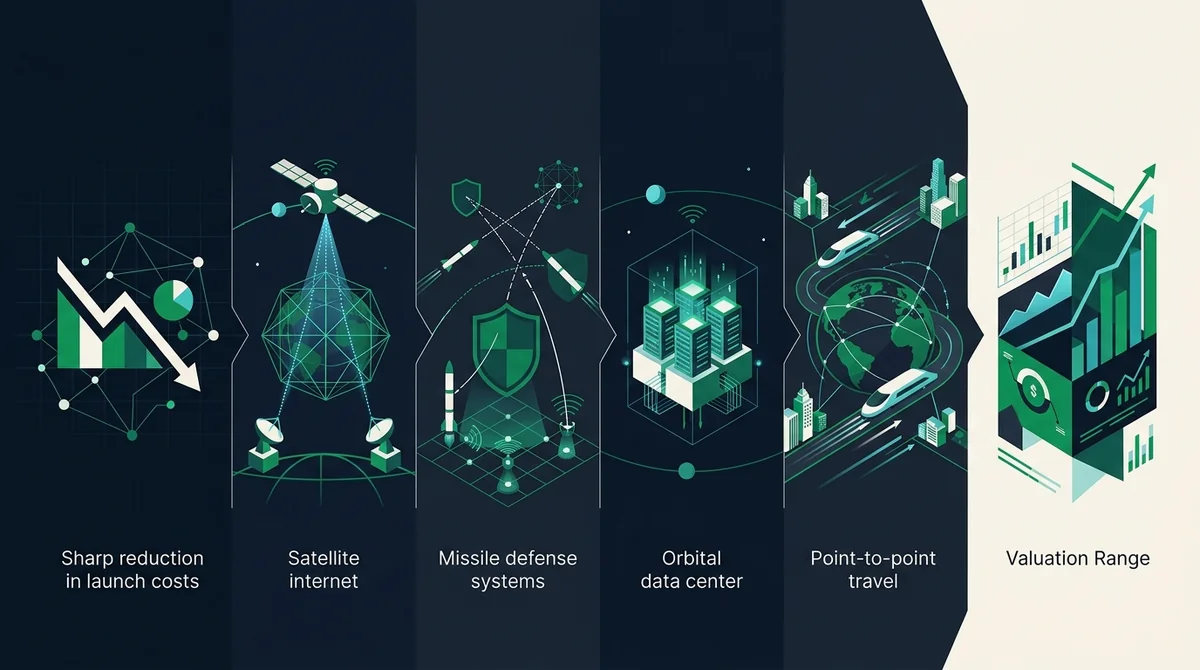
Held's bullish logic rests on a key number: the cost of putting one kilogram into orbit. During the Space Shuttle era, that cost was about $20,000; under the Starship vision, it could fall to $10. He argues that once costs drop to that magnitude, many space applications that were previously uneconomical would suddenly become viable, unlocking enormous latent demand.
He has also backed this view with his own money. Five years ago, Held sold most of his stake in the crypto exchange Kraken and invested in SpaceX. He compares that bet to his early conviction in Bitcoin—as far back as 2012, he began studying Bitcoin's fixed supply of 21 million coins.
Four Major Use Cases: Starlink, Missile Defense, Orbital Data Centers, and Point-to-Point Travel
Held sees Starlink as only an early proof point. It is not merely a fiber-optic substitute, but could grow into a business capable of challenging traditional telecom operators. At the same time, he identifies broader application areas.
In missile defense, detecting rocket launches from orbit could allow the United States to intercept threats with almost no warning. He likens the concept to the Golden Dome missile defense system.
Orbital data centers are another direction. Although launch costs still exist, once in orbit, operating costs are nearly zero. Point-to-point travel is equally attractive: a New York-to-Tokyo flight could be cut to 25 minutes.
Taken together, Held believes the addressable market for space infrastructure could ultimately exceed total global economic output.
Valuation Forecast: From $10 Trillion to $100 Trillion
Held predicts that if Starship's production capacity continues to expand, SpaceX's valuation could reach $10 trillion within three years. By his late 50s, that figure could touch $100 trillion.
Other prominent investors have expressed similar optimism. Cathie Wood recently called SpaceX her top pick and predicted it could become the most important company in history.
However, this view is not without risk. SpaceX's stock has been notably volatile since going public, drawing down 35% from its peak even though it has joined the Nasdaq-100 Index. Elon Musk's own long-term revenue targets have often run ahead of Wall Street estimates, underscoring the uncertainty of multi-decade forecasts.
Overall, Held's thesis offers a lens for viewing the space economy: when a foundational cost falls by an order of magnitude, the structure of demand can change fundamentally. Whether the $100 trillion valuation will become reality remains to be seen.
Sources and Editorial Note
This article distills themes from the publicly available original link and adapts and restructures the content without adding unverified facts. The original author's views do not represent this site's position; please refer to the original page for current data.