One of the most watched frontiers in finance today is the collision of trillion-dollar institutional balance sheets with blockchain code, i.e., real-world asset (RWA) tokenization. But the key point to reveal here is that technology itself is never the complete answer. Putting these massive assets on-chain requires a 'trust architecture' that goes far beyond writing clever smart contracts.
The Technology Myth and the Three-Layer Architecture
Tech circles love to talk about asset fractionalization or making sovereign debt 'democratic.' But tokenizing a building or a bond does not change what you actually own. Wrapping U.S. Treasuries or a Manhattan commercial building in an ERC-20 smart contract does not automatically create a new asset class in the eyes of the law. The law looks through the code to economic substance; a tokenized bond is still a debt security.
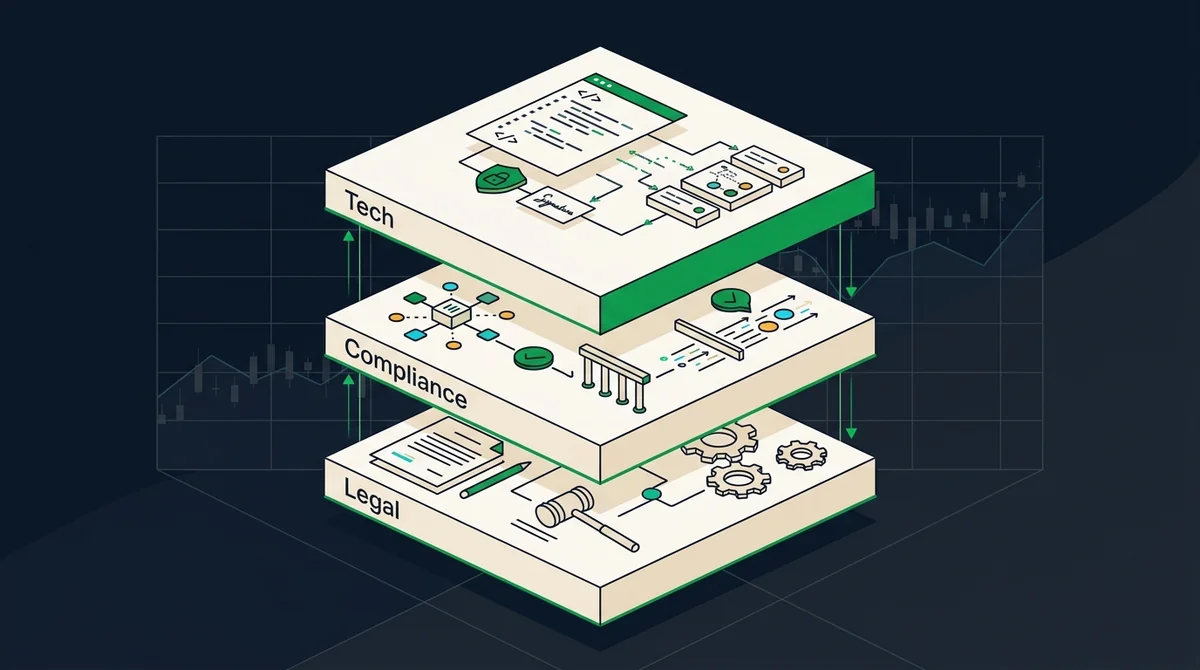
This exposes the core problem of the entire ecosystem: the oracle and enforceability gap. If you issue a token for 10% of a physical warehouse, what actually guarantees that you own it when things go wrong? To bridge the gap between code and reality, issuers must build a three-layer architecture:
- The first layer is the legal layer, namely special purpose vehicles (SPVs) and trusts;
- The second layer is the compliance layer, handling identity thresholds and similar matters;
- The third layer is the technical layer, i.e., the smart contracts themselves.
The key point: without the first legal layer, your token is by no means the key to the warehouse; it is merely a decorative entry on an electronic ledger.
The Transatlantic Divergence
Looking at the world's two largest capital markets, the United States and Europe present a stark contrast in regulatory philosophy. The United States relies heavily on ex-post enforcement, deeply anchored in the 1946 Supreme Court Howey test and the securities laws of the 1930s. Europe has taken a proactive, bold path: the EU is building a simultaneous, systematized taxonomy through the Markets in Crypto-Assets Regulation (MiCA) and the EU DLT pilot regime, and providing genuinely usable sandboxes for market infrastructure.
Because the United States has no dedicated tokenization law, issuers can only squeeze modern innovation into existing safe harbors. To tokenize private credit or U.S. Treasuries, you typically need to use Regulation D for accredited investors, Regulation S for strictly offshore offerings, or seek an alternative trading system (ATS) license. In short, U.S. issuers are forced to cram 21st-century distributed networks into mid-20th-century paper frameworks.
Asia's Testing Ground
Turning to the Eastern Hemisphere, the playbook is completely different, with a focus on collaborative testing. Singapore launched Project Guardian, working with tier-one banks such as JP Morgan and UBS to run real pilots using institutional DeFi protocols, prioritizing asset-backed security. Hong Kong rolled out Project Ensemble, setting clear rules for tokenized green bonds and public offerings. In the Middle East, the UAE's VARA and ADGM directly grant legal personality to decentralized autonomous organizations (DAOs).
These jurisdictions are not waiting; they are proactively building an asset-backed digital highway.
The Global Regulatory Matrix
To understand the friction in this multi-trillion-dollar transformation, one must see the vast differences in primary market risk across regions. The United States faces severe regulatory uncertainty and aggressive enforcement. EU issuers face dual institutional friction between MiCA and MiFID 2. Singapore and Hong Kong, while having strict institutional access and custody requirements, also provide clear sandbox frameworks.
This fragmented global puzzle is exactly the reality every large institution now confronts.
The Arbitrage Trap
Global fragmentation inevitably breeds regulatory arbitrage. Such is the nature of capital markets: if one country takes two years to approve a prospectus, and another jurisdiction grants an exemption in two weeks, capital will flow to the path of least resistance. Thus the market sees protocols setting up special purpose vehicles in the Cayman Islands, issuing tokens through Swiss foundations, and market-making in Abu Dhabi.
But for real-world assets, the music stops here. Unlike decentralized meme coins or Bitcoin, which have no physical anchor at all, tokenized RWAs represent something in the real physical world. Suppose a token corresponds to an apartment building in Florida; U.S. property law and foreclosure law strictly govern that land. No matter how cleverly you design your Cayman SPV, the asset has a fixed address, and ultimately the local court decides whether your digital certificate is enforceable.
A currently popular approach is to tokenize U.S. Treasuries offshore via Regulation S. This safe harbor requires a distribution compliance lock-up period of 40 days to one year, and the tokens must not be sold to U.S. persons. But the problem is that an offshore registration does not automatically become a magic shield against SEC extraterritorial jurisdiction. If the SEC sees secondary market flowback—tokens re-entering the United States—and determines that such flowback was foreseeable, it can dismantle the entire structure and deem the whole matter an unregistered domestic distribution.
Issuers typically destroy their offshore shield inadvertently in the following three situations:
- The front-end IP geoblocking is superficial. The SEC knows anyone can use a VPN to bypass website blocks; if the underlying smart contract is permissionless, Americans can interact directly.
- The offshore entity establishes liquidity pools on permissionless automated market makers such as Uniswap, and tokens easily flow into the hands of U.S. retail investors—the shield disappears immediately.
- Core investment decisions or marketing touch the U.S. mainland in any way, and the entire offshore fiction collapses.
The SEC possesses powerful cross-border legal weapons. Under Dodd-Frank's 'conduct and effects' test, jurisdiction exists whenever there is substantial U.S. conduct or a substantial effect on U.S. capital markets, such as draining domestic liquidity. In private litigation, Morrison's irrevocable liability principle means that if an American triggers a smart contract from U.S. soil, liability falls within the United States. Add the Investment Company Act of 1940, and offshore token issuers are effectively walking a regulatory tightrope of extreme risk.
The Endgame of Embedded Compliance
If regulatory arbitrage is a trap, then circumventing the law is clearly not the solution. The real solution is to hard-code the law itself into the asset. This is the true paradigm shift for the entire field: from post-trade manual paperwork to on-chain embedded compliance.
With permissioned standards such as ERC-3643, compliance checks are compiled directly into the smart contract bytecode. If a transaction violates the law, the token transfer doesn't just trigger a back-office alert; it is mathematically reverted, and the transaction never happens.
On-chain enforcement in practice looks like this: privacy-preserving KYC identity oracles replace paper registries; smart contracts automatically and instantly block transfers to sanctioned addresses; national-level embargoes are enforced directly at the execution layer; and even the expiration of a buyer's 'accredited investor' status is tracked. The bytecode becomes the ultimate rigid enforcer, making non-compliant transactions technically impossible to complete. The oracle-to-reality gap discussed earlier is thus closed.
The final questions remain: can traditional finance truly reconcile with immutable blockchain architecture? Can we translate centuries of complex legal text into mathematically verifiable code?
Real-world asset tokenization is not an exit from global regulation; it is more like a mirror reflecting how fragmented the current system is. The winners will not be those hiding in offshore tax havens, but the institutions that can answer the questions above in the affirmative. This is the multi-trillion-dollar transformation we are witnessing.