
MSX RWA Research Watch: On October 18, 2026, three same-day Seeking Alpha reports showed that KPN set a target to cut capital expenditure by 20% by 2027, and expects free cash flow of €1.1 billion and a dividend of €0.25 per share; Wells Fargo's third-quarter net interest margin was flat at 2.43%, net interest income rose by $200 million quarter over quarter to $12.5 billion, and loans grew 1.7% quarter over quarter; Aker BP shares rose about 50% since the author's previous article, after which the source author downgraded the rating to Hold. The following covers key facts, verification paths, and boundary notes.
1. Koninklijke KPN: What are the 2027 capex cut of 20% and dividend guidance of €0.25 per share?
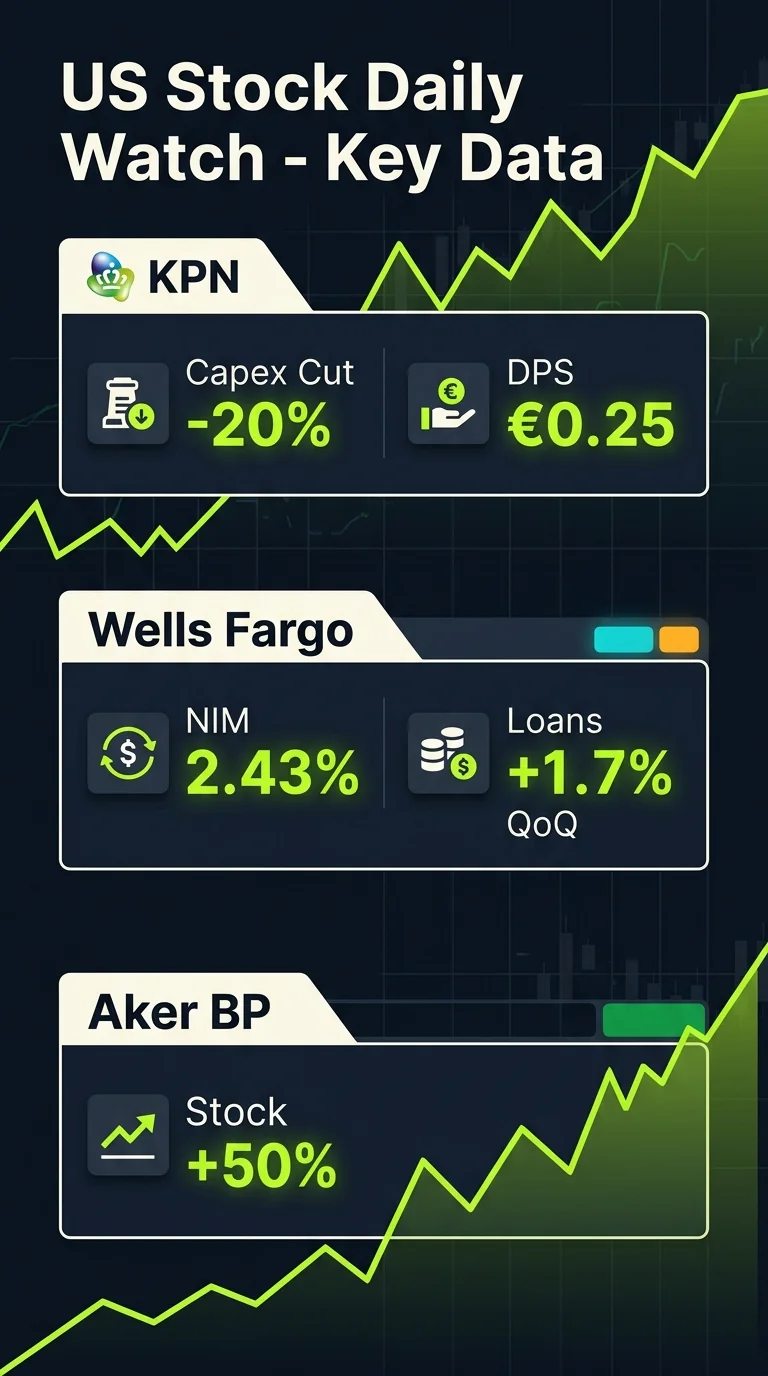
1. 2027 capex cut of 20% and free cash flow target of €1.1 billion
According to a Seeking Alpha report on October 18, 2026, Koninklijke KPN set a target to reduce capital expenditure by 20% by 2027 and expects free cash flow to reach €1.1 billion. In the telecommunications industry, capital expenditure is usually closely related to network expansion, spectrum investment, and infrastructure maintenance, so a 20% cut is itself a directional signal: management may prefer to control incremental investment and prioritize free cash flow. The same report also mentioned that KPN expects free cash flow of €1.1 billion. Placing the capex cut alongside the free cash flow target shows that under the 2027 framework, the company is trying to convey to the market both capital discipline and cash generation.
For readers, the key verification point is whether the base year and specific items for the 20% capex cut are given in the original article. Current public reporting only provides the target value of a "20% cut," without disclosing whether it is relative to 2025, 2026, or some other base period, and without stating whether the cut applies to maintenance capex or expansionary capex. Therefore, until further confirmation from the company's official financial reports is available, it is not appropriate to directly infer the specific impact of the cut on revenue growth, network quality, or future competitiveness. Whether the €1.1 billion free cash flow target includes one-time items and whether it is consistent with current accounting standards should also be subject to the company's subsequent announcements. Independent judgment of this site: the substantive binding force of this guidance depends on whether the company later incorporates it into formal earnings outlook; the headline numbers alone are insufficient as a valuation basis.
2. Dividend of €0.25 per share: a shareholder return signal alongside the 2027 free cash flow
In the same Seeking Alpha report, KPN expects a dividend of €0.25 per share. This dividend expectation is placed together with the €1.1 billion free cash flow target, forming a combined shareholder return signal. If the free cash flow target can be achieved, the dividend has certain financial support; but this inference is a conditional judgment, not a proven cause and effect. Existing public information does not state whether the dividend expectation corresponds to a statutory payout ratio or whether it is directly affected by the capex reduction plan.
Do not interpret the capex cut, free cash flow, and dividend as a single causal chain. A possible market interpretation is that in a low-growth telecom environment, stable or moderately rising dividends can provide allocation value for the stock; but the chain of "cutting capex → boosting free cash flow → supporting dividends" requires clear company guidance to hold. The verification path is to return to the source URL and check whether the original text gives a clear explanation of the relationship among the three; if not, they can only be viewed as parallel disclosures.
2. Wells Fargo third quarter: What are the net interest margin of 2.43% and loan expansion data?
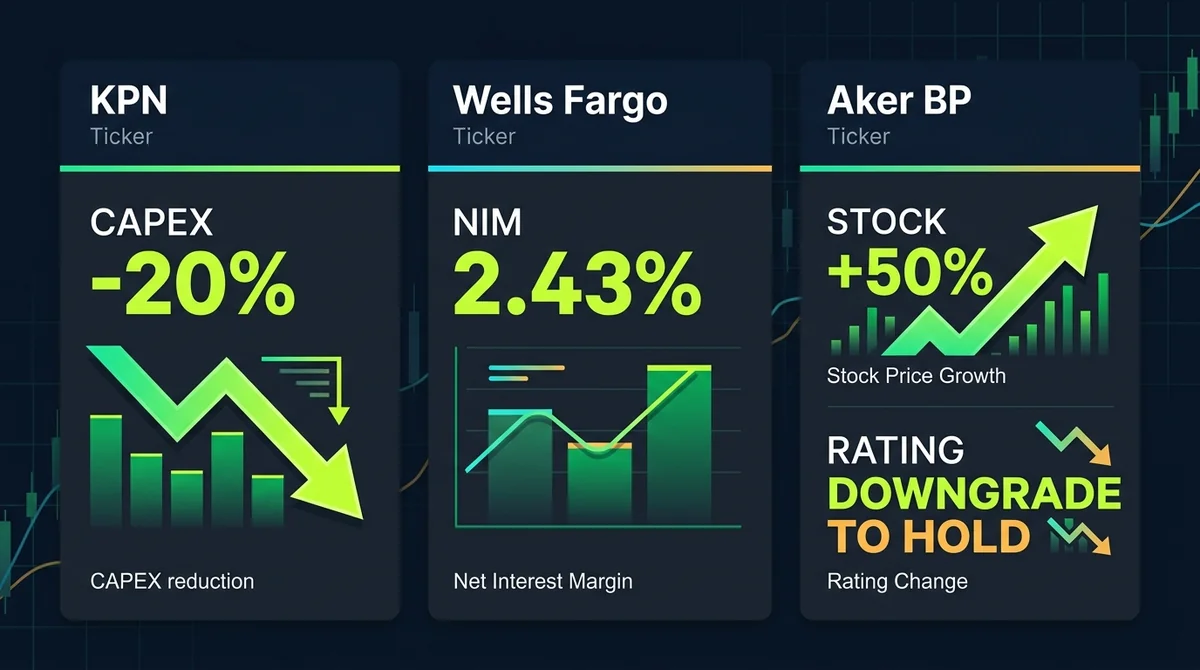
1. Net interest margin of 2.43% and net interest income up $200 million QoQ to $12.5 billion
According to a Seeking Alpha report on October 18, 2026, Wells Fargo's third-quarter net interest margin remained at 2.43%, and net interest income increased by $200 million quarter over quarter to $12.5 billion. A flat net interest margin means that the difference between the bank's asset yields and liability costs did not widen or narrow significantly; in the current environment of repeated interest rate expectations, keeping the net interest margin from falling itself shows some resilience in its liability cost management or asset structure. Net interest income increased by $200 million quarter over quarter. If calculated according to the source statement, the previous quarter's net interest income was about $12.3 billion. This growth is a mild improvement in the bank's core profitability indicator.
In terms of actual impact, net interest income is one of the bank's most important revenue sources, and its sequential improvement may partially ease market concerns about margin compression. However, the absolute level of 2.43% is not high; whether it is competitive with peers and whether it is affected by loan pricing or deposit repricing pace still needs to be analyzed in combination with loan structure, deposit costs, and provisions. The reader verification path is to visit the source URL at the end, check the original wording of "net interest margin of 2.43%" and "net interest income increased by $200 million quarter over quarter to $12.5 billion" in the earnings commentary, and look for any management comments on the margin outlook.
2. Loans up 1.7% QoQ, up 11% YoY, and loan-to-deposit ratio of 69%
The same earnings commentary also showed that Wells Fargo's third-quarter loans increased 1.7% quarter over quarter and 11% year over year, with the loan-to-deposit ratio at 69%. The simultaneous quarter-over-quarter and year-over-year loan growth indicates that the bank's balance sheet is still expanding; a loan-to-deposit ratio of 69% means that loans account for a moderate share of deposits, neither excessively using deposits for lending nor showing serious idle liquidity pressure. These data, together with the 2.43% net interest margin and $12.5 billion net interest income, form a relatively complete snapshot of the bank's operations.
Existing public information does not confirm a direct causal relationship between loan growth and the sequential increase in net interest income; both may stem from changes in customer financing demand and the pricing environment, but more data are needed. For example, whether the 11% year-over-year loan growth is sustainable depends on macroeconomic conditions, credit demand, and capital constraints. This site does not package "loan expansion" and "net interest income growth" as a proven causal relationship; it only observes them as same-window data. Readers can use the source URL to check whether the loan scope includes specific business lines such as commercial loans and consumer loans.
3. Aker BP: Why was the rating downgraded to Hold after shares rose about 50%?
1. Aker BP shares rose about 50% since the author's previous article
According to a Seeking Alpha report on October 18, 2026, Aker BP shares rose about 50% since the author's previous article. This gain is an important reference for understanding the background of the rating adjustment. A large share price increase itself may reflect changes in oil prices, improved production expectations, or rising market sentiment, but the source article does not provide a list of drivers. Therefore, existing public information can only confirm the result of "an increase of about 50%," and cannot determine the specific attribution behind it.
In terms of time sequence, Aker BP shares rose about 50% since the author's previous article, and there may be an interval between that and the publication time of that article, but the source does not disclose the specific publication date of the previous article. Even if the timing is close, it cannot be inferred from this that the increase has a causal relationship with the views in that article. Readers who need to review should check the publication time and views of the author's previous article, but this information is not provided in the current task data. Independent judgment of this site: the gain itself is an objective market result, but its causes should be treated with reservation; it is not appropriate to use the views of a single article to explain price behavior.
2. The author downgraded Aker BP to Hold and judged that the stock is unlikely to break out of its long-term range
The same source shows that the article author downgraded Aker BP to Hold, believing that the stock is unlikely to break out of its long-term range. This action and judgment both come from an external author and do not constitute an independent rating view of this site. In the external author's framework, downgrading to Hold after a share price increase of about 50% usually means a downward revision of expected marginal returns; however, the specific upper and lower bounds of the "long-term range" are not disclosed in the source, so it is difficult to quantify the meaning of "unlikely to break out."
Independent judgment of this site: from a neutral perspective, a downgrade to Hold expresses more that "upside is limited" rather than fundamental deterioration, but this requires the original text to supplement. The reader verification path is to open the source URL and examine the technical levels or valuation methods on which the author bases the range; if the original text does not give range values, the conclusion of "unlikely to break out of the long-term range" should be understood as a subjective judgment rather than an established fact. This article does not treat it as this site's judgment on Aker BP's future price direction.
4. Comparison of core events of the three companies and reader verification paths
1. Subject-indicator-source date comparison: KPN capex, Wells Fargo net interest margin, Aker BP rating
The following table summarizes the key indicators, values, and source dates for the three companies on the same day for quick location:
| Subject | Indicator | Value/Status | Source Date | Source Domain |
|---|---|---|---|---|
| Koninklijke KPN | Capex reduction target by 2027 | Cut 20% | 2026-10-18 | Seeking Alpha |
| Koninklijke KPN | 2027 free cash flow expectation | €1.1 billion | 2026-10-18 | Seeking Alpha |
| Koninklijke KPN | Dividend expectation per share | €0.25 | 2026-10-18 | Seeking Alpha |
| Wells Fargo | Q3 net interest margin | 2.43% | 2026-10-18 | Seeking Alpha |
| Wells Fargo | Net interest income QoQ change | Increased by $200 million to $12.5 billion | 2026-10-18 | Seeking Alpha |
| Wells Fargo | Loans QoQ / YoY / loan-to-deposit ratio | +1.7% / +11% / 69% | 2026-10-18 | Seeking Alpha |
| Aker BP | Share price gain since previous article | About 50% | 2026-10-18 | Seeking Alpha |
| Aker BP | Source author rating action | Downgraded to Hold | 2026-10-18 | Seeking Alpha |
Note that the three subjects belong to different industries; the comparison is only for same-day information aggregation, not for return or risk comparison.
2. Verification path based on Seeking Alpha source URLs and dates
The reader verification path is very direct: visit each source_url to check the numbers and wording in the original reports. The specific URLs are as follows:
- KPN related: https://seekingalpha.com/article/4954796-koninklijke-kpn-expect-25-percent-dividend-increase-2027?source=feed_all_articles
- Wells Fargo related: https://seekingalpha.com/article/4955059-wells-fargo-earnings-not-inspiring-enough-7-percent-income-opportunity-is?source=feed_all_articles
- Aker BP related: https://seekingalpha.com/article/4955053-aker-bp-the-stock-is-unlikely-to-break-out-of-long-term-range-rating-downgrade?source=feed_all_articles
When checking, focus on: whether KPN's 20% capex cut specifies a base year; whether Wells Fargo's net interest income sequential increase includes specific interest items; whether Aker BP's long-term range has specific values. If this information is missing from the original, it should be regarded as undisclosed and should not be supplemented on your own.
5. FAQ
Q1: What is KPN's 2027 capex reduction target? A1: According to a Seeking Alpha report on October 18, 2026, Koninklijke KPN set a target to cut capital expenditure by 20% by 2027, while expecting free cash flow of €1.1 billion and a dividend of €0.25 per share.
Q2: What is KPN's 2027 free cash flow target? A2: The same report shows that KPN expects 2027 free cash flow of €1.1 billion.
Q3: What were Wells Fargo's third-quarter net interest margin and net interest income? A3: Wells Fargo's third-quarter net interest margin remained at 2.43%, and net interest income increased by $200 million quarter over quarter to $12.5 billion.
Q4: What are Wells Fargo's third-quarter loan growth data? A4: Wells Fargo's third-quarter loans increased 1.7% quarter over quarter and 11% year over year, with the loan-to-deposit ratio at 69%.
Q5: What was Wells Fargo's net interest income in the previous quarter? A5: The report only said that net interest income increased by $200 million quarter over quarter to $12.5 billion, so the previous quarter was about $12.3 billion, but the source did not directly disclose the prior value.
Q6: Why was Aker BP downgraded? A6: The source article author downgraded Aker BP to Hold after its shares rose about 50%, judging that the stock is unlikely to break out of its long-term range; this judgment comes from an external author and does not constitute an independent rating by this site.
Q7: Does Aker BP's long-term range have specific values? A7: The source article did not disclose specific upper and lower bounds of the long-term range, only giving the statement "unlikely to break out of the long-term range"; it is necessary to check the original text for confirmation.
Q8: What are the source dates and outlets for this information? A8: All data are from three Seeking Alpha reports dated October 18, 2026, and the specific URLs are listed in the body.
Data scope, sources, and boundaries
All facts in this article are from three Seeking Alpha reports dated October 18, 2026, and the original URLs are listed above. Statistical scope and cutoff date: the above data are disclosures as of the publication date of the source articles on October 18, 2026; the reporting periods are KPN's 2027 guidance, Wells Fargo's third-quarter financial results, and Aker BP's share price performance up to the article publication.
Unknown or unconfirmed items: the base year and specific items for KPN's 20% capex cut are not disclosed in the source; Wells Fargo's prior net interest income is not directly disclosed and is inferred from "increased by $200 million to $12.5 billion"; the upper and lower bounds of Aker BP's long-term range are not disclosed; there is no publicly available information confirming a direct causal relationship among the three companies' events, and the temporal proximity is only a same-day source observation.
Non-causal statement: this article does not interpret the capex cut, free cash flow, and dividend as a single causal chain; does not explain Wells Fargo's loan growth and net interest income change as a proven causal relationship; and does not treat the Aker BP downgrade as an independent rating by this site. All analysis and inferences are based on source facts and do not constitute investment advice.
Risk warning: Macroeconomic and US stock market fluctuations are severe. This content is for MSX RWA research observation only and does not constitute any investment advice.